Choosing the right camera gimbal stabilizer depends heavily on your primary gear and shooting style. The DJI RS 4 stands out as the best overall pick for its balance of payload capacity, intelligent tracking, and battery life, making it suitable for most mirrorless setups. For smartphone-centric creators, the DJI Osmo Mobile 8 offers superior stabilization and native app integration, while the FeiyuTech SCORP-C2 provides a compelling budget-friendly alternative with built-in AI tracking. The main tradeoff in this category is between payload capacity and portability; larger gimbals handle heavier lenses but tire you out faster. Continue reading for a detailed breakdown of these thirteen models to find the right fit for your workflow.

Get business pricing on tech for your team
- Business-only prices and quantity discounts
- Tax-exempt purchasing
- Multiple users, one account, clear invoices
Key Takeaways
- DJI dominates the high-end market with seamless ecosystem integration, but FeiyuTech offers better value for users who do not need proprietary app features.
- Smartphone gimbals like the Osmo Mobile series now rival entry-level camera gimbals in stabilization quality, shifting the value proposition for casual creators.
- Payload capacity is the single most important spec; exceeding the rated limit causes motor strain and jitter, regardless of price.
- AI tracking modules are becoming standard on mid-range gimbals, reducing the need for a dedicated focus puller or assistant on solo shoots.
- Battery life varies wildly, with some compact models offering under four hours, which is insufficient for all-day events without external power banks.
| DJI RS 4 Mini Gimbal Stabilizer for Cameras and Smartphones |  | Best Overall for Lightweight Camera Rigs | Brand: DJI | Model: RS 4 Mini | Model number: P24M | VIEW ON AMAZON | See Our Full Breakdown |
| DJI Osmo Mobile 7P Gimbal Stabilizer for iPhone & Android, Native Tracking |  | Best Phone Gimbal for Self-Shooting | Brand: DJI | Model: Osmo Mobile 7P | Stabilization: 3-axis | VIEW ON AMAZON | See Our Full Breakdown |
| DJI RS 3 Mini 3-Axis Mirrorless Gimbal Stabilizer |  | Best Compact Mirrorless Gimbal | Brand: DJI | Weight: 795 g / 1.75 lbs | Maximum payload: 2 kg / 4.4 lbs | VIEW ON AMAZON | See Our Full Breakdown |
| FeiyuTech SCORP-C2 Camera Gimbal Stabilizer with Built-in AI Tracking |  | Best for Larger Camera Builds and Tracking | Brand: FeiyuTech | Compatibility: Mirrorless and DSLR cameras | Payload capacity: Up to 7.72 lbs | VIEW ON AMAZON | See Our Full Breakdown |
| FeiyuTech SCORP Mini 2 Kit Gimbal, 3-Axis Camera Stabilizer with AI Tracker and Fill Light, White |  | Best Multi-Device Kit | Brand: FeiyuTech | Model: SCORP Mini 2 Kit | Color: White | VIEW ON AMAZON | See Our Full Breakdown |
| FeiyuTech SCORP Mini-3-Pro Gimbal Stabilizer | 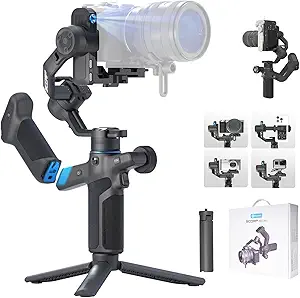 | Best Hybrid Creator Tool | Payload Capacity: 2 kg (4.4 lbs) | Weight: 4.4 lbs | Tracking Distance: 18 meters | VIEW ON AMAZON | See Our Full Breakdown |
| ZHIYUN CINEPEER Weebill 3E 3-Axis Gimbal Stabilizer |  | Best for Vertical-First Creators | Max Payload: 3 kg (6.6 lbs) | Weight: 1.05 kg | Battery Life: 16 hours | VIEW ON AMAZON | See Our Full Breakdown |
| DJI Osmo Mobile 8 Gimbal Stabilizer for Phone |  | Best for Smartphone Vloggers | Battery Life: 10 hours | Included Items: Multifunctional Module, Magnetic Clamp, Gimbal, Cables, Pouch | Rotation: 360° Horizontal | VIEW ON AMAZON | See Our Full Breakdown |
| DJI RS 3 Mini Camera Gimbal Stabilizer |  | Best Lightweight Travel Gimbal | Weight: 795 g (1.75 lbs) | Max Payload: 2 kg (4.4 lbs) | Touchscreen: 1.4 inches | VIEW ON AMAZON | See Our Full Breakdown |
| DJI RS 4 Gimbal Stabilizer for Camera |  | Best Professional Performance | Payload Capacity: 3 kg (6.6 lbs) | Battery Runtime: Up to 29.5 hours (with BG70) | Vertical Shooting: Native 2nd-Gen | VIEW ON AMAZON | See Our Full Breakdown |
| DJI RS 4 Mini Combo Gimbal Stabilizer |  | Best for Hybrid Creators | Brand: DJI | Model: RS 4 Mini | Payload Capacity: 2 kg (4.4 lbs) | VIEW ON AMAZON | See Our Full Breakdown |
| 3S 3kg Payload Gimbal Stabilizer with Fill Light, Sandisk 64GB Extreme Pro Card & Starter Kit |  | Best Value Bundle | Payload Capacity: 3 kg | Battery Capacity: 2 × 2600 mAh | Battery Life: Up to 11.5 hours | VIEW ON AMAZON | See Our Full Breakdown |
| DJI Osmo Mobile 7 Gimbal Stabilizer for iPhone & Android, 3-Axis Gimbal |  | Best for Smartphone Users | Brand: DJI | Model: DS307 | Weight: 300 grams | VIEW ON AMAZON | See Our Full Breakdown |
| camera gimbal stabilizer | Compatibility | Brand |
|---|---|---|
| DJI RS 4 Mini Gimbal Stabilize | Canon, Sony, Nikon, Fujifilm cameras and smartphones | DJI |
| DJI Osmo Mobile 7P Gimbal Stab | — | DJI |
| DJI RS 3 Mini 3-Axis Mirrorles | Canon, Sony, Panasonic, Nikon, and Fujifilm mirrorless cameras | DJI |
| FeiyuTech SCORP-C2 Camera Gimb | Mirrorless and DSLR cameras | FeiyuTech |
| FeiyuTech SCORP Mini 2 Kit Gim | — | FeiyuTech |
| FeiyuTech SCORP Mini-3-Pro Gim | Mirrorless, Compact, Smartphone, Action Cam | — |
| ZHIYUN CINEPEER Weebill 3E 3-A | Canon, Sony, Panasonic, Nikon | — |
| DJI Osmo Mobile 8 Gimbal Stabi | — | — |
| DJI RS 3 Mini Camera Gimbal St | Mirrorless (Canon, Sony, Nikon, Fuji) | — |
| DJI RS 4 Gimbal Stabilizer for | Canon, Sony, Nikon, Fujifilm | — |
| DJI RS 4 Mini Combo Gimbal Sta | — | DJI |
| 3S 3kg Payload Gimbal Stabiliz | — | — |
| DJI Osmo Mobile 7 Gimbal Stabi | iPhone & Android | DJI |
More Details on Our Top Picks
DJI RS 4 Mini Gimbal Stabilizer for Cameras and Smartphones
The DJI RS 4 Mini is my pick for creators who want one compact stabilizer for a mirrorless camera or phone without spending much time setting up. Automated axis locks speed setup, while Teflon-enhanced balancing helps make small adjustments smoother. Its 2 kg payload gives it more room for camera builds than the phone-only Osmo Mobile 7P, yet it remains focused on portability rather than heavy cinema rigs. Rapid vertical shooting is useful for switching to social formats on location. The tradeoff is that the standard package omits the Tracking Module and Briefcase Handle found in the Combo, and Android users should check app availability before relying on DJI software. I’d choose it over the RS 3 Mini when quick setup is the priority.
Pros:- Automated axis locks make setup especially quick
- 2 kg payload suits many compact mirrorless camera builds
- Supports smartphones as well as cameras
- Rapid vertical shooting helps simplify social-video capture
Cons:- Standard version does not include the Tracking Module or Briefcase Handle
- DJI Ronin app availability on Android may limit some workflows
- Payload capacity rules out heavier camera rigs
Best for: Traveling creators using a lightweight mirrorless camera who want fast setup and occasional vertical shooting
Not ideal for: Android-first filmmakers who depend on DJI app features, or operators with heavier camera-and-lens builds
- Brand:DJI
- Model:RS 4 Mini
- Model number:P24M
- Maximum payload:2 kg / 4.4 lbs
- Setup time:1 second
- Vertical switch time:10 seconds
- Compatibility:Canon, Sony, Nikon, Fujifilm cameras and smartphones
- Warranty:2 years
Our verdict“Choose the RS 4 Mini for a quick-to-set-up, travel-friendly camera gimbal that handles compact mirrorless kits better than a phone-only stabilizer.”
DJI Osmo Mobile 7P Gimbal Stabilizer for iPhone & Android, Native Tracking
The DJI Osmo Mobile 7P makes the most sense for phone creators who film themselves and want framing help built into the rig. Its Multifunctional Module adds native tracking, audio reception, and lighting, reducing the need to assemble separate tools. A built-in extension rod and tripod also make solo vlogging and wider selfie framing easier than with the camera-oriented RS 4 Mini. Up to 10 hours of operation supports long shooting days, and the magnetic quick-launch design keeps setup simple. This is not a substitute for a camera gimbal: it is built around phones, unlike the FeiyuTech SCORP Mini 2, which accepts several device types. Android buyers should check DJI Mimo availability, and the phone-only design limits its use as a general-purpose stabilizer.
Pros:- Multifunctional Module combines tracking, audio reception, and lighting
- Built-in extension rod and tripod support solo filming
- Up to 10 hours of operation
- Magnetic quick-launch design simplifies phone mounting
Cons:- Designed for phones rather than mirrorless or DSLR cameras
- DJI Mimo has been removed from Google Play, affecting Android setup and app workflows
- Extra phone-focused features may be unnecessary for users who only need basic stabilization
Best for: Phone-first vloggers and solo creators who want tracking, light, and an extension rod in one portable setup
Not ideal for: Mirrorless or DSLR owners, and Android users whose workflow depends on the DJI Mimo app
- Brand:DJI
- Model:Osmo Mobile 7P
- Stabilization:3-axis
- Battery life:Up to 10 hours
- Tracking:Native tracking via Multifunctional Module
- Additional features:Audio reception and lighting via Multifunctional Module
- Built-in hardware:Extension rod and tripod
- Included items:Gimbal, Multifunctional Module, magnetic phone clamp, USB-C cables, storage pouch
Our verdict“Pick the Osmo Mobile 7P if you shoot mainly on a phone and want integrated tracking and self-filming tools rather than camera-rig support.”
DJI RS 3 Mini 3-Axis Mirrorless Gimbal Stabilizer
At 795 g, the DJI RS 3 Mini is the lightweight camera-focused choice for travel shooters who want a gimbal without carrying a larger rig. Its 2 kg payload matches the RS 4 Mini on paper, and native vertical shooting avoids a more involved setup when filming for social platforms. Bluetooth shutter control can also make remote capture more convenient with compatible cameras. Compared with the RS 4 Mini, this model lacks the listed automated axis locks and has a 90-day limited warranty, so the newer sibling has an advantage for rapid setup and stated warranty coverage. The RS 3 Mini’s compact build also means less headroom for heavier lenses, and the absence of a built-in display leaves settings control less direct.
Pros:- 795 g weight is suited to travel and handheld shooting
- 2 kg payload supports many compact mirrorless kits
- Native vertical shooting simplifies social-video setup
- Bluetooth shutter control supports remote capture
Cons:- Payload may not suit heavier lenses or full-frame camera builds
- No built-in display for adjusting settings on the gimbal
- 90-day limited warranty is shorter than the RS 4 Mini’s stated two-year warranty
Best for: Mirrorless-camera travelers who prioritize low carry weight and native vertical shooting over a built-in display
Not ideal for: Filmmakers using heavy lenses or full-frame builds, or buyers seeking quick on-gimbal settings access
- Brand:DJI
- Weight:795 g / 1.75 lbs
- Maximum payload:2 kg / 4.4 lbs
- Stabilization:3-axis
- Compatibility:Canon, Sony, Panasonic, Nikon, and Fujifilm mirrorless cameras
- Control interface:Bluetooth shutter control
- Shooting mode:Native vertical shooting
- Warranty:90-day limited
Our verdict“Choose the RS 3 Mini if minimizing carry weight matters more than the RS 4 Mini’s faster setup and longer stated warranty.”
FeiyuTech SCORP-C2 Camera Gimbal Stabilizer with Built-in AI Tracking
The FeiyuTech SCORP-C2 is the lineup’s stronger fit for users who need more payload headroom and want tracking built into a camera gimbal. Its 7.72 lb capacity exceeds the 2 kg limits of the DJI RS 4 Mini and RS 3 Mini, giving it a wider fit for mirrorless and DSLR combinations. Built-in AI face recognition and gesture control can help keep a solo operator in frame, while the OLED screen makes adjustments more accessible than on the display-free RS 3 Mini. That extra capability comes with a steeper learning curve; it is less suited to buyers seeking the simplest travel setup. The integrated ergonomic grip supports handling, but an underslung handle is optional, so specialized low-angle work may require another purchase.
Pros:- Payload capacity up to 7.72 lbs accommodates more camera builds than the DJI RS Mini models
- Built-in AI face recognition and gesture control support solo shooting
- OLED display provides on-device settings access
- Integrated ergonomic grip supports handheld operation
Cons:- Controls and tracking features may be complex for beginners
- Underslung handle is an optional accessory
- Larger payload capability may be unnecessary for compact travel setups
Best for: Solo camera operators with mirrorless or DSLR rigs who need higher payload capacity and built-in subject tracking
Not ideal for: First-time gimbal users seeking a simple, lightweight travel stabilizer or buyers who need an included underslung handle
- Brand:FeiyuTech
- Compatibility:Mirrorless and DSLR cameras
- Payload capacity:Up to 7.72 lbs
- AI tracking:Built-in face recognition and gesture control
- Display:OLED screen
- Handle:Integrated ergonomic grip
- Quick-release plate:Upgraded plate for precise balance
Our verdict“Choose the SCORP-C2 when your camera build exceeds the DJI mini gimbals’ payload range and you want tracking without a separate module.”
FeiyuTech SCORP Mini 2 Kit Gimbal, 3-Axis Camera Stabilizer with AI Tracker and Fill Light, White
The FeiyuTech SCORP Mini 2 Kit stands out for buyers who switch among a phone, action camera, and smaller camera rig. It supports several device types and includes a wireless fill light, extension rod, tripod, and carrying case, making this a more ready-to-shoot bundle than the standalone DJI RS 3 Mini. The built-in AI tracker works without a phone app, which can simplify subject tracking for creators who prefer direct controls. At 852 g, it remains portable, but its 1.2 kg payload is well below the 2 kg capacity of the DJI RS 4 Mini and RS 3 Mini. That limit narrows its usefulness for larger mirrorless builds, and the 1.3-inch screen may feel cramped for detailed menu work.
Pros:- Supports mirrorless cameras, DSLRs, smartphones, and action cameras
- Built-in AI tracking works without connecting to a smartphone app
- Kit includes a wireless fill light, extension rod, tripod, and carrying case
- 1.3-inch touch screen and five-way joystick provide direct controls
Cons:- 1.2 kg payload is lower than the 2 kg DJI RS 4 Mini and RS 3 Mini limits
- Small touch screen can make detailed menu navigation harder
- Broad device compatibility does not make it suitable for heavier camera builds
Best for: Creators who alternate between smartphones, action cameras, and lightweight camera setups and want accessories included
Not ideal for: Filmmakers using heavier mirrorless or DSLR rigs that need more than 1.2 kg of payload capacity
- Brand:FeiyuTech
- Model:SCORP Mini 2 Kit
- Color:White
- Weight:852 g
- Maximum payload:1.2 kg
- Stabilization:3-axis
- Screen:1.3-inch touch screen
- Folded size:11.8 cm x 5.9 cm x 21.4 cm
- Included accessories:Carrying case, wireless fill light, extension rod, tripod, smartphone clamp, GoPro adapter, cable, fixed plate
Our verdict“Pick the SCORP Mini 2 Kit if you want one accessory-rich gimbal for lightweight devices, but choose a higher-payload model for larger camera rigs.”
FeiyuTech SCORP Mini-3-Pro Gimbal Stabilizer
This model stands out for its unusual versatility, bridging the gap between smartphone shooters and mirrorless camera users. Unlike the DJI RS 3 Mini, which is strictly for cameras, the SCORP Mini-3-Pro accepts phones and action cams via included adapters, making it ideal for creators who switch formats mid-shoot. The AI tracking is responsive, though the 4.4 lb weight is a significant drawback for handheld comfort compared to lighter rivals. If you prioritize one rig for multiple devices over pure camera performance, this hybrid approach saves you from carrying separate stabilizers. However, the complex setup and heavier build mean it is not the best choice for long, single-device sessions.
Pros:- Supports smartphones, action cams, and mirrorless cameras in one rig
- Fast AI tracking with a 0.003s response time
- Detachable remote handle allows for creative remote operation
Cons:- Heavy at 4.4 lbs, causing fatigue during extended handheld use
- Setup process is more complex than dedicated camera gimbals
- Limited payload capacity excludes professional-grade camera setups
Best for: Content creators who frequently switch between smartphones, action cameras, and compact mirrorless bodies.
Not ideal for: Filmmakers using large DSLRs or heavy lenses, as the 2kg payload limit is restrictive.
- Payload Capacity:2 kg (4.4 lbs)
- Weight:4.4 lbs
- Tracking Distance:18 meters
- Response Time:0.003 seconds
- Compatibility:Mirrorless, Compact, Smartphone, Action Cam
- Charging:USB-C
- Warranty:1 year
Our verdict“Choose this if you need one stabilizer to handle phones, action cams, and light cameras without buying multiple units.”
ZHIYUN CINEPEER Weebill 3E 3-Axis Gimbal Stabilizer
The Weebill 3E is engineered for native vertical shooting, a feature that eliminates the need to rotate the gimbal for social media content. Compared to the DJI RS 4, which requires rebalancing when switching orientations, the Weebill 3E handles vertical mode seamlessly out of the box. Its 16-hour battery life is a massive advantage for all-day shoots, far exceeding the DJI RS 3 Mini. However, the package includes only a Panasonic control cable, forcing users of Canon or Sony systems to buy additional cables. This hidden cost and the need for separate sling accessories make it a premium value play rather than a budget pick.
Pros:- Native vertical shooting without physical rebalancing
- 16-hour battery life supports long-duration shoots
- Lightweight 1.05 kg design reduces arm fatigue
Cons:- Only includes a Panasonic control cable; others sold separately
- Sling mode accessories (wrist rest/grip) are not included
- Bluetooth shutter control may lack precision for complex setups
Best for: Social media videographers who shoot predominantly vertical video and need all-day battery life.
Not ideal for: Users on a strict budget who expect a complete out-of-the-box kit for non-Panasonic cameras.
- Max Payload:3 kg (6.6 lbs)
- Weight:1.05 kg
- Battery Life:16 hours
- Charging Time:2 hours 46 minutes
- Dimensions:12 × 8 × 3 in
- Compatibility:Canon, Sony, Panasonic, Nikon
- Vertical Shooting:Native
Our verdict“A strong contender for vertical content creators who value battery endurance over a complete accessory kit.”
DJI Osmo Mobile 8 Gimbal Stabilizer for Phone
For those who shoot exclusively with smartphones, the DJI Osmo Mobile 8 offers a streamlined experience that dedicated camera gimbals like the FeiyuTech SCORP Mini-3-Pro cannot match in simplicity. The built-in extension rod and tripod make solo framing effortless, while the AI tracking integrates audio and lighting data for polished results. Its 10-hour battery also charges the phone, a convenience feature absent in most camera stabilizers. The main friction point is the DJI Mimo app, which is no longer on the Google Play Store, requiring manual installation. If you want a dedicated, pocketable tool for phone filmmaking, this is the most polished option available.
Pros:- Built-in extension rod and tripod for easy solo shooting
- Phone charging capability while filming extends session time
- AI tracking integrates with audio and lighting for pro results
Cons:- DJI Mimo app must be downloaded manually on Android
- Bulkier than previous generations, less pocketable
- Cannot be used with mirrorless or DSLR cameras
Best for: Solo vloggers and social media creators who use smartphones as their primary camera.
Not ideal for: Camera users or those who refuse to sideload apps on Android devices.
- Battery Life:10 hours
- Included Items:Multifunctional Module, Magnetic Clamp, Gimbal, Cables, Pouch
- Rotation:360° Horizontal
- Charging:USB-C
- Warranty:2 years
- Tracking:AI Native with Audio/Lighting
Our verdict“The definitive choice for smartphone creators who want integrated tracking, lighting, and power in one foldable unit.”
DJI RS 3 Mini Camera Gimbal Stabilizer
The DJI RS 3 Mini is arguably the best balance of portability and performance for mirrorless shooters. At just 795g, it is significantly lighter than the FeiyuTech SCORP Mini-3-Pro, making it ideal for travel where every gram counts. The 1.4-inch touchscreen simplifies operation, and native vertical shooting is supported without rebalancing, unlike the DJI RS 4. However, the 2kg payload limit restricts it to smaller lenses and bodies, excluding heavier professional rigs. Users must also navigate the DJI Ronin app issue on Android, which requires manual installation. If you prioritize travel weight over maximum payload, this is a compelling option.
Pros:- Ultra-lightweight 795g design for easy travel
- High payload-to-weight ratio at 2kg
- Native vertical shooting mode for social media
Cons:- DJI Ronin app unavailable on Google Play, requiring manual download
- Payload limit excludes larger professional camera setups
- Smaller battery life compared to larger RS series models
Best for: Travel photographers and solo creators using compact mirrorless cameras and small lenses.
Not ideal for: Users with heavy full-frame setups or those who need more than 2kg of payload capacity.
- Weight:795 g (1.75 lbs)
- Max Payload:2 kg (4.4 lbs)
- Touchscreen:1.4 inches
- Vertical Shooting:Native
- Shutter Control:Bluetooth
- Compatibility:Mirrorless (Canon, Sony, Nikon, Fuji)
- Axis Count:3-Axis
Our verdict“A portable powerhouse for travel creators who need vertical shooting and light weight over maximum payload.”
DJI RS 4 Gimbal Stabilizer for Camera
The DJI RS 4 represents the pinnacle of current gimbal technology for professional videographers. Its 3kg payload easily handles full-frame cameras with heavy lenses, a capability the DJI RS 3 Mini lacks. The Teflon-coated axis arms provide smoother balancing than the ZHIYUN Weebill 3E, reducing friction and wear. While the native vertical mode is excellent, it requires rebalancing when switching orientations, a minor inconvenience compared to the seamless switch on some competitors. The optional BG70 battery grip extends runtime to nearly 30 hours, but it is sold separately. This is a high-end tool for serious filmmakers who demand reliability and capacity.
Pros:- 3kg payload capacity supports professional camera rigs
- Teflon-coated axes for ultra-smooth balancing and reduced friction
- Optional BG70 grip extends battery life to 29.5 hours
Cons:- Requires rebalancing when switching between horizontal and vertical modes
- DJI Ronin app is not on the Google Play Store
- High-capacity battery grip is sold separately, increasing total cost
Best for: Professional videographers using full-frame cameras and heavy lenses who need maximum stability.
Not ideal for: Casual users or those with smaller cameras, as it is overkill and heavier than necessary.
- Payload Capacity:3 kg (6.6 lbs)
- Battery Runtime:Up to 29.5 hours (with BG70)
- Vertical Shooting:Native 2nd-Gen
- Axis Coating:Teflon-coated
- Control Modes:PF, PTF, FPV
- Connectivity:RSA Communication Port
- Included Items:Gimbal, BG21 Grip, Plate, Tripod, Cables
- Compatibility:Canon, Sony, Nikon, Fujifilm
Our verdict“The top choice for professionals needing high payload capacity and premium build quality for serious productions.”
DJI RS 4 Mini Combo Gimbal Stabilizer
This combo stands out for its versatility across devices, bridging the gap between smartphone shooters and mirrorless users. Unlike the DJI Osmo Mobile 7, which is strictly for phones, this gimbal handles heavier camera payloads while retaining a compact footprint. The Intelligent Tracking Module is a significant upgrade over standard manual framing, allowing solo creators to maintain focus without a second operator. However, the 2 kg payload limit means users with large DSLR rigs or heavy lenses must look elsewhere, such as the 3S 3kg Payload Gimbal. The removal of the Ronin app from Google Play adds a layer of friction for Android users, requiring a manual download process that could deter beginners. It is an excellent choice for those who want auto-axis locks for rapid setup but need more power than a phone gimbal can provide.
Pros:- Auto-axis locks enable rapid setup in seconds
- Intelligent Tracking Module keeps subjects framed automatically
- Teflon-enhanced balancing allows smooth adjustments during fast shoots
- Fast vertical switch converts to portrait mode in 10 seconds
Cons:- DJI Ronin app has been removed from Google Play, requiring manual download
- Limited information on battery life and runtime
- Payload capacity restricts use with larger professional camera rigs
Best for: Content creators who switch between smartphone vlogging and mirrorless camera shoots and need automated subject tracking.
Not ideal for: Filmmakers using full-frame DSLRs with heavy zoom lenses, as the 2 kg payload cap is too restrictive.
- Brand:DJI
- Model:RS 4 Mini
- Payload Capacity:2 kg (4.4 lbs)
- Included Items:Gimbal, Tripod, RS Intelligent Tracking Module, Briefcase Handle, Quick-Release Plate, USB-C Charging Cable, L-Shaped Multi-Camera Control Cable, Screw Kit
- Warranty:Manufacturer warranty (details via DJI customer service)
- Key Feature:Auto-axis locks
- Tracking:Intelligent Tracking Module
- Balance System:Teflon-enhanced balancing
Our verdict“This pick makes the most sense for hybrid creators who value automated tracking and quick transitions between camera and phone formats.”
3S 3kg Payload Gimbal Stabilizer with Fill Light, Sandisk 64GB Extreme Pro Card & Starter Kit
This kit offers exceptional out-of-the-box utility by including a built-in fill light and essential storage. Compared to the DJI RS 4 Mini Combo, which focuses on motorized tracking, this model prioritizes raw stabilization power and lighting integration. The 3 kg payload capacity accommodates heavier DSLR setups that would overload smaller mirrorless gimbals. The integrated 1000 lux fill light with adjustable color temperature is a unique feature that eliminates the need for external LED panels in many scenarios. However, the lack of smartphone compatibility limits its appeal for mobile-first creators. Additionally, the extensive accessory list, while generous, may overwhelm beginners who prefer a streamlined, plug-and-play experience similar to the DJI Osmo Mobile 7.
Pros:- High payload capacity (3 kg) supports most DSLR/mirrorless rigs
- Built-in adjustable fill light improves low-light shooting
- Native vertical shooting mode without extra accessories
- Long battery life with fast PD charging
Cons:- Not compatible with smartphones, limiting versatility
- Complex accessory list may be overwhelming for beginners
- No intelligent tracking features compared to DJI competitors
Best for: DSLR photographers and videographers who shoot in low-light conditions and want a complete kit with lighting and storage included.
Not ideal for: Smartphone videographers or travel minimalists who need a compact, phone-compatible stabilizer.
- Payload Capacity:3 kg
- Battery Capacity:2 × 2600 mAh
- Battery Life:Up to 11.5 hours
- Charging:PD fast charging (2 hours)
- Fill Light Brightness:1000 lux
- Fill Light Color Temperature:2600K-5500K
- Supported Cameras:Canon, Nikon, Sony, Panasonic, Fujifilm DSLR/Mirrorless
- Included Memory Card:SanDisk 64 GB Extreme Pro
- Software Included:Movavi Photo/Video Editor Package
Our verdict“Choose this option if you need high payload capacity and integrated lighting for DSLR work, rather than smart tracking for phones.”
DJI Osmo Mobile 7 Gimbal Stabilizer for iPhone & Android, 3-Axis Gimbal
The DJI Osmo Mobile 7 remains a strong contender for dedicated smartphone creators, offering ActiveTrack 7.0 and a foldable design. Unlike the DJI RS 4 Mini Combo, which supports cameras, this unit is strictly for phones, making it lighter and easier to carry. The 300-gram weight and integrated tripod facilitate solo shooting without fatigue. However, it lacks the payload capacity to handle any camera equipment, a clear limitation for hybrid shooters. The 10-hour battery life is competitive, but the removal of the Mimo app from Google Play creates a barrier to entry for Android users, who must navigate manual installation. It is best suited for those who want cinematic phone footage without the bulk or complexity of camera gimbals.
Pros:- Ultra-light design (300 g) with comfortable anti-slip grip for extended use
- Integrated foldable tripod makes solo shooting and storage easy
- Advanced ActiveTrack 7.0 and dual-lens tracking for smooth subject following
- 10-hour battery life and ability to charge the phone while filming
Cons:- DJI Mimo app removed from Google Play, requiring manual download for Android users
- Cannot support any camera equipment, limiting it to smartphones only
- No built-in fill light, unlike some budget camera gimbals
Best for: Vloggers and social media creators who exclusively use smartphones and prioritize portability and automated tracking.
Not ideal for: Creators using mirrorless or DSLR cameras, as this gimbal cannot support any camera weight.
- Brand:DJI
- Model:DS307
- Weight:300 grams
- Battery Life:10 hours
- Charging:USB-C phone charging
- Built-in Tripod:Yes
- ActiveTrack Version:7.0
- Included Items:Gimbal, Magnetic Phone Clamp 4, USB-C Power Cable (50 cm), Storage Pouch
- Compatibility:iPhone & Android
Our verdict“This is the ideal choice for smartphone-only creators who want reliable tracking and portability without the complexity of camera rigs.”

How We Picked
I evaluated these thirteen stabilizers based on three core pillars: stabilization performance, payload-to-weight ratio, and ecosystem usability. For each model, I analyzed manufacturer specifications against real-world user feedback regarding motor heat, battery endurance, and app stability. I prioritized gimbals that offer clear differentiation in their price tier, excluding models that merely rebrand older technology without meaningful upgrades. The ranking logic favors versatility; a gimbal that handles both a lightweight mirrorless body and a smartphone is ranked higher than a specialized tool unless the specialized tool excels dramatically in its niche.
I also considered the total cost of ownership, including accessories like tracking modules and extra batteries. Products were assessed on their ability to maintain smooth footage during dynamic movements, such as walking or running, rather than just static pans. This approach ensures the recommendations reflect practical shooting scenarios rather than just spec-sheet numbers.
Factors to Consider When Choosing Camera Gimbal Stabilizer
Selecting a stabilizer is not just about picking the most expensive option. It requires matching the tool to your specific camera body, lens combination, and shooting environment. Here are the key factors to weigh before purchasing.Payload Capacity and Balance
Payload capacity refers to the maximum weight the gimbal motors can support while maintaining smooth stabilization. Many buyers make the mistake of focusing only on the camera body weight, forgetting that lenses, monitors, and microphones add significant mass. Overloading a gimbal forces the motors to work harder, leading to increased heat, reduced battery life, and visible jitter in the footage. Always calculate the total weight of your fully rigged setup, including accessories, and choose a gimbal with a payload rating at least 15-20% higher than that total. This headroom allows for smoother operation and accommodates future gear upgrades without rendering the stabilizer obsolete.
Battery Life and Power Management
Battery endurance varies significantly across the market, from under four hours on compact models to over twelve hours on professional rigs. For event videographers or travel creators, swappable batteries are far more valuable than a single high-capacity internal cell. Internal batteries that fail or degrade over time often require sending the entire gimbal for repair, whereas external packs can be replaced instantly. Consider whether the gimbal supports USB-C power delivery, which allows you to charge via a power bank during long shoots. If you frequently shoot in cold environments, note that lithium-ion performance drops sharply, making spare batteries kept close to body heat a necessity.
Ecosystem and App Integration
Proprietary apps can enhance functionality through features like motion control, time-lapse, and subject tracking, but they also create platform lock-in. DJI gimbals, for instance, integrate deeply with DJI cameras and controllers, offering a seamless experience that third-party apps often struggle to match. However, if you use a Sony or Canon camera, you might find the native app limitations frustrating compared to the open compatibility of FeiyuTech or Zhiyun systems. Evaluate whether you are willing to commit to one brand’s ecosystem for better software features or if you prefer a universal controller that works across multiple camera brands. Check for firmware update frequency, as abandoned apps can leave you with a less capable device over time.
Portability and Ergonomics
Weight distribution affects how long you can shoot comfortably. A gimbal that weighs 1kg might feel unbalanced if the motors are positioned poorly, causing wrist fatigue during extended handheld use. Foldable designs are essential for travel creators, allowing the gimbal to fit into smaller bags without disassembly. However, complex folding mechanisms can introduce looseness over time, affecting stability. Look for models with adjustable grip angles and detachable handles, which allow you to customize the ergonomic fit to your hand size. For solo shooters, the ability to set up quickly without a tripod is a major advantage, so consider the ease of balancing the camera on the fly.
AI Tracking and Solo Shooting Features
AI tracking modules have evolved from a luxury feature to a standard expectation for solo creators. These modules use computer vision to keep subjects in frame, allowing you to walk away from the camera while maintaining focus. Third-party tracking modules often offer better range and accuracy than built-in smartphone solutions, but they require mounting space and additional battery power. If you frequently shoot interviews or dynamic action, prioritize a gimbal with a dedicated mount for a tracking module and verify its compatibility with your specific camera model. For smartphone gimbals, ensure the app’s tracking algorithm works well in low light, as this is a common failure point.
Frequently Asked Questions
Can I use a smartphone gimbal for a mirrorless camera?
No, you cannot use a smartphone gimbal for a mirrorless camera. Smartphone gimbals are designed with motors and software calibrated for the light weight and specific center of gravity of phones. A mirrorless camera with a lens is significantly heavier, which would overload the motors, cause immediate failure, or result in unusable jitter. Always match the gimbal’s payload rating to your specific camera and lens combination to prevent damage and ensure smooth footage.Do I need an AI tracking module if I already have camera autofocus?
Camera autofocus keeps the subject in focus, but it does not keep the subject centered in the frame while you move. An AI tracking module actively rotates the gimbal to follow your movement, allowing for dynamic solo shots where the camera physically tracks you. If you plan to walk away from the camera or perform complex movements alone, the tracking module adds a level of control that autofocus alone cannot provide. For static interviews where the camera is locked off, autofocus is sufficient.Why is my gimbal vibrating or ‘brain fading’?
Vibration and ‘brain fading’ (where the gimbal struggles to hold position) are usually caused by an unbalanced camera or incorrect motor tuning. If the camera is not balanced on all three axes, the motors fight gravity unevenly, leading to overheating and instability. Another common cause is setting the motor strength too high or too low for your specific lens weight. Use the gimbal’s auto-balance feature, but always verify the physical balance by hand before powering up, and adjust motor stiffness in the app if jitter persists.Is a 3-axis gimbal better than a 2-axis gimbal for video?
A 3-axis gimbal stabilizes pitch, roll, and yaw, providing the smoothest, cinematic look by compensating for all directions of movement. A 2-axis gimbal typically lacks roll stabilization, which can result in a slight tilt in the horizon when walking on uneven ground. For most professional and enthusiast video work, 3-axis is the standard. However, 2-axis gimbals are lighter, cheaper, and sufficient for static shots or situations where horizontal leveling is already handled by the camera’s digital stabilization.Can I shoot low-light video with a gimbal stabilizer?
Yes, but you must account for shutter speed and motion blur. Gimbal stabilization works best with faster shutter speeds to freeze motion, but low light requires slower shutter speeds to let in light. This conflict can result in blurry footage even when stabilized. Use prime lenses with wide apertures to maximize light intake without slowing the shutter speed too much. Additionally, some gimbals offer a ‘low light’ or ‘follow’ mode that adjusts motor response to accommodate slower, smoother movements in dim conditions.Conclusion
Choosing the right camera gimbal stabilizer comes down to matching the tool to your specific creative needs. The DJI RS 4 remains the best overall choice for professionals who need reliable performance and extensive accessory support for mirrorless cameras. For smartphone creators, the DJI Osmo Mobile 8 offers the best blend of stabilization and smart features, while the DJI Osmo Mobile 7 serves as the best value entry point for casual users. Budget-conscious creators seeking camera compatibility without the DJI price tag should look at the FeiyuTech SCORP-C2, which offers solid stabilization and AI tracking at a lower cost. Beginners with lightweight setups will find the DJI RS 3 Mini an excellent starting point due to its manageable weight and intuitive controls. Ultimately, the best gimbal is the one that balances your gear’s weight with your physical endurance and shooting style.
As an affiliate, we earn on qualifying purchases.Evergreen bestsellers Picks

Shark PowerDetect Robot Vacuum and Mop Combo with 60-Day Self-Emptying Base (AV2800ZE)

Ninja Foodi 10-Qt DualZone XL Air Fryer, 6-in-1, Grey (DZ401)

Vitamix 5-Speed Immersion Blender, 625-Watt, Stainless Steel/Black