
Choosing the right gimbal stabilizer for mirrorless camera gear can make or break your video production quality. After evaluating thirteen leading models, the DJI RS 4 Mini stands out as the best overall choice due to its exceptional balance of portability, payload capacity, and intelligent tracking features. For those prioritizing budget without sacrificing core stability, the Zhiyun Weebill S remains a formidable contender, while the FeiyuTech SCORP Mini 2 Kit offers unique value with its integrated AI tracking and fill light. The primary tradeoff in this category lies between weight and payload capacity; heavier gimbals handle larger cinema lenses but fatigue users quickly, whereas compact models sacrifice some stability for ease of carry. Continue reading for a detailed breakdown of how each gimbal performs against specific shooting needs and camera bodies.

Get business pricing on tech for your team
- Business-only prices and quantity discounts
- Tax-exempt purchasing
- Multiple users, one account, clear invoices
Key Takeaways
- The DJI ecosystem dominates the premium segment with superior motor smoothness and native vertical shooting, but at a higher price point compared to competitors.
- FeiyuTech has aggressively integrated AI tracking sensors into mid-range gimbals, offering a distinct advantage for solo creators who need automated subject following.
- Payload capacity claims often differ from real-world performance; lightweight mirrorless bodies (Sony A7C, Fuji X-S20) are better served by mini-gimbals than full-size rigs.
- Native vertical shooting has become a standard expectation for social media content, with DJI and Zhiyun offering seamless axis locks that competitors still struggle to match.
- Battery life varies wildly, with quick-release battery systems (like DJI‘s) proving more practical for long shoots than fixed internal batteries found in older Zhiyun models.
| DJI RS 3 Mini Camera Gimbal Stabilizer |  | Best for Travel Content Creators | Weight (Portrait Mode): 795 g (1.75 lbs) | Weight (Horizontal Arm): 850 g (1.8 lbs) | Payload Capacity: 2 kg (4.4 lbs) | VIEW ON AMAZON | See Our Full Breakdown |
| Zhiyun Weebill S [Official] 3-Axis Gimbal Stabilizer for Mirrorless and DSLR Cameras | 3-Axis Gimbal Stabilizer for Mirrorless and DSLR Cameras” image=”https://m.media-amazon.com/images/I/61gfyx2UFfL._AC_SY300_SX300_QL70_ML2_.jpg” link=”0″] | Best Value for Heavy Rig Support | Payload Capacity: 2.5 kg | Weight: 900 g | Folded Dimensions: 19 x 14 x 30 cm | VIEW ON AMAZON | See Our Full Breakdown |
| DJI RS 4 Gimbal Stabilizer for Camera |  | Best Overall Professional Gimbal | Payload Capacity: 3 kg (6.6 lbs) | Battery Runtime (with BG70 Grip): Up to 29.5 hours | Vertical Shooting: Native 2nd-Gen vertical mode | VIEW ON AMAZON | See Our Full Breakdown |
| FeiyuTech SCORP Mini 2 Kit Gimbal |  | Best for Beginners and Hybrid Shooters | Brand: FeiyuTech | Model Name: SCORP Mini 2 Kit | Item Weight: 852 g | VIEW ON AMAZON | See Our Full Breakdown |
| DJI RS 4 Mini Combo Gimbal Stabilizer |  | Best Complete Starter Kit | Brand: DJI | Model: P24M (RS 4 Mini) | Payload Capacity: 2 kg (4.4 lbs) | VIEW ON AMAZON | See Our Full Breakdown |
| FeiyuTech SCORP 2 Gimbal Stabilizer |  | Best for AI-Assisted Solo Shooting | Payload Capacity: 2.5 kg | Axes: 3-axis | Touchscreen Size: 1.3 inches | VIEW ON AMAZON | See Our Full Breakdown |
| FeiyuTech SCORP Mini-3 Pro Gimbal Stabilizer | 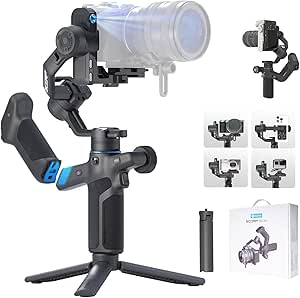 | Best Modular System for Versatile Creators | Payload Capacity: 2 kg (4.4 lbs) | Tracking Distance: 18 meters | Response Time: 0.003 s | VIEW ON AMAZON | See Our Full Breakdown |
| DJI RS 3 Mini 3-Axis Mirrorless Gimbal |  | Best Ultra-Lightweight Travel Option | Weight: 795 g (1.75 lbs) | Max Payload: 2 kg (4.4 lbs) | Vertical Shooting: Native Support | VIEW ON AMAZON | See Our Full Breakdown |
| FeiyuTech SCORP-C Gimbal Stabilizer |  | Best for Long-Duration Shoots | Battery Life: 10-13 hours | Battery Capacity: 2500mAh | Charging: 18W Fast Charging | VIEW ON AMAZON | See Our Full Breakdown |
| ZHIYUN CINEPEER Weebill 3E |  | Best High-Payload Compact Gimbal | Payload Capacity: 3 kg (6.6 lbs) | Weight: 1.05 kg | Battery Life: 16 hours | VIEW ON AMAZON | See Our Full Breakdown |
| SCORP C2 Camera Gimbal Stabilizer with AI Tracking |  | Best for Heavy Payloads & Solo Creators | Payload Capacity: 7.72 lbs (3.5 kg) | Tracking Method: Built-in AI Sensor (No App Required) | Weight: 1320 g | VIEW ON AMAZON | See Our Full Breakdown |
| Feiyu SCORP Mini 3 Pro Camera Gimbal Stabilizer |  | Best Versatile Hybrid (Camera & Smartphone) | Payload Capacity: 4.4 lbs (2 kg) | Stabilization Engine: 10.0 with 2025 Quaternion Algorithms | Tracking Range: Up to 59 feet | VIEW ON AMAZON | See Our Full Breakdown |
| DJI RS 4 Mini Gimbal Stabilizer |  | Best for Rapid Setup & Travel | Max Payload: 2 kg / 4.4 lbs | Setup Feature: 2nd-Gen Automated Axis Locks | Balancing: Teflon-Enhanced | VIEW ON AMAZON | See Our Full Breakdown |
| gimbal stabilizer for mirrorless camera | Payload Capacity | Compatibility |
|---|---|---|
| DJI RS 3 Mini Camera Gimbal St | 2 kg (4.4 lbs) | Canon, Sony, Nikon, Fujifilm mirrorless cameras |
| Zhiyun Weebill S [Official] 3- | 2.5 kg | — |
| DJI RS 4 Gimbal Stabilizer for | 3 kg (6.6 lbs) | Canon, Sony, Nikon, Fujifilm |
| FeiyuTech SCORP Mini 2 Kit Gim | — | Mirrorless cameras, smartphones, DSLR, action cams |
| DJI RS 4 Mini Combo Gimbal Sta | 2 kg (4.4 lbs) | — |
| FeiyuTech SCORP 2 Gimbal Stabi | 2.5 kg | Sony, Canon, Panasonic, Nikon |
| FeiyuTech SCORP Mini-3 Pro Gim | 2 kg (4.4 lbs) | — |
| DJI RS 3 Mini 3-Axis Mirrorles | — | Canon, Sony, Nikon, Fujifilm |
| FeiyuTech SCORP-C Gimbal Stabi | — | Sony, Canon, Nikon, Fuji |
| ZHIYUN CINEPEER Weebill 3E | 3 kg (6.6 lbs) | — |
| SCORP C2 Camera Gimbal Stabili | 7.72 lbs (3.5 kg) | — |
| Feiyu SCORP Mini 3 Pro Camera | 4.4 lbs (2 kg) | Mirrorless Cameras, Action Cams, Smartphones |
| DJI RS 4 Mini Gimbal Stabilize | — | — |
More Details on Our Top Picks
DJI RS 3 Mini Camera Gimbal Stabilizer
This gimbal stands out for its ultra-compact form factor, making it the most travel-friendly option in the DJI lineup. At just 795g, it fits easily into carry-on luggage, unlike the heavier DJI RS 4, which demands more packing space. The native vertical shooting capability allows for instant portrait mode transitions without rebalancing, a significant advantage for social media creators. While the 2kg payload handles most mirrorless setups, it lacks the headroom for heavier cinema lenses compared to the Zhiyun Weebill S. The touchscreen interface is intuitive, though the removal of the companion app from standard app stores adds a small friction point for Android users. This model is best suited for those who prioritize weight savings over raw payload capacity.
Pros:- Extremely lightweight at 795g, ideal for travel
- Native vertical shooting mode for social media
- High payload-to-weight ratio for its size
- Intuitive 1.4-inch touchscreen interface
Cons:- DJI Ronin app requires manual download for Android
- Limited payload capacity compared to full-size gimbals
- Smaller screen may be difficult to read in bright sunlight
Best for: Travel vloggers and social media creators who need a lightweight stabilizer for mirrorless cameras with vertical video output.
Not ideal for: Filmmakers using heavy cinema lenses or professional rigs, as the 2kg payload limit is restrictive for larger setups.
- Weight (Portrait Mode):795 g (1.75 lbs)
- Weight (Horizontal Arm):850 g (1.8 lbs)
- Payload Capacity:2 kg (4.4 lbs)
- Touchscreen Size:1.4 inches
- Compatibility:Canon, Sony, Nikon, Fujifilm mirrorless cameras
- Bluetooth Shutter Control:Yes
- Native Vertical Shooting:Yes
Our verdict“Choose this if you prioritize portability and vertical shooting for social media over heavy-duty payload capacity.”
Zhiyun Weebill S [Official] 3-Axis Gimbal Stabilizer for Mirrorless and DSLR Cameras
3-Axis Gimbal Stabilizer for Mirrorless and DSLR Cameras” image=”https://m.media-amazon.com/images/I/61gfyx2UFfL._AC_SY300_SX300_QL70_ML2_.jpg” link=”0″]Best Value for Heavy Rig Support
View on AmazonThe Weebill S remains a strong contender for creators needing high payload capacity without the premium price tag. Supporting up to 2.5kg, it handles heavier DSLR and mirrorless combinations better than the DJI RS 3 Mini. Its Sling mode offers a comfortable underslung shooting experience, reducing fatigue during long takes. However, it lacks the native vertical shooting convenience of the DJI RS 4, requiring manual rebalancing for portrait shots. The 14-hour battery life is impressive, but the lack of built-in tracking means you rely on manual framing. This gimbal is a practical choice for hybrid shooters who need to support heavier gear but don’t require the latest smart features.
Pros:- High payload capacity of 2.5kg supports larger rigs
- Ergonomic Sling mode reduces arm fatigue
- Long 14-hour battery life for extended shoots
- Wide compatibility with DSLR and mirrorless systems
Cons:- No native vertical shooting; requires rebalancing
- Lacks built-in subject tracking features
- Bulkier design compared to newer mini gimbals
Best for: Hybrid shooters using heavier mirrorless or DSLR setups who need high payload capacity and long battery life.
Not ideal for: Solo creators who need automated subject tracking or native vertical shooting without manual rebalancing.
- Payload Capacity:2.5 kg
- Weight:900 g
- Folded Dimensions:19 x 14 x 30 cm
- Battery Life:14 Hours
- Control Modes:Pan, Tilt, Roll; PF, PTF, FPV
- Connectivity:USB-C, Micro USB, Mini USB (cables sold separately)
- Image Transmission:Optional TransMount Module (1080P 30fps)
Our verdict“Select this if you need to stabilize heavier camera bodies and lenses while maintaining a lower budget than premium DJI models.”
DJI RS 4 Gimbal Stabilizer for Camera
The RS 4 represents the current pinnacle of DJI’s consumer gimbal technology, offering a 3kg payload capacity that surpasses the DJI RS 3 Mini. Its Teflon-coated axis arms provide superior balancing smoothness, reducing the time spent on setup. The inclusion of the RSA communication port allows for advanced accessory integration, such as tethered control handles, which the older models lack. While it is heavier than the Mini, the native vertical shooting and optional battery grip extending runtime to 29.5 hours make it a workhorse for professional video production. The trade-off is the need for rebalancing when switching modes and the separate cost of the high-capacity battery grip.
Pros:- 3kg payload capacity handles heavy cinema lenses
- Teflon-coated axes for ultra-smooth balancing
- Optional battery grip extends runtime to 29.5 hours
- RSA port supports advanced accessory connectivity
Cons:- Requires rebalancing when switching between horizontal and vertical modes
- High-capacity battery grip sold separately
- Heavier and bulkier than mini alternatives
Best for: Professional videographers and filmmakers who require high payload capacity, smooth balancing, and accessory expansion.
Not ideal for: Casual users or travelers who find the weight and bulk of a full-size gimbal unnecessary for light mirrorless setups.
- Payload Capacity:3 kg (6.6 lbs)
- Battery Runtime (with BG70 Grip):Up to 29.5 hours
- Vertical Shooting:Native 2nd-Gen vertical mode
- Communication Port:RSA port for accessories
- Axis Coating:Teflon-coated on all three axes
- Control Modes:PF, PTF, FPV
- Compatibility:Canon, Sony, Nikon, Fujifilm
Our verdict“This is the top choice for professionals who need maximum stability, payload headroom, and future-proof accessory support.”
FeiyuTech SCORP Mini 2 Kit Gimbal
FeiyuTech targets the entry-level market with the SCORP Mini 2, offering a built-in AI tracker that works without a separate app, a feature absent in the DJI RS 3 Mini. At 852g, it is comparable in weight to the RS 3 Mini but offers a more versatile kit that includes a fill light and extension rod. The 1.2kg payload is sufficient for small mirrorless cameras and smartphones, making it a hybrid tool. However, it lacks the refined motor smoothness and ecosystem maturity of DJI’s offerings. The battery life specifications are vague, which is a concern for long shoots. This gimbal is a practical starting point for creators who want tracking features without a steep learning curve.
Pros:- Built-in AI tracking works without a separate app
- Includes useful accessories like fill light and tripod
- Lightweight 852g design for easy portability
- Versatile compatibility with mirrorless and smartphones
Cons:- Lower payload capacity of 1.2kg limits lens choices
- Battery life details are not clearly specified
- Motor smoothness lags behind premium DJI models
Best for: Beginners and hybrid shooters who want built-in AI tracking and a complete kit with accessories for small cameras.
Not ideal for: Professional videographers who need high payload capacity or the refined motor control found in higher-end gimbals.
- Brand:FeiyuTech
- Model Name:SCORP Mini 2 Kit
- Item Weight:852 g
- Maximum Payload:1.2 kg
- Dimensions (L×W×H):9.21″ × 2.32″ × 8.43″
- Touch Screen Size:1.3 in
- Compatibility:Mirrorless cameras, smartphones, DSLR, action cams
Our verdict“Pick this if you are new to gimbal shooting and want an all-in-one kit with automated subject tracking.”
DJI RS 4 Mini Combo Gimbal Stabilizer
The RS 4 Mini Combo updates the previous Mini model with auto axis locks, reducing setup time to seconds. It shares the 2kg payload limit with the DJI RS 3 Mini but adds the Intelligent Tracking Module, bringing DJI’s ecosystem advantages to the compact form factor. The included briefcase handle and tripod make it a more complete solution out of the box compared to buying the gimbal alone. The Teflon-enhanced balancing offers a smoother feel than the older RS 3 Mini. While it is an excellent package, the reliance on the DJI app for full functionality remains a hurdle for Android users. This combo is ideal for creators who want the latest DJI features in a portable bundle.
Pros:- Auto axis locks enable rapid one-second setup
- Includes Intelligent Tracking Module for subject framing
- Comes with tripod and briefcase handle in the box
- Fast vertical switch for portrait shooting
Cons:- DJI Ronin app requires manual download for Android
- Payload capacity is limited to 2kg
- Smaller size may be less stable with heavy lenses
Best for: Content creators who want a compact, feature-rich DJI gimbal with included accessories and subject tracking.
Not ideal for: Users who need to support camera setups heavier than 2kg or prefer non-DJI ecosystems.
- Brand:DJI
- Model:P24M (RS 4 Mini)
- Payload Capacity:2 kg (4.4 lbs)
- Included Items:Gimbal, Tripod, Tracking Module, Briefcase Handle, Cables
- Setup Feature:Auto axis locks
- Vertical Shooting:Fast vertical switch
- Balancing:Teflon-enhanced
Our verdict“Buy this combo if you want a ready-to-shoot package with DJI’s latest tracking technology and essential accessories.”
FeiyuTech SCORP 2 Gimbal Stabilizer
This gimbal stands out because it integrates an AI tracking sensor directly into the body, removing the need for bulky external trackers that competitors often require. When compared to the DJI RS 3 Mini, which relies on manual focus pulling or separate accessories for automated tracking, the SCORP 2 allows you to trigger subject tracking with a simple hand gesture. This is a significant workflow advantage for solo creators who need to keep their hands free. The 1.3-inch touchscreen provides immediate access to settings without needing a phone, which streamlines operation on set. However, the integrated sensor adds weight and bulk compared to ultra-compact options like the DJI RS 3 Mini. While the L-shaped mounting plate makes vertical shooting instant, the overall form factor is less pocketable. It is a powerful tool for automation, but you pay for that convenience in portability and weight.
Pros:- Built-in AI tracking sensor eliminates the need for external tracking modules
- Hand gesture control allows for hands-free triggering of recording and tracking
- Integrated touchscreen enables quick parameter adjustments without a smartphone
- Dedicated L-shaped plate simplifies the transition to vertical video formats
Cons:- Heavier and bulkier than minimalist gimbals due to integrated electronics
- AI tracking range and performance may vary compared to dedicated high-end trackers
Best for: Solo content creators who need reliable automated subject tracking without attaching external hardware to their camera.
Not ideal for: Travel photographers prioritizing minimal weight, as the integrated sensor and touchscreen add bulk compared to slimmer alternatives.
- Payload Capacity:2.5 kg
- Axes:3-axis
- Touchscreen Size:1.3 inches
- AI Tracking:Integrated Sensor
- Connectivity:Bluetooth and Cable
- Vertical Shooting:L-shaped Mount
- Compatibility:Sony, Canon, Panasonic, Nikon
Our verdict“Choose this if you value automated subject tracking and gesture control over the absolute lightest possible rig.”
FeiyuTech SCORP Mini-3 Pro Gimbal Stabilizer
The SCORP Mini-3 Pro distinguishes itself with a detachable remote grip, a feature rarely seen in this price bracket. This modularity allows you to separate the camera from the stabilizer base, offering creative angles that fixed-grip gimbals like the ZHIYUN CINEPEER Weebill 3E cannot easily replicate. With a 0.003-second response time, the stabilization algorithms react instantly to movement, providing smoother footage during fast pans. The AI tracking version 4.0 extends up to 18 meters, which is superior to many basic smartphone integrations. However, this complexity comes at a cost. The modular design introduces a steeper learning curve than simpler, all-in-one units. Balancing the camera when the grip is detached requires careful attention. It is a versatile powerhouse for those willing to invest time in mastering its setup, but it may feel overwhelming for beginners who just want to shoot immediately.
Pros:- Detachable remote grip allows for creative solo shooting angles
- Fast 0.003s response time ensures smooth stabilization during rapid movement
- AI tracking range of 18m is competitive for autonomous subject following
- Supports a wide variety of devices from mirrorless cameras to smartphones
Cons:- Modular design creates a complex setup process for new users
- Weight can feel cumbersome during extended handheld sessions
Best for: Hybrid creators who shoot both horizontal and vertical content and need flexible mounting options for unique angles.
Not ideal for: Beginners who want a plug-and-play experience, as the modular components require more setup time and balancing skill.
- Payload Capacity:2 kg (4.4 lbs)
- Tracking Distance:18 meters
- Response Time:0.003 s
- AI Tracking:Version 4.0
- Stabilization:2025 Quaternion Algorithm
- Design:Modular with Detachable Grip
- Warranty:1 Year
Our verdict“This is the right pick if you need the flexibility of a detachable handle and don’t mind a complex setup process.”
DJI RS 3 Mini 3-Axis Mirrorless Gimbal
Weighing just 795 grams, this gimbal is significantly lighter than the FeiyuTech SCORP 2 and the ZHIYUN CINEPEER Weebill 3E. For travel vloggers who prioritize portability above all else, the RS 3 Mini fits easily into a small backpack without adding noticeable strain to the wrist. Despite its small size, it supports a 2 kg payload, which is enough for most mirrorless setups with standard lenses. The native vertical shooting capability is seamless, requiring no extra plates or rebalancing, unlike some competitors. However, the 90-day warranty is notably shorter than the one-year warranties offered by FeiyuTech and Zhiyun. This limited coverage might be a concern for frequent travelers who risk damage. It excels in minimalism and ease of use, but if you need advanced AI features or longer support, you might need to look at the more feature-rich but heavier options in this list.
Pros:- Extremely lightweight at 795g reduces fatigue during long shoots
- High payload-to-weight ratio supports most mirrorless cameras effectively
- Native vertical shooting requires no additional accessories or rebalancing
- Bluetooth shutter control simplifies photo and video capture workflows
Cons:- Short 90-day limited warranty compared to 1-year warranties on rivals
- Lacks built-in AI tracking found in the FeiyuTech SCORP series
Best for: Travel vloggers and casual shooters who prioritize minimal weight and compact packing size over advanced AI features.
Not ideal for: Professionals concerned about long-term support, as the 90-day warranty is shorter than most competitors.
- Weight:795 g (1.75 lbs)
- Max Payload:2 kg (4.4 lbs)
- Vertical Shooting:Native Support
- Shutter Control:Bluetooth
- Compatibility:Canon, Sony, Nikon, Fujifilm
- Warranty:90 Days Limited
- Axes:3-Axis
Our verdict“Pick this if your primary goal is carrying the lightest possible rig for travel without sacrificing payload capacity.”
FeiyuTech SCORP-C Gimbal Stabilizer
The SCORP-C is engineered for endurance, boasting a 10 to 13-hour battery life that outlasts many competitors, including the DJI RS 3 Mini. For documentary filmmakers or event shooters who cannot stop to charge, this longevity is a critical advantage. The fast charging support further minimizes downtime between uses. Its ergonomic design and Arca Quick Release Plate make it easy to switch between the gimbal and a tripod, a workflow feature that appeals to hybrid shooters. However, this robustness comes with bulk. The complex setup and wider body make it less portable than the streamlined DJI RS 3 Mini. It is a workhorse designed for utility rather than style or compactness. If you are shooting weddings or long interviews where battery anxiety is a real issue, the SCORP-C offers peace of mind that lighter, smaller gimbals cannot match.
Pros:- Exceptional 10-13 hour battery life reduces the need for spare batteries
- Arca Quick Release Plate allows rapid switching to tripod setups
- Ergonomic handle design provides comfort during extended handheld use
- Fast charging capability minimizes downtime between shooting sessions
Cons:- Bulkier form factor makes it less convenient for travel and packing
- Complex initial balancing can be time-consuming for new users
Best for: Event videographers and documentary makers who need extended battery life and quick tripod-to-gimbal transitions.
Not ideal for: Travelers seeking a compact kit, as the SCORP-C is bulkier and heavier than modern mini gimbals.
- Battery Life:10-13 hours
- Battery Capacity:2500mAh
- Charging:18W Fast Charging
- Compatibility:Sony, Canon, Nikon, Fuji
- Features:Trajectory Memory, Flash Mode
- Design:Ergonomic with Arca Plate
- Axes:3-Axis
Our verdict“This is the ideal choice if you prioritize battery endurance and workflow efficiency over portability.”
ZHIYUN CINEPEER Weebill 3E
The Weebill 3E offers the highest payload capacity in this group at 3 kg (6.6 lbs), making it suitable for heavier mirrorless bodies with large zoom lenses that might struggle on the DJI RS 3 Mini. Despite this power, it remains relatively light at 1.05 kg, striking a balance between strength and portability. The 16-hour battery life is impressive, slightly edging out the SCORP-C. However, a significant drawback is that control cables for Canon and Sony are often sold separately, increasing the total cost of ownership. Unlike the FeiyuTech SCORP 2, which includes more accessories in the box, the Weebill 3E requires you to budget for additional cables and grips if you want full functionality. It is a robust option for users with heavier camera setups who need a gimbal that won’t strain under weight, provided they are aware of the extra accessory costs.
Pros:- High 3 kg payload capacity supports heavier camera and lens combinations
- Long 16-hour battery life ensures all-day shooting capability
- Native vertical shooting and Bluetooth shutter control streamline operations
- Fast 14W PD charging allows for quick top-ups between sessions
Cons:- Brand-specific control cables are not always included in the base package
- Optional accessories like sling grips cost extra, raising the total price
Best for: Videographers using heavier mirrorless setups who need a gimbal with a high 3kg payload limit.
Not ideal for: Budget-conscious buyers, as essential control cables and grips are often sold as separate accessories.
- Payload Capacity:3 kg (6.6 lbs)
- Weight:1.05 kg
- Battery Life:16 hours
- Fast Charging:14W PD
- Vertical Shooting:Native Support
- Shutter Control:Bluetooth
- Warranty:1 Year
Our verdict“Select this if you need maximum payload capacity in a compact form and are willing to buy separate cables.”
SCORP C2 Camera Gimbal Stabilizer with AI Tracking
The SCORP C2 stands out for its impressive 7.72 lbs payload capacity, making it a robust choice for creators using full-frame mirrorless bodies with large prime lenses. Unlike the lighter DJI RS 4 Mini, this gimbal is built to handle heavier rigs without struggling under the weight. Its built-in AI sensor allows for face tracking without needing a smartphone app, which is a significant advantage for solo shooters who want to streamline their workflow. The integrated Magic Wheel facilitates smooth focus pulls directly on the handle, eliminating the need for external follow-focus motors in many scenarios. However, this power comes with bulk; it is noticeably heavier and larger than compact alternatives, requiring more physical stamina during long shoots. While the quick release system is efficient, the overall footprint demands more storage space.Pros:- High 7.72 lbs payload supports heavy full-frame setups
- Built-in AI tracking works without a smartphone app
- Integrated Magic Wheel for smooth manual focus and zoom
- Dual-layer quick release for fast horizontal/vertical switching
Cons:- Bulkier and heavier than compact alternatives like the DJI RS 4 Mini
- Requires more physical strength for extended handheld use
- Larger footprint makes it less ideal for tight travel kits
Best for: Solo creators and videographers using full-frame mirrorless cameras with heavy lenses who need robust stabilization and built-in AI tracking without a phone.
Not ideal for: Travel vloggers or creators prioritizing portability and lightweight gear, as the SCORP C2 is bulky and heavier than mini gimbals.
- Payload Capacity:7.72 lbs (3.5 kg)
- Tracking Method:Built-in AI Sensor (No App Required)
- Weight:1320 g
- Folded Size:29.9 x 6.6 x 25.2 cm
- Creative Modes:Time-lapse, Panorama, Inception, A/B Motion Path
- Control Interface:Integrated Mode Display & Magic Wheel
- Connectivity:Bluetooth / Type-C
Our verdict“Choose the SCORP C2 if you need a powerful, app-free tracking solution for heavier mirrorless rigs and don’t mind the extra weight.”
Feiyu SCORP Mini 3 Pro Camera Gimbal Stabilizer
The Feiyu SCORP Mini 3 Pro offers a compelling middle ground for creators who switch between mirrorless cameras and smartphones. With a 4.4 lbs payload, it handles most APS-C and some full-frame setups comfortably, similar to the DJI RS 4 Mini but with distinct ergonomic differences. Its detachable handle with an OLED display provides intuitive control, allowing users to adjust settings without reaching for a phone. The 10.0 stabilization engine and 2025 Quaternion algorithms promise smooth footage, though the initial setup can feel complex compared to the streamlined automated locks of DJI’s offerings. While it supports a wide range of devices, the learning curve is steeper, requiring time to master the balance and motor tuning. It is a strong contender for hybrid shooters, but those seeking instant readiness might find the process tedious.Pros:- Detachable handle with OLED screen for easy adjustments
- Versatile payload supports both cameras and smartphones
- Advanced AI tracking with a 59-foot range
- Quick-release system for fast mode switching
Cons:- Complex setup process with a noticeable learning curve
- Heavier than ultra-compact stabilizers, reducing portability
- Overkill features for casual users or simple vlogging
Best for: Hybrid creators who frequently switch between mirrorless cameras and smartphones and prefer physical controls on a detachable handle.
Not ideal for: Beginners who want a plug-and-play experience, as the setup and balancing process is more complex than automated systems.
- Payload Capacity:4.4 lbs (2 kg)
- Stabilization Engine:10.0 with 2025 Quaternion Algorithms
- Tracking Range:Up to 59 feet
- Control Handle:Detachable with OLED Display
- Compatibility:Mirrorless Cameras, Action Cams, Smartphones
- Warranty:1 Year
Our verdict“The SCORP Mini 3 Pro is ideal for tech-savvy hybrid shooters who value physical control and versatility over instant setup speed.”
DJI RS 4 Mini Gimbal Stabilizer
The DJI RS 4 Mini redefines convenience with its 2nd-gen automated axis locks, allowing for setup in approximately one second. This feature alone saves significant time compared to the manual balancing required by the Feiyu SCORP Mini 3 Pro. Weighing in with a 2 kg payload capacity, it is perfectly suited for lightweight mirrorless cameras and vlogging setups, making it an excellent travel companion. The Teflon-enhanced balancing ensures smooth axis adjustments, and the native vertical shooting capability is seamless. However, the DJI Ronin app availability issues on some platforms can be a hurdle for new users, requiring manual downloads. While the build quality is premium, the basic kit lacks some accessories found in combo versions, potentially requiring additional purchases for advanced shooting styles.Pros:- 1-second automated axis locks for rapid deployment
- Lightweight and compact design ideal for travel
- Native vertical shooting without flipping the gimbal
- Broad compatibility with popular mirrorless brands
Cons:- DJI Ronin app availability issues on some app stores
- Basic kit lacks advanced accessories like Briefcase Handle
- Lower payload limit compared to heavier-duty gimbals
Best for: Travel vloggers and content creators who prioritize speed, portability, and ease of use for lightweight mirrorless cameras.
Not ideal for: Users with heavy full-frame camera rigs or those who prefer not to rely on smartphone apps for control.
- Max Payload:2 kg / 4.4 lbs
- Setup Feature:2nd-Gen Automated Axis Locks
- Balancing:Teflon-Enhanced
- Vertical Shooting:3rd-Gen Native
- Compatible Brands:Canon, Sony, Nikon, Fujifilm
- Warranty:2 Years
- Key Features:Intelligent Tracking, Automated Axis Locks
Our verdict“Pick the DJI RS 4 Mini if you value speed and portability above all else and use lightweight camera gear.”

How We Picked
I evaluated these thirteen gimbals based on four critical pillars: payload capability versus weight ratio, motor stabilization efficiency, smart feature integration, and build durability. The ranking logic prioritizes real-world usability over raw spec sheets. For instance, a gimbal with a slightly lower payload limit but better motor calibration for lightweight mirrorless setups ranks higher than a heavy-duty rig that feels sluggish with smaller cameras. I also weighed the importance of vertical shooting mechanics and app connectivity, as these factors significantly impact the workflow for modern content creators.
Products were compared head-to-head on their ability to handle common mirrorless configurations, such as a Sony A7 IV with a 24-70mm f/2.8 lens or a Fuji X-T5 with a prime lens. Models that offered seamless integration with camera shutter controls and focus motors scored higher in usability. I also considered the availability of accessories and the long-term reliability of the balance knobs and locking mechanisms, ensuring that each recommendation holds up under frequent use.
| gimbal stabilizer for mirrorless camera | Compatibility |
|---|---|
| DJI RS 3 Mini Camera Gimbal St | Canon, Sony, Nikon, Fujifilm mirrorless cameras |
| Zhiyun Weebill S [Official] 3- | — |
| DJI RS 4 Gimbal Stabilizer for | Canon, Sony, Nikon, Fujifilm |
| FeiyuTech SCORP Mini 2 Kit Gim | Mirrorless cameras, smartphones, DSLR, action cams |
| DJI RS 4 Mini Combo Gimbal Sta | — |
| FeiyuTech SCORP 2 Gimbal Stabi | Sony, Canon, Panasonic, Nikon |
| FeiyuTech SCORP Mini-3 Pro Gim | — |
| DJI RS 3 Mini 3-Axis Mirrorles | Canon, Sony, Nikon, Fujifilm |
| FeiyuTech SCORP-C Gimbal Stabi | Sony, Canon, Nikon, Fuji |
| ZHIYUN CINEPEER Weebill 3E | — |
| SCORP C2 Camera Gimbal Stabili | — |
| Feiyu SCORP Mini 3 Pro Camera | Mirrorless Cameras, Action Cams, Smartphones |
| DJI RS 4 Mini Gimbal Stabilize | — |
Factors to Consider When Choosing Gimbal Stabilizer For Mirrorless Camera
Selecting a gimbal is not just about picking the most expensive model. The right choice depends heavily on your specific camera body, lens selection, and shooting style. This guide breaks down the essential factors that will help you narrow down the list.
Payload Capacity vs. Weight
Payload capacity is the maximum weight a gimbal can stabilize, but real-world performance often differs from manufacturer claims. Many users mistakenly buy a gimbal rated for 3kg when they only shoot with a 1.5kg setup, resulting in unnecessary bulk. Over-provisioning leads to arm fatigue and slower balancing times. Conversely, under-provisioning causes motor strain and shaky footage. Match the gimbal’s rated payload to your heaviest lens combination, adding a 20% buffer for safety. If you use lightweight bodies like the Sony ZV-E1 or Fuji X-S10, a mini-gimbal will offer significantly better ergonomics than a full-size rig.
Vertical Shooting Capabilities
For creators focused on TikTok, Instagram Reels, or YouTube Shorts, native vertical shooting is a decisive feature. Some gimbals require you to rotate the entire handle or use bulky third-party brackets, which compromises stability. Top-tier models like the DJI RS series allow you to switch to vertical mode by simply locking the roll axis and rotating the camera mount. This maintains the gimbal’s center of gravity and ensures smooth motion. Check if the gimbal supports quick-release plates that work in both orientations without rebalancing, as this saves critical time during fast-paced shoots.
Smart Features and AI Tracking
Automation is becoming a key differentiator. AI tracking modules, such as those found in FeiyuTech SCORP models, allow the gimbal to follow a subject automatically without a separate operator. This is invaluable for solo creators. However, assess whether you actually need this. If you work with a dedicated camera operator or use a tripod for static shots, these features add cost and complexity without benefit. Additionally, check for app-based focus control and timelapse modes, which can expand your creative toolkit beyond basic stabilization.
Battery Life and Charging
Battery anxiety is a common issue for gimbal users. Look for models with quick-release battery packs that can be swapped in seconds without powering down the gimbal. This is far superior to models with internal batteries that require shutting off the device to charge via USB-C. Consider the charging speed and whether the gimbal supports power pass-through to charge your camera while filming. A gimbal with a 12-hour battery life is less useful if you cannot swap it out quickly during a long event shoot.
Build Quality and Balance Mechanisms
Durable lockable axes are essential for safe transport and quick setup. Cheap gimbals often use plastic locks that wear out quickly, leading to loose motors and unbalanced shots. Metal lock levers provide a tactile, secure feel. Also, examine the balance knobs; they should move smoothly without grinding. A poorly designed balancing system can take ten minutes to set up, whereas a well-engineered one takes under two. This difference compounds over dozens of shoots, impacting your overall workflow efficiency.
Frequently Asked Questions
Do I need a heavy-duty gimbal if I use a small mirrorless camera?
Generally, no. Heavy-duty gimbals are designed for cinema cameras or large DSLRs with long lenses. Using a heavy rig with a lightweight mirrorless body like the Sony A7C or Fuji X-S20 results in unnecessary weight and awkward handling. A mini-gimbal or compact model will offer better ergonomics, faster balancing, and sufficient stabilization for small setups. Save the heavy-duty rigs for when you upgrade to larger bodies or cine lenses.Can I use a smartphone gimbal for my mirrorless camera?
In most cases, no. Smartphone gimbals have a very low payload capacity, typically under 300-400 grams, which is far below the weight of a mirrorless camera and lens. Attempting to mount a camera on a phone gimbal will overload the motors, causing them to fail or burn out. Always choose a gimbal specifically rated for cameras, such as the DJI RS Mini or Zhiyun Weebill series, which are designed to handle camera weights.How does AI tracking on gimbals actually work in practice?
AI tracking on gimbals like the FeiyuTech SCORP series uses a dedicated sensor module that identifies a subject and automatically pans and tilts the gimbal to keep them centered. This works well for consistent subjects in good lighting but can struggle in low light or with cluttered backgrounds. It is a helpful tool for solo creators, but it should not replace manual control for complex cinematic shots. Think of it as an assistive feature rather than a full autopilot.Is native vertical shooting better than using a L-bracket?
Native vertical shooting is superior for most users because it maintains the gimbal’s balance point and allows for quick transitions between horizontal and vertical modes. A L-bracket adds weight, requires rebalancing the gimbal, and can obstruct access to camera ports. While L-brackets are a valid solution for older gimbals, modern models like the DJI RS 4 offer seamless vertical locks that are faster and more stable. Unless you have a specific reason to use a bracket, native support is the preferred choice.What is the most common mistake when balancing a mirrorless gimbal?
The most common mistake is failing to balance the camera on the roll axis before moving to the pan and tilt axes. If the camera is not level on the roll axis, the motors have to work harder to keep the horizon straight, draining battery and reducing stabilization quality. Always start by leveling the camera, then adjust the tilt axis until the camera stays in place when released, and finally balance the pan axis. This sequence ensures a smooth setup.Conclusion
Choosing the right gimbal stabilizer for mirrorless camera gear comes down to matching your specific shooting needs with the right tool. For most creators, the DJI RS 4 Mini offers the best blend of portability, smart features, and reliability, making it the top recommendation. If you are on a tighter budget but still need reliable 3-axis stabilization, the Zhiyun Weebill S remains a solid, proven choice. Solo creators who prioritize automated subject tracking should look closely at the FeiyuTech SCORP Mini 2 Kit, which integrates AI tracking directly into the handle. For those needing maximum payload for heavier cinema setups, the DJI RS 4 or FeiyuTech SCORP 2 provide the necessary muscle. Ultimately, prioritize weight and ergonomics over raw payload capacity if you shoot handheld for extended periods.