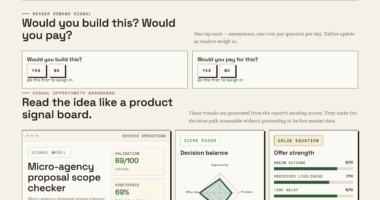

📊 Full opportunity report: Raw-feed licensing. The contract that doesn’t exist yet. on ThorstenMeyerAI.com — validation score, market gap, and execution plan.

Get business pricing on tech for your team
- Business-only prices and quantity discounts
- Tax-exempt purchasing
- Multiple users, one account, clear invoices
TL;DR
A critical licensing category for raw-feed data used in AI downstream rewriting lacks an industry-standard contract. This gap parallels historical issues in music licensing and affects multiple industry players.
The industry currently lacks an industry-standard contract for raw-feed licensing used in downstream AI rewriting, creating a significant legal and economic gap that impacts multiple stakeholders.
While licensing agreements exist for training data and display rights, the third category—raw-feed licensing for downstream per-audience rewrite—remains unregulated by a formal contract. This absence creates a structural mismatch, as the unit economics of AI inference and content distribution collide with existing licensing frameworks, notably those established in the music industry since 1909.
Industry sources indicate that the missing contract is central to resolving how raw-feed content is licensed, priced, and attributed when used for AI-generated rewriting. Major players, including AI labs, publishers, wire cooperatives, and search engines, are reluctant to establish a standard due to conflicting interests and strategic considerations. The lack of a formal framework hampers transparency and fair compensation, risking further industry fragmentation.
Recent discussions suggest that statutory pressure and economic analysis are pushing toward developing a new contractual model, but no consensus has been reached. Experts compare the situation to the early 20th-century music licensing crisis, where the absence of a clear legal structure led to disputes and eventual legislative intervention.
Raw-Feed Licensing:
The Contract That
Doesn’t Exist Yet
royalty (2025)
local Mac fleet, open-weight
streaming rate by 2027
(scaffolding scale)
Reddit–OpenAI 2024
Stack Overflow–OpenAI 2024
Shutterstock multi-deal
News Corp–Meta $150M/3yr
Axel Springer ~$13M/yr
FT $5–10M/yr · AP–Google
No standard contract.
Contract
via TollBit
via TollBit
by both licenses
as a license type
Per-stream music royalty and per-rewrite inference cost are in the same numerical neighbourhood because both are units of derivative-work production at scale. The contract that should price them against each other does not exist yet.Thorsten Meyer · Raw-Feed Licensing · Post-Wire 02
Implications of the Missing Raw-Feed Contract for AI and Media
The absence of a formal raw-feed licensing contract risks perpetuating economic disparities among industry players, complicating fair remuneration for content creators, and delaying the development of sustainable AI content ecosystems. Without clear legal standards, stakeholders may face increased litigation, reduced transparency, and potential stifling of innovation in downstream AI rewriting applications.
raw data licensing agreements for AI
As an affiliate, we earn on qualifying purchases.
As an affiliate, we earn on qualifying purchases.
Historical and Industry Background of Licensing Gaps
Existing licensing frameworks for training data and display rights are well-established, with contracts in place between major AI labs and publishers. However, the third category—raw-feed licensing—lacks a standardized contract, despite its critical role in downstream AI rewriting. The situation echoes the early 1900s music licensing crisis, where the lack of a clear legal framework led to disputes and legislative responses.
Since 2021, industry analysts have highlighted the economic collision between the unit costs of AI inference and traditional licensing royalties, which are rooted in statutory frameworks from the early 20th century. The current impasse reflects structural resistance from industry stakeholders who prefer to maintain the status quo, avoiding the creation of a new contractual model that could threaten existing power balances.
“The missing contract for raw-feed licensing is a structural gap that echoes early 20th-century music licensing issues, and its resolution will shape the future of AI content economics.”
— Thorsten Meyer
Unresolved Legal and Economic Challenges in Raw-Feed Licensing
It is not yet clear when or how a standardized contract for raw-feed licensing will be developed, or which industry stakeholder will lead its creation. The extent to which statutory pressure will influence the final shape remains uncertain, as does the potential for industry-wide consensus.
Next Steps Toward Establishing a Raw-Feed Licensing Framework
Industry stakeholders, regulators, and policymakers are expected to engage in negotiations over the coming months, with potential legislative or regulatory interventions. Key milestones include drafting proposed contractual models, testing them through pilot agreements, and possibly establishing new industry standards or statutory guidelines to formalize raw-feed licensing.
Key Questions
Why is there no standard contract for raw-feed licensing yet?
Industry stakeholders have conflicting interests, strategic resistance, and economic concerns that hinder the development of a standardized contract. Some prefer to maintain existing arrangements that favor their position, delaying formalization.
How does the lack of a contract affect AI development?
The absence of clear licensing terms creates legal uncertainty, complicates fair compensation, and may slow innovation by increasing risk and reducing transparency in downstream AI rewriting applications.
What parallels exist between this issue and historical licensing crises?
Experts compare it to the early 1900s music licensing issues, where the lack of a legal framework led to disputes and legislative intervention, suggesting similar developments could occur in AI licensing.
Who are the main parties resisting the creation of a raw-feed contract?
Major AI labs, large publishers, wire cooperatives, and search engines are hesitant, each preferring to avoid creating a contractual framework that might limit their strategic interests or economic advantages.
Source: ThorstenMeyerAI.com
Fall Picks
fall essentials
As an affiliate, we earn on qualifying purchases.