Virtual Reality 2.0 is about to elevate your digital experiences to a whole new level. With advanced haptic feedback, you’ll feel textures and weight like never before. Coupled with spatial audio, you’ll hear every rustle and chirp around you, making virtual worlds feel incredibly real. This fusion of sensory enhancements will blur the line between reality and the digital, transforming how you engage with virtual environments. There’s so much more to explore in this exciting future!
Key Takeaways
- Next-generation VR will provide deeper immersion, allowing users to experience different eras and locations vividly.
- Enhanced haptic feedback will enable users to feel textures and the weight of virtual objects for more realistic interactions.
- Spatial audio will create a 3D soundscape that mimics real-world perception, enhancing environmental awareness.
- The combination of haptic feedback and spatial audio will significantly increase user engagement, blurring the lines between reality and virtual experiences.
- Future VR innovations will make interactions more natural and intuitive, elevating overall user enjoyment in digital environments.
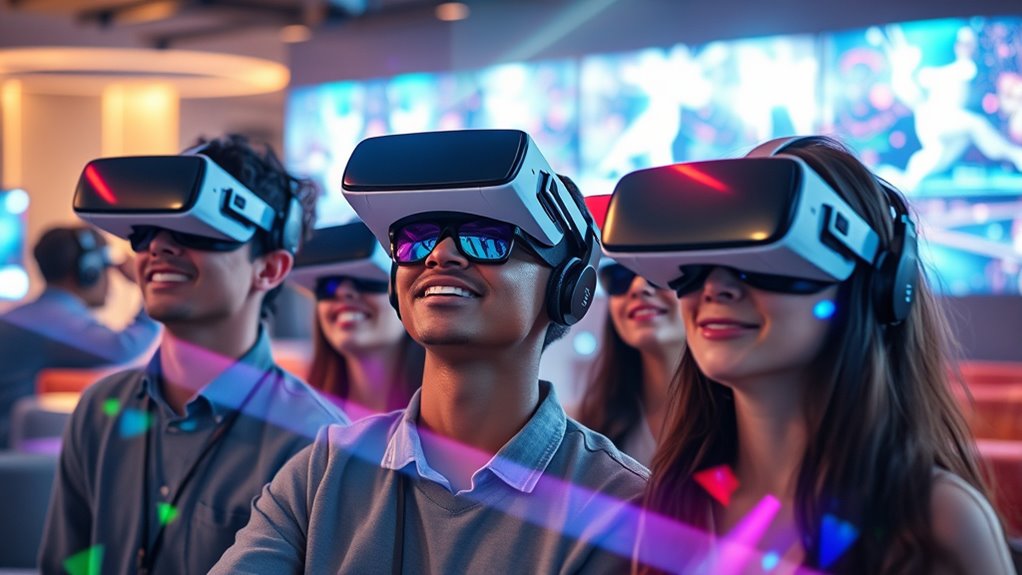
Have you ever wondered what the future of virtual reality holds? As technology continues to evolve, virtual reality (VR) is on the brink of a revolution that promises to deepen our immersion in digital worlds like never before. Imagine slipping on a headset and being transported to a bustling city in a different era, where you can feel the vibrations of the street beneath your feet and hear the distant sounds of life around you. This isn’t just a dream; it’s an exciting glimpse into what’s next.
One of the key advancements driving this immersive experience is haptic feedback. You might’ve experienced basic haptic responses in your gaming controllers, but the next generation of VR is set to take this to an entirely new level. Imagine feeling the texture of a rough wall as you lean against it or the subtle resistance when you grasp a virtual object. With advanced haptic technology, every interaction you have in a VR environment can be enhanced, making it feel more tangible and real. You won’t just see and hear; you’ll actually feel the weight and movement of your virtual surroundings.
Alongside haptic feedback, spatial audio will play a pivotal role in transforming your experience. Unlike traditional stereo sound, spatial audio creates a three-dimensional soundscape that mimics how we naturally perceive sound in the real world. Imagine walking through a virtual forest where you can hear the rustling leaves to your left and the distant chirping of birds behind you. This kind of sound immersion allows you to react instinctively based on audio cues, adding a layer of realism that enhances gameplay and exploration.
As you explore these new worlds, the combination of haptic feedback and spatial audio means you’ll be more engaged than ever before. Whether you’re battling in a fantasy realm or navigating a historical landscape, you’ll find yourself lost in the experience, almost forgetting you’re wearing a headset. The line between reality and the digital domain blurs, making it easier for you to immerse yourself in whatever scenario unfolds.
In short, the future of virtual reality is incredibly bright. With innovations in haptic feedback and spatial audio, you’ll be stepping into experiences that feel more alive than anything you’ve encountered before. So, get ready to embrace a reality that’s not just virtual but deeply immersive, redefining how you interact with digital environments. Additionally, the art of Italian espresso can complement your virtual adventures by providing a rich sensory experience that enhances your overall enjoyment.

Meta Quest 3 512GB | VR Headset — Thirty Percent Sharper Resolution — 2X Graphical Processing Power — Virtual Reality Without Wires — Access to 40+ Games with a 3-Month Trial of Meta Horizon+ Included
NEARLY 30% LEAP IN RESOLUTION — Experience every thrill in breathtaking detail with sharp graphics and stunning 4K…
As an affiliate, we earn on qualifying purchases.
As an affiliate, we earn on qualifying purchases.
Frequently Asked Questions
What Hardware Is Needed for Virtual Reality 2.0 Experiences?
For next-level virtual reality experiences, you’ll need specific hardware. Start with a high-quality VR headset that supports eye tracking systems, so you can interact more naturally with your environment. You’ll also want haptic gloves to feel virtual objects, enhancing your immersion. A powerful computer or console is essential for processing the graphics. Ultimately, don’t forget a spacious play area to move around freely and enjoy the full experience without limitations.
Are There Any Health Risks Associated With Virtual Reality Use?
Yes, there are health risks associated with virtual reality use. You might experience motion sickness due to the disconnect between what your eyes see and your body feels. Eye strain can also occur from prolonged use, especially if you’re not taking breaks or adjusting settings for comfort. It’s important to listen to your body—if you feel dizzy or experience discomfort, take a break and give your eyes a rest.
How Does Virtual Reality 2.0 Differ From Earlier Versions?
Virtual Reality 2.0 bursts forth like a supernova, illuminating your experience with enhanced haptic feedback that makes virtual interactions feel tangible. Unlike earlier versions, it wraps you in a cocoon of realism, allowing you to genuinely feel the environment around you. Plus, the social integration is seamless, letting you connect with others in ways that feel natural and engaging. You won’t just see the virtual world; you’ll feel it, share it, and live it.
Can Virtual Reality 2.0 Be Used for Educational Purposes?
Yes, you can definitely use Virtual Reality 2.0 for educational purposes! It transforms learning by creating virtual classrooms where you can engage with subjects in a hands-on way. Gamified learning makes the experience fun and interactive, helping you grasp complex concepts more easily. With immersive simulations, you’re not just reading about history or science; you’re experiencing it, which enhances retention and understanding. This innovative approach makes education more accessible and enjoyable for everyone.
What Are the Costs Associated With Virtual Reality 2.0 Technology?
Imagine you’re in a bustling marketplace, exploring the costs of virtual reality 2.0 technology. You’ll find that a cost analysis reveals a range of expenses, including hardware, software, and ongoing maintenance. While some options are affordable, others present significant affordability barriers, especially for smaller businesses or educational institutions. As you weigh these costs, remember to contemplate the potential return on investment, which can often outweigh initial financial hurdles.

KIWI design Audio Head Strap with Battery for Meta/Oculus Quest 3/3S, K4 Duo DualFast Charging Headset, VR Accessories with Balanced Design for Enhanced Sound Effects & Playtime
All-in-One Audio Head Strap with Battery: The K4 Duo Headset revolutionizes your VR experience by combining premium audio…
As an affiliate, we earn on qualifying purchases.
As an affiliate, we earn on qualifying purchases.
Conclusion
As you step into the world of Virtual Reality 2.0, imagine this: by 2025, the VR market is expected to soar to over $44 billion. That’s not just a number; it’s a gateway to experiences that blur the lines between reality and imagination. Whether you’re exploring distant planets or walking through historic events, the future is immersive and enthralling. So gear up and get ready—your next adventure is just a headset away!

Samsung ET-YO324BBEGUS Gear VR Controller
Motion controller for more realistic interaction
As an affiliate, we earn on qualifying purchases.
As an affiliate, we earn on qualifying purchases.

BOBOVR S3 Pro Battery Strap Accessories,Head Air Cooling System and 10000mah Hot-swappable Battery Pack,Compatible with Meta Quest 3/Quest 3S
Compatible with Meta Quest 3/Quest 3s: Still using BOBOVR’s innovative power swap design, the new battery architecture separates…
As an affiliate, we earn on qualifying purchases.
As an affiliate, we earn on qualifying purchases.