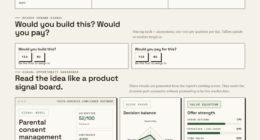

📊 Full opportunity report: Could Anthropic’s Watermarks Limit Claude’s Role In Education And Employment? on ThorstenMeyerAI.com — validation score, market gap, and execution plan.

Get business pricing on tech for your team
- Business-only prices and quantity discounts
- Tax-exempt purchasing
- Multiple users, one account, clear invoices
TL;DR
Anthropic has implemented watermarks in Claude-generated content to support transparency and comply with EU rules. This development could impact how AI-assisted work is detected in education and employment, though detection remains uncertain.
Anthropic has introduced machine-readable watermarks in outputs from supported Claude models, including embedded text patterns that can survive copying and some editing as detailed in the original analysis. This move, tied to European Union transparency regulations, aims to help identify AI-generated content but raises concerns among users about privacy and detection in educational and workplace settings.
Starting August 2, 2026, Claude models launched in the EU will support text watermarks that are embedded within the generated content, making it possible to detect whether material was produced by Claude even after copying or minor editing. These watermarks are designed to be imperceptible and do not alter the meaning or readability of the text, according to Anthropic.
In addition to text, supported image files such as SVG, PNG, and JPG can receive signed provenance metadata based on the C2PA open standard, recording whether Claude processed or altered the file. This feature is available across cloud platforms like AWS, Google Cloud, and Microsoft Foundry, though support may vary by platform and feature set.
While the policy aims to improve transparency, it has prompted complaints from students and workers worried that their use of Claude could be detected without their knowledge, potentially affecting privacy and trust. Anthropic emphasizes that a watermark does not prove misconduct or authorship, only that Claude was involved in generating or editing the content.
Impact of Watermarks on AI Detection in Schools and Workplaces
This development could significantly influence how AI-assisted work is monitored in educational and professional environments. Detectable watermarks may provide institutions with a new tool to identify AI-generated content, potentially affecting policies around AI use and academic integrity. However, the effectiveness of detection remains uncertain, and false positives or misinterpretations could lead to unfair consequences.
Moreover, the implementation of such watermarks raises privacy concerns, as users may be unknowingly flagged for AI assistance. The policy’s global reach, driven by EU regulations, means that even non-European users might be subject to detection mechanisms, influencing broader AI usage norms.
As an affiliate, we earn on qualifying purchases.
Background on AI Watermarking and EU Transparency Rules
Anthropic’s move follows its signing of the EU AI Act Article 50(2) Code of Practice on transparency, which encourages AI providers to embed identifiable markers in generated content. The company announced that models launched from August 2, 2026, in the EU will support watermarking, with plans to extend support to earlier models. This aligns with broader efforts to regulate AI transparency and accountability.
Prior to this, AI detection relied mainly on probabilistic assessments, which could be inaccurate or easily circumvented. The new watermarking approach aims to provide a more reliable provenance signal, although technical details and detection tools are still under development.
“The watermark is designed to be imperceptible and does not affect the quality or readability of the content. It helps support transparency without compromising user experience.”
— Anthropic spokesperson
Technical Limitations and Detection Effectiveness Still Unclear
Anthropic has not disclosed detailed technical specifications of the watermarking process, making independent assessment difficult. It is unclear how reliably the watermarks can be detected after heavy editing, translation, or file conversions. Support for older Claude models and third-party detection tools remains in development, and the actual scope of detection accuracy is still unknown.
Additionally, the system does not prove authorship or misconduct, only that Claude processed the content, which complicates enforcement and policy interpretation.
Future Developments in Detection Tools and Policy Implementation
Anthropic plans to publish technical guidance and detection mechanisms soon, alongside extending watermark support to older Claude models. Schools, employers, and software developers will need to evaluate how to incorporate watermark detection into their policies, balancing transparency with privacy. The effectiveness of detection in real-world scenarios, especially after editing or paraphrasing, will be a critical focus in the coming months.
Legal and ethical discussions around AI watermarking and privacy are expected to intensify as the technology becomes more widespread.
Key Questions
Will every Claude response now contain a watermark?
No. Support for watermarking is available for models launched on or after August 2, 2026, with support for older models still in development.
Can a watermark prove that Claude wrote an assignment?
No. Detection indicates that Claude may have processed the content but does not establish original authorship or policy violations.
Will copying Claude-generated text remove the watermark?
Because the watermark is embedded within the text, it will generally travel with copied content, but heavy editing or short excerpts may reduce detection reliability.
Are employers and schools able to detect watermarks now?
Anthropic says detection tools will be available soon, but detailed mechanisms are still pending, and effectiveness in everyday use remains to be seen.
Does this watermarking mean I cannot use Claude anonymously?
The watermark does not identify individual users or accounts, only that Claude processed the content. Privacy concerns remain a topic of debate.
Source: ThorstenMeyerAI.com
Fall Picks
fall essentials
As an affiliate, we earn on qualifying purchases.