
📊 Full opportunity report: Near-Miss AI Technology: Making Warehouses Safer Than Ever on IdeaNavigator AI — validation score, market gap, and execution plan.

Get business pricing on tech for your team
- Business-only prices and quantity discounts
- Tax-exempt purchasing
- Multiple users, one account, clear invoices
TL;DR
An AI system now analyzes existing warehouse CCTV footage to identify near-misses and safety violations. This technology aims to improve safety management and reduce injuries, with testing underway in multiple warehouses.
Near-miss detection AI for existing warehouse CCTV cameras is entering testing in select warehouses, offering a new approach to safety management. This technology can identify forklift-pedestrian proximity, blind-corner conflicts, and rack contact, helping safety managers proactively address hazards. The development is driven by advances in vision models and the economic incentives from insurance reductions, making it a timely innovation for industrial safety.
IdeaNavigator AI is developing an AI system designed to analyze existing real-time CCTV feeds in warehouses. The system detects critical safety events such as forklift-to-pedestrian proximity, blind-corner near-misses, rack strikes, and speed violations. It then compiles weekly digests with clips and severity assessments, which are emailed to safety teams to inform their next steps.
This technology is intended as a first-win workflow for safety managers, leveraging existing infrastructure without requiring new hardware. Its initial validation involves processing two weeks of archived footage from three mid-market warehouses, with success measured by safety managers’ willingness to pay and reductions in incident rates, according to IdeaNavigator AI.
The market focus is on industrial safety and EHS software, with a subscription model scaled by the number of cameras, and positioned against potential insurance premium reductions for facilities that adopt the system.
Potential Impact on Warehouse Safety Management
This innovation could significantly improve safety oversight in warehouses by providing continuous, automated monitoring of hazards that are often overlooked in manual reviews. By proactively identifying near-misses and unsafe behaviors, the system aims to reduce injuries and related costs. The ability to document safety indicators may also influence insurance premiums, creating financial incentives for facilities to adopt the technology.
Experts emphasize that such AI tools can complement existing safety protocols, offering real-time insights without replacing human oversight. The potential for widespread adoption could reshape safety practices in the logistics and warehousing industries.
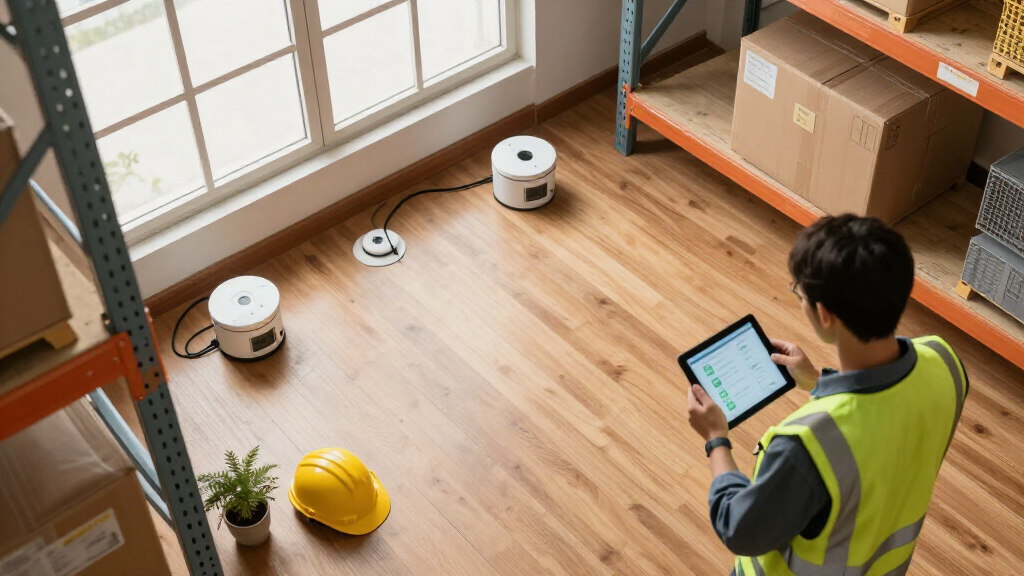
warehouse CCTV safety monitoring system
As an affiliate, we earn on qualifying purchases.
As an affiliate, we earn on qualifying purchases.
Background on Warehouse Safety and AI Developments
Warehouses generate hundreds of hours of CCTV footage daily, but most of it remains unanalyzed until an incident occurs. This leads to missed opportunities for prevention and documentation of hazards. Recent advances in computer vision have enabled classification of safety-critical events, such as forklift proximity and speed violations, from commodity CCTV feeds.
Industry stakeholders and insurers are increasingly interested in proactive safety measures. Some safety programs are now rewarded with lower premiums when they can demonstrate documented safety improvements. The development of near-miss detection AI aligns with this trend, offering a scalable solution that leverages existing infrastructure.
Previous efforts focused on manual review or specialized sensors, but the new approach relies on AI models trained to recognize safety-critical events directly from standard CCTV feeds, making it more feasible for widespread adoption.
“This AI system could transform safety monitoring by providing continuous, automated detection of hazards using the existing CCTV infrastructure.”
— an anonymous researcher
Unresolved Questions About Deployment and Effectiveness
It is not yet clear how accurately the AI will detect hazards across diverse warehouse layouts and camera setups. The effectiveness of the system in reducing actual incidents remains to be proven through broader testing and long-term studies. Additionally, questions remain about data privacy, integration with existing safety protocols, and the cost-benefit balance for different facility sizes.
Next Steps for Validation and Adoption
IdeaNavigator AI plans to complete initial testing within the next few months, processing archived footage from multiple warehouses. If results demonstrate reliable hazard detection and positive safety impacts, the company will move toward broader deployment and commercial rollout. Further validation will involve measuring incident rate reductions and safety team feedback to refine the system.
Key Questions
How does the AI detect near-misses in warehouses?
The AI analyzes CCTV feeds to identify proximity between forklifts and pedestrians, speed violations, and contact with racks or other structures, flagging potential hazards for review.
Can this system be implemented with existing CCTV cameras?
Yes, the system is designed to ingest real-time RTSP feeds from current CCTV infrastructure, avoiding the need for new hardware investments.
What are the benefits for warehouse operators?
Operators can proactively identify hazards, reduce injury risks, document safety efforts, and potentially lower insurance premiums through improved safety records.
When will this AI system be available for general use?
The technology is currently in testing, with commercial availability expected after successful validation, likely within the next year.
Are there privacy concerns related to CCTV analysis?
While privacy considerations are important, the system analyzes existing footage for safety events and does not require additional data collection beyond current surveillance practices.
Source: IdeaNavigator AI
Fall Picks
fall essentials
As an affiliate, we earn on qualifying purchases.