
📊 Full opportunity report: Retirement Care Planner on IdeaNavigator AI — validation score, market gap, and execution plan.
TL;DR
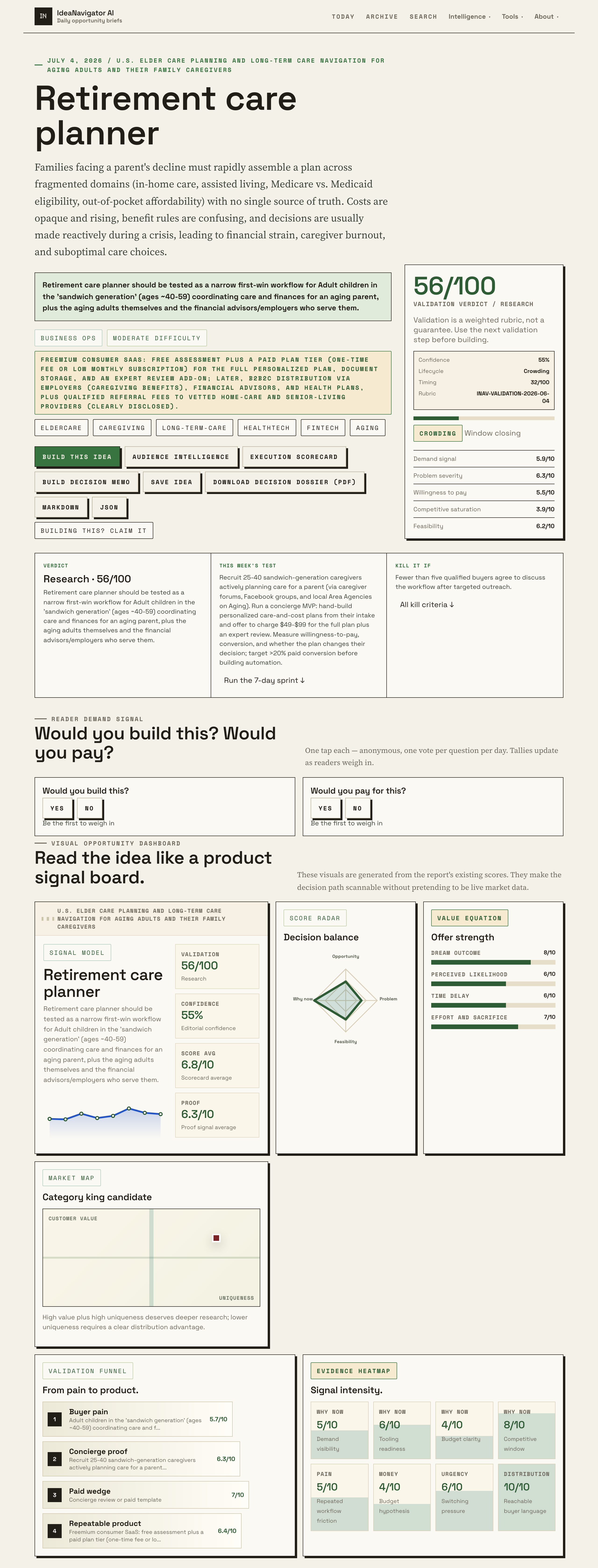
A new retirement care planning web app is being piloted to assist adult children in their 40s and 50s managing complex elder care decisions. The tool aims to provide personalized cost and care options, addressing urgent market demand.
A new retirement care planning web app is being tested as a targeted solution for middle-aged adult children managing aging parents’ care. The tool aims to streamline complex decision-making around care options and costs, addressing an urgent and growing market need.
The proposed platform targets the ‘sandwich generation’ — adults aged approximately 40 to 59 — who often face fragmented care options and opaque costs when caring for aging parents. The initial testing involves a concierge MVP, where caregivers provide basic information about their parent’s health, location, and finances. The app then generates a personalized care-and-cost plan, including local cost comparisons, benefit eligibility explanations, affordability projections, and a prioritized action checklist.
This effort is motivated by demographic trends: by 2030, roughly 73 million Americans will be aged 65 or older, with a high likelihood of requiring long-term care. Costs for assisted living and nursing home care have risen sharply, with median assisted living costs reaching approximately $6,200 per month and nursing home costs around $115,000 annually. Caregivers report mounting financial and emotional strain, creating a demand for structured guidance and decision support tools.
The MVP will be offered free initially, with a paid tier providing full plans, document storage, and expert reviews. The pilot aims to validate willingness-to-pay, plan effectiveness, and impact on decision-making before automating the appointment no-show recovery process for broader deployment. The project will focus on a high-cost state to manage data complexity, with plans to expand based on initial results.
Why a Retirement Care Planner Is a Market-Driven Innovation
This development addresses a critical gap in elder care management, offering a structured, personalized approach to complex decisions that traditionally require multiple fragmented sources. As the U.S. population ages rapidly, families face rising costs and emotional burdens, making accessible planning tools increasingly vital. If successful, this platform could reduce caregiver burnout, improve care quality, and lower financial strain by enabling proactive, informed decisions.
Furthermore, the model’s potential for integration with employers, financial advisors, and health plans could expand its reach and impact, creating a new standard in elder care support. The initiative also signals a shift toward digital, user-friendly solutions tailored for middle-aged caregivers navigating the ‘sandwich’ role.

Rockgoya Shower Grab Bar, 2 Pack 12 Inch Bathroom Grab Bar, 304 Stainless Steel 1.25" Diameter Anti-Slip Handicap Grab Bar Support Shower Rail Senior Handrail Shower Safety Bar Handle
Premium 304 Stainless Steel Material: The material of the shower grab bars is 304 stainless steel, which is…
As an affiliate, we earn on qualifying purchases.
As an affiliate, we earn on qualifying purchases.
Growing Need for Structured Elder Care Planning Solutions
The U.S. is experiencing a demographic shift with a rising number of seniors and a shrinking pool of family caregivers. By 2030, 73 million Americans will be 65 or older, with nearly 70% of those turning 65 today expected to need long-term care at some point. Costs for elder care services have surged, with median assisted living costs reaching $6,200 monthly and nursing home costs around $115,000 annually, according to recent data.
Caregivers, often adult children in their 40s and 50s, face fragmented decision-making environments, with opaque costs, confusing benefit rules, and limited centralized guidance. During crises, they tend to make reactive choices, risking financial hardship and suboptimal care. Current solutions lack personalized, comprehensive planning tools tailored for this demographic, creating a significant market opportunity.
The concept of a structured digital planning tool has gained traction as a potential solution, with early prototypes focusing on local cost comparisons, benefit explanations, and action checklists. The current testing phase aims to validate demand and usability before wider rollout.
“The rising costs and complexity of elder care demand innovative, accessible planning tools tailored for middle-aged caregivers.”
— an anonymous researcher

Quicken WillMaker & Trust 2026 – Estate Planning Software – Will, Living Trust, Health Care Directive, Financial, Power of Attorney – Legally Binding- CD – PC/Mac & Online
America's #1 estate planning software — Install from CD, Download (Windows or Mac), or Access Online. Create a…
As an affiliate, we earn on qualifying purchases.
As an affiliate, we earn on qualifying purchases.
Uncertainties Around Adoption and Effectiveness
It is not yet clear how many caregivers will be willing to pay for the full service, or how effectively the tool will influence decision quality and timing. The pilot’s small sample size limits broader applicability, and long-term impacts remain untested. Additionally, integration with existing elder care systems and provider networks is still in early planning stages.

Canon P23-DHV-3 Printing Calculator with Double Check Function, Tax Calculation and Currency Conversion – Paper Roll Included in Box
Easy Paper Loading: We have made loading paper easier than ever by moving the paper slot higher up…
As an affiliate, we earn on qualifying purchases.
As an affiliate, we earn on qualifying purchases.
Next Steps in Testing and Expansion Plans
The project team plans to expand the pilot to include 25-40 actively caregiving participants, measuring willingness-to-pay, decision impact, and user satisfaction. Based on initial results, they will refine the platform and consider automation and broader deployment. Future steps include scaling to additional states and developing partnerships with employers, financial advisors, and elder care providers.

Peace of Mind Planner: Important Information about My Belongings, Business Affairs, and Wishes
Durable hardcover with concealed wire-o binding
As an affiliate, we earn on qualifying purchases.
As an affiliate, we earn on qualifying purchases.
Key Questions
How will the retirement care planner help caregivers make decisions?
The platform will generate personalized care and cost plans based on caregiver input, local data, and benefit eligibility, helping families compare options and prioritize actions.
Is the service free during the testing phase?
Yes, the initial MVP will be offered free, with a paid tier planned for full plans, expert reviews, and document storage after validation.
What costs are typically involved in elder care planning now?
Costs vary widely, with assisted living median costs around $6,200 per month and nursing home semi-private rooms approximately $115,000 annually. Costs are often opaque and difficult to compare.
Who is the target user for this platform?
The primary users are adult children aged 40-59 who are coordinating care for an aging parent, along with the parents themselves and associated financial or health advisors.
When will the platform be available to the public?
It is too early to specify a release date; the current phase focuses on pilot testing and validation before broader rollout.
Source: IdeaNavigator AI