Choosing an AI email writing assistant can mean choosing a prompt guide rather than a standalone app. The five options here are books or guides about using general-purpose AI tools, and the supplied information does not identify email software, integrations, or independent automation capabilities. I rank AI Email Shortcuts for Work first for its direct coverage of everyday email tasks, while The 15-Minute Inbox is the more manager-focused pick and AI for Executive Assistants and Office Managers offers broader administrative prompts across ChatGPT and Claude.

Get business pricing on tech for your team
- Business-only prices and quantity discounts
- Tax-exempt purchasing
- Multiple users, one account, clear invoices
The main tradeoff is email focus versus wider office coverage. A dedicated email guide may keep its advice closer to composing, revising, and following up; a broader office-work guide may help with related tasks but devote less attention to email. Since the available descriptions do not establish a guide’s depth, format, or results, I compare only the stated audience and scope. Use this list to match a guide to your workflow, not as proof that any one product will save a fixed amount of time.
Key Takeaways
- AI Email Shortcuts for Work is the most directly matched option for writing, replying, summarizing, polishing, and following up on workplace email.
- The 15-Minute Inbox speaks most clearly to busy managers who want a guide centered on professional replies and inbox tasks, though its time-saving claim is not substantiated in the supplied details.
- AI for Executive Assistants and Office Managers has the widest stated administrative prompt scope, spanning email, scheduling, meetings, and documents with both ChatGPT and Claude.
- Hire Claude AI suits professionals seeking a Claude-centered guide that extends from email into reports, meetings, and paperwork.
- AI for Office Work is the broadest beginner-oriented choice, but buyers who mainly want email guidance may prefer a more focused title.
| AI Email Shortcuts for Work: Simple Prompts to Write, Reply, Summarize, Polish, and Follow Up Without Overthinking | 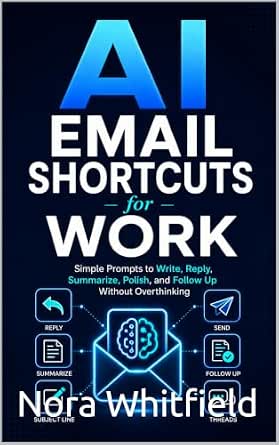 | Best Overall for Everyday Work Email | Product type: Guide to AI prompts for workplace email | Stated task coverage: Writing, replying, summarizing, polishing, and following up | Audience: People handling everyday work email | VIEW LATEST PRICE | See Our Full Breakdown |
| The 15-Minute Inbox: ChatGPT Email Blueprints for Busy Managers |  | Best for Busy Managers | Product type: Guide to using ChatGPT for work email | Primary audience: Busy managers | Stated focus: Professional replies and inbox tasks | VIEW LATEST PRICE | See Our Full Breakdown |
| AI for Executive Assistants and Office Managers: ChatGPT and Claude Prompts for Email, Scheduling, Meetings, and Documents |  | Best for Administrative Teams | Product type: Prompt guide for administrative work | Primary audience: Executive assistants and office managers | Named AI tools: ChatGPT and Claude | VIEW LATEST PRICE | See Our Full Breakdown |
| Hire Claude AI: Your Assistant for Email, Reports, Meetings, and Paperwork |  | Best for Claude-Centered Admin Work | Product type: Guide to using Claude for administrative tasks | Primary audience: Professionals, freelancers, and business owners | Named AI tool: Claude AI | VIEW LATEST PRICE | See Our Full Breakdown |
| AI for Office Work: A Beginner’s Guide to Writing Emails, Summarizing Documents, Using Excel Smarter, and Saving Hours Every Week with AI Assistants |  | Best for Beginners Exploring Office AI | Product type: Beginner’s guide to AI for office work | Primary audience: Beginners | Email coverage: Writing emails | VIEW LATEST PRICE | See Our Full Breakdown |
| AI email writing assistant | Product type | Primary audience | Email coverage | Other stated coverage |
|---|---|---|---|---|
| AI Email Shortcuts for Work: S | Guide to AI prompts for workplace email | — | — | — |
| The 15-Minute Inbox: ChatGPT E | Guide to using ChatGPT for work email | Busy managers | — | — |
| AI for Executive Assistants an | Prompt guide for administrative work | Executive assistants and office managers | Prompts for email tasks | Scheduling, meetings, and documents |
| Hire Claude AI: Your Assistant | Guide to using Claude for administrative tasks | Professionals, freelancers, and business owners | Email management | Reports, meetings, and paperwork |
| AI for Office Work: A Beginner | Beginner’s guide to AI for office work | Beginners | Writing emails | Document summaries and Excel |
More Details on Our Top Picks
AI Email Shortcuts for Work: Simple Prompts to Write, Reply, Summarize, Polish, and Follow Up Without Overthinking
AI Email Shortcuts for Work takes the most direct route to the problem named in this roundup: getting workplace email written and handled with AI prompts. Its stated coverage includes composing, replying, summarizing, polishing, and following up. That range matters because inbox work is not only about drafting a first message; readers also need help responding to existing threads, shortening long correspondence, adjusting wording, and deciding how to nudge a conversation forward.
Compared with The 15-Minute Inbox, this guide names more distinct email tasks and is not presented as specifically manager-focused. That makes it the strongest fit for a wider group of office workers, though it may be less tailored to a manager’s particular inbox pressures. Compared with AI for Executive Assistants and Office Managers, its scope stays closer to email instead of spreading across scheduling and meetings. If email is the primary job to be done, that focus gives it the clearest position in this ranking.
The limits are just as relevant. The supplied description calls the prompts simple and practical, but does not show examples, explain how the guide handles sensitive or high-stakes messages, or specify its format and depth. I would treat it as a potentially useful prompt guide rather than a complete AI email system. It is also not described as a dedicated app or as integrating with an inbox. Buyers who need a wider administrative reference may get more range from the executive-assistant guide, while beginners who want help with spreadsheets and documents may prefer AI for Office Work.
Pros:- Names five practical workplace email tasks rather than focusing on drafting alone.
- Keeps its stated scope tightly centered on work email.
- Presents itself as a simple, practical prompt resource.
- Fits a wider range of office workers than a manager-specific guide.
Cons:- The supplied details do not show sample prompts or how thoroughly each task is covered.
- No product format, integration, or update information is provided.
- It may offer less help with scheduling, documents, spreadsheets, or other office work.
Best for: Office workers who want prompt-based help across the full everyday email cycle: drafting, replying, summarizing, polishing, and following up.
Not ideal for: Readers seeking a standalone email app, verified inbox integrations, detailed samples, or broad training in non-email office tasks.
- Product type:Guide to AI prompts for workplace email
- Stated task coverage:Writing, replying, summarizing, polishing, and following up
- Audience:People handling everyday work email
- Approach:Simple, practical prompts
- Named AI tools:Not specified in the supplied description
- Format:Not specified
- Sample prompt details:Not provided
- Inbox integrations:Not specified
Our verdict“I rank it first for readers who want the broadest stated set of practical work-email prompts without shifting the main focus to other office tasks.”
The 15-Minute Inbox: ChatGPT Email Blueprints for Busy Managers
The 15-Minute Inbox has the clearest occupational focus of the five: it is aimed at busy managers seeking professional replies and a more streamlined inbox. That specificity is useful for buyers who do not want a general introduction to AI office work. The promise is centered on applying ChatGPT to work email, so it sits closer to the core need than broad guides covering spreadsheets, paperwork, or meetings.
Its title emphasizes speed, but the supplied description does not substantiate the stated 15-minute framing or quantify any time savings. I would read that as a positioning signal, not a guaranteed outcome. Compared with AI Email Shortcuts for Work, the manager guide appears narrower: it highlights professional replies and inbox tasks, while the other title explicitly lists writing, summarizing, polishing, and follow-ups. That makes this one more targeted, but the other provides clearer evidence of task breadth in the description.
It may be a sensible match for a manager who wants to standardize routine correspondence, but available details do not explain whether the blueprints are reusable templates, step-by-step lessons, or examples. The format and contents are not specified, either. Buyers who work across administrative duties or use more than one AI model may find AI for Executive Assistants and Office Managers more aligned. Those who want a clearly itemized set of general email tasks should compare it closely with the first-ranked guide before choosing.
Pros:- Targets busy managers rather than an unspecified general audience.
- Focuses on professional work replies and inbox streamlining.
- Centers on ChatGPT for email use.
- Keeps its stated purpose narrower than broad office-work guides.
Cons:- The time-saving claim in the title is not supported by details in the supplied description.
- The format and actual contents of the guide are not specified.
- The description names fewer distinct email tasks than AI Email Shortcuts for Work.
Best for: Managers who primarily want ChatGPT-oriented guidance for professional work replies and routine inbox tasks.
Not ideal for: Readers who need a documented prompt sample set, substantiated time-saving results, multi-tool guidance, or broad coverage beyond managerial email.
- Product type:Guide to using ChatGPT for work email
- Primary audience:Busy managers
- Stated focus:Professional replies and inbox tasks
- Named AI tool:ChatGPT
- Approach:Email blueprints
- Time-saving evidence:Not substantiated in the supplied details
- Format:Not specified
- Integration details:Not specified
Our verdict“I recommend it to managers drawn to a focused ChatGPT email guide, provided they treat the title’s time claim as a promise to investigate rather than a proven result.”
AI for Executive Assistants and Office Managers: ChatGPT and Claude Prompts for Email, Scheduling, Meetings, and Documents
AI for Executive Assistants and Office Managers is the most explicitly cross-functional option in the lineup while still naming email among its core subjects. It offers ready-to-use prompts for email, scheduling, meetings, and document work, and its stated use of both ChatGPT and Claude gives readers a broader tool frame than the ChatGPT-centered manager guide. For assistants and office managers whose day rarely ends at the inbox, that mix may be more valuable than a guide devoted only to email.
The tradeoff is breadth over email depth. This book covers four types of administrative work, so an email-first buyer cannot assume that every listed email task receives extensive treatment. By comparison, AI Email Shortcuts for Work explicitly names writing, replies, summaries, polishing, and follow-ups, making its email coverage easier to judge from the supplied description. This pick is also more role-specific than Hire Claude AI, which targets professionals, freelancers, and business owners and extends into reports and paperwork.
Its ready-to-use prompt approach is appealing for readers who want starting points rather than abstract discussion. Still, no examples or details about the guide’s format and depth are available here, and the description does not explain how prompts differ between ChatGPT and Claude. I would choose it when email is one part of a wider administrative workflow, not when a buyer needs proof of detailed email instruction or a fully integrated assistant. The cross-tool promise is useful, but the actual level of model-specific guidance remains unknown.
Pros:- Covers email alongside scheduling, meetings, and documents.
- Names both ChatGPT and Claude.
- Describes its prompts as ready to use.
- Targets executive assistants and office managers directly.
Cons:- The supplied details do not indicate how much space is devoted specifically to email.
- No sample prompts or guide-format details are provided.
- The depth of its ChatGPT and Claude differences is not explained.
Best for: Executive assistants and office managers who want prompt ideas spanning correspondence, scheduling, meetings, and documents across ChatGPT and Claude.
Not ideal for: Email-only buyers who want extensive task-by-task email instruction, or readers who need confirmed prompt examples and model-specific setup details.
- Product type:Prompt guide for administrative work
- Primary audience:Executive assistants and office managers
- Named AI tools:ChatGPT and Claude
- Email coverage:Prompts for email tasks
- Other stated coverage:Scheduling, meetings, and documents
- Prompt approach:Ready-to-use prompts
- Format and depth:Not specified in supplied details
- Software integration:Not specified
Our verdict“I would choose this guide over an email-only title when administrative work spans several functions and using both ChatGPT and Claude matters.”
Hire Claude AI: Your Assistant for Email, Reports, Meetings, and Paperwork
Hire Claude AI frames Claude as a helper for the routine written and administrative work that can crowd a professional’s day. Its stated audience includes busy professionals, freelancers, and business owners, and its coverage extends from email into reports, meetings, and paperwork. That makes it broader than a focused email prompt guide, with a practical appeal for independent workers who manage their own correspondence and office tasks.
The most useful distinction is the named tool: this title centers on Claude AI, while AI for Executive Assistants and Office Managers explicitly covers both Claude and ChatGPT. Readers who want options across those two assistants may prefer that broader guide. On the other hand, this one names reports and paperwork, giving it a different mix of adjacent tasks. Compared with AI Email Shortcuts for Work, it is less directly email-centered and does not list specific email actions such as summarizing or following up.
The supplied description offers no stated drawbacks, but that does not establish the guide’s depth or quality. Key buying details are missing: format, examples, workflow instructions, and any explanation of how Claude should be used with private or sensitive business material. I would treat the broad assistant framing as a reason to investigate it for mixed administrative needs, not as evidence of automated task handling. If your primary need is writing and improving messages, the first-ranked title gives a clearer account of email task coverage.
Pros:- Targets professionals, freelancers, and business owners.
- Covers email, reports, meetings, and paperwork.
- Keeps Claude as the central named assistant.
- May suit readers who want email guidance connected to wider administrative tasks.
Cons:- The description does not enumerate specific email workflows or prompt types.
- Format, examples, and depth are not supplied.
- It does not state that it covers ChatGPT or integrates with work software.
Best for: Freelancers, business owners, and professionals who want a Claude-centered guide spanning email and other routine administrative work.
Not ideal for: Readers who need multiple AI platforms, explicit coverage of specific email actions, or confirmed integration with email and document software.
- Product type:Guide to using Claude for administrative tasks
- Primary audience:Professionals, freelancers, and business owners
- Named AI tool:Claude AI
- Email coverage:Email management
- Other stated coverage:Reports, meetings, and paperwork
- Stated goal:Reduce backlogs and save time
- Format and examples:Not specified
- Integrations:Not specified
Our verdict“This is the most fitting Claude-focused pick for independent professionals whose AI use needs to stretch beyond the inbox, though its email-specific depth is unclear.”
AI for Office Work: A Beginner’s Guide to Writing Emails, Summarizing Documents, Using Excel Smarter, and Saving Hours Every Week with AI Assistants
AI for Office Work is the broadest introductory option here. It places email writing alongside document summaries and smarter spreadsheet work, and it is explicitly aimed at beginners. That makes the guide relevant to someone who is not only trying to write messages faster but also wants a first orientation to several everyday office uses for AI assistants. Its value is the starting point across tasks, rather than a narrow email workflow.
That breadth also places it behind the email-specific choices for a buyer whose inbox is the main concern. AI Email Shortcuts for Work spells out five message-related tasks, while this guide names writing emails but gives equal title space to documents and Excel. Compared with AI for Executive Assistants and Office Managers, it is more beginner-oriented and adds spreadsheets, but the executive-assistant guide identifies two specific tools and a more defined administrative audience. The right choice depends on whether the reader values an accessible general introduction or task-specific prompt coverage.
The supplied description does not identify which AI assistants are covered, how the email section is structured, or whether the book includes practical examples. Its promise about saving hours is not supported by evidence in the information provided, so I would not treat it as a predictable result. Buyers already comfortable with AI who want detailed email replies, follow-ups, and summaries may find the guide too wide in scope. For a new user seeking several office applications in one place, however, its beginner positioning is its clearest point of difference.
Pros:- Explicitly targets beginners.
- Includes email writing among practical office uses.
- Adds document summaries and spreadsheet tasks.
- Provides a wider starting scope than email-only prompt guides.
Cons:- Email is only one of several stated subject areas.
- The AI assistants covered are not named in the supplied details.
- No examples, format information, or substantiation for the time-saving claim is provided.
Best for: Newcomers who want an introduction to AI-assisted email writing alongside document summaries and spreadsheet tasks.
Not ideal for: Experienced AI users seeking specialized email workflows, named-model guidance, or evidence for a specific time-saving outcome.
- Product type:Beginner’s guide to AI for office work
- Primary audience:Beginners
- Email coverage:Writing emails
- Other stated coverage:Document summaries and Excel
- Named AI assistants:Not specified
- Stated approach:Practical office tasks
- Format and examples:Not specified
- Time-saving evidence:Not provided
Our verdict“I would pick it as an entry point for several office uses, but not as my first choice when detailed email help is the main requirement.”

How We Picked
I ranked these options by how directly their stated scope answers the search for an AI email writing assistant. The first question was whether email is the central subject or one part of a wider office-work guide. I then compared the types of email tasks named, the intended reader, and whether the guide identifies one AI tool or more than one. This gives readers a practical way to see which title is closest to their daily inbox needs.
The ranking reflects the information supplied for each product, not a claim that I tested the books or verified the results they promise. The descriptions do not provide formats, page counts, sample prompts, update policies, technical integrations, or evidence for time savings. I do not infer those missing details. A title that mentions prompts may still vary in depth, and a guide about using ChatGPT or Claude is not the same thing as an email client with built-in automation.
For that reason, task fit carries more weight than broad feature claims. Email-centered guides rank ahead of general office references for a reader whose main goal is drafting and managing messages. Wider administrative coverage earns a place when it is explicitly described, but it also creates a tradeoff: the guide may spread its attention across scheduling, meetings, documents, reports, or spreadsheets. The final order prioritizes direct email coverage, then audience fit and stated tool or workflow breadth.
| AI email writing assistant | Product type | Primary audience | Email coverage | Other stated coverage |
|---|---|---|---|---|
| AI Email Shortcuts for Work: S | Guide to AI prompts for workplace email | — | — | — |
| The 15-Minute Inbox: ChatGPT E | Guide to using ChatGPT for work email | Busy managers | — | — |
| AI for Executive Assistants an | Prompt guide for administrative work | Executive assistants and office managers | Prompts for email tasks | Scheduling, meetings, and documents |
| Hire Claude AI: Your Assistant | Guide to using Claude for administrative tasks | Professionals, freelancers, and business owners | Email management | Reports, meetings, and paperwork |
| AI for Office Work: A Beginner | Beginner’s guide to AI for office work | Beginners | Writing emails | Document summaries and Excel |
Factors to Consider When Choosing AI Email Writing Assistants
These five products are guides to using AI assistants, not five standalone email applications. I would choose by matching the guide’s stated scope to the work I actually want AI to help with, then check the listing for details that are absent from the supplied descriptions.
Start with the email tasks you repeat
Some guides name only broad email help, while AI Email Shortcuts for Work explicitly lists writing, replying, summarizing, polishing, and following up. That distinction helps set expectations: if a daily routine involves long threads and follow-up messages, a guide that names those tasks looks more directly relevant than one that only mentions email writing. Managers focused on professional replies may prefer The 15-Minute Inbox, but its description does not itemize the same range of tasks. Before choosing, identify whether your pain point is drafting from scratch, replying tactfully, shortening correspondence, or maintaining follow-through.
Decide how much non-email coverage is useful
A broader guide can be the better purchase when email sits inside a larger administrative workload. AI for Executive Assistants and Office Managers includes scheduling, meetings, and documents, while Hire Claude AI names reports, meetings, and paperwork. AI for Office Work adds document summaries and Excel. That range can help a buyer who wants one introductory reference for several work activities, but it also means email is not necessarily the dominant subject. For an inbox-first reader, broader coverage should be a benefit only if those neighboring tasks matter too.
Match the guide to the AI assistant you plan to use
Tool names provide a useful filter, but they do not prove that a guide includes platform integration or advanced instruction. The 15-Minute Inbox names ChatGPT, and Hire Claude AI centers on Claude. The executive-assistant title names both ChatGPT and Claude, while the beginner’s office guide does not identify its assistants in the supplied details. If you already rely on one tool, a guide built around it may feel more relevant. If you want flexibility, check whether the material actually compares prompts or workflows across platforms rather than assuming that naming two models means equal depth.
Treat time-saving language as a claim, not a guarantee
Several titles frame AI as a way to save time or reduce backlogs, but the available product details do not provide measured results. The 15-minute title and the beginner guide’s hours-per-week language should not be taken as verified outcomes. A prompt can speed up a first draft, yet a person still needs to check accuracy, tone, confidential information, and whether a response is appropriate to send. I would look for a clear explanation of review steps and realistic examples before relying on a guide’s efficiency framing.
Check format, examples, and privacy guidance before buying
The descriptions supplied here do not establish page count, format, sample prompt quality, revision guidance, or update cadence. Those details can change whether a guide works as a quick-reference prompt library or a longer introduction. For work messages, I would also look for advice on removing sensitive details before putting content into an AI assistant and on verifying names, dates, figures, and commitments in generated drafts. None of the listed summaries confirms a particular privacy workflow, so readers should check the full product information rather than infer safeguards from the word “assistant.”
Frequently Asked Questions
Are these products email apps or AI email services?
No. Based on the supplied descriptions, these are guides about using AI assistants such as ChatGPT or Claude for email and related office work. They are not described as standalone email clients, inbox extensions, or services that automatically connect to a mailbox. If you need an app with direct inbox access, search for products that explicitly state their supported email platforms, integrations, permissions, and data-handling practices.
Which guide is the closest match for everyday workplace email?
AI Email Shortcuts for Work is the clearest match because its description names writing, replying, summarizing, polishing, and following up. That range makes it the most directly aligned with recurring message work. The 15-Minute Inbox is a more manager-specific alternative focused on professional replies and inbox tasks, though the available description gives fewer task-level details.
Which option covers more than email?
AI for Executive Assistants and Office Managers spans email, scheduling, meetings, and documents, with prompts for ChatGPT and Claude. Hire Claude AI adds reports, meetings, and paperwork, while AI for Office Work includes document summaries and Excel. Choose one of these broader guides if you want AI ideas for several office tasks; choose an email-centered title if adjacent topics are unlikely to be useful.
Do any of these guides guarantee a specific amount of time saved?
The supplied information does not substantiate a specific time-saving result. A title may refer to a 15-minute inbox or saving hours, but the descriptions provide no supporting measurement or account of how those outcomes were established. Treat such language as a stated aim, and check for practical examples and review steps before expecting a particular change to your workload.
What should I check before using AI to draft work email?
Check what information you are allowed to share with the AI tool, remove confidential details when required, and review every draft for accuracy, tone, recipients, dates, and commitments. AI-generated wording can sound polished while still misrepresenting a fact or making an unintended promise. These product summaries do not confirm specific privacy features or safety procedures, so consult your organization’s policies and the tool’s own data controls.
Conclusion
For a reader whose main goal is to handle routine work messages, I would start with AI Email Shortcuts for Work because it names the widest set of email-specific tasks. Managers focused on professional replies should compare it with The 15-Minute Inbox, while treating the time framing as unverified. Executive assistants and office managers with work beyond email have the strongest match in AI for Executive Assistants and Office Managers. Freelancers and business owners interested in Claude across paperwork and reports may prefer Hire Claude AI; newcomers who also want help with documents and spreadsheets should look at AI for Office Work. My ranking is about stated fit, not proven results, so check the full product details for format, examples, privacy advice, and actual prompt depth before choosing.