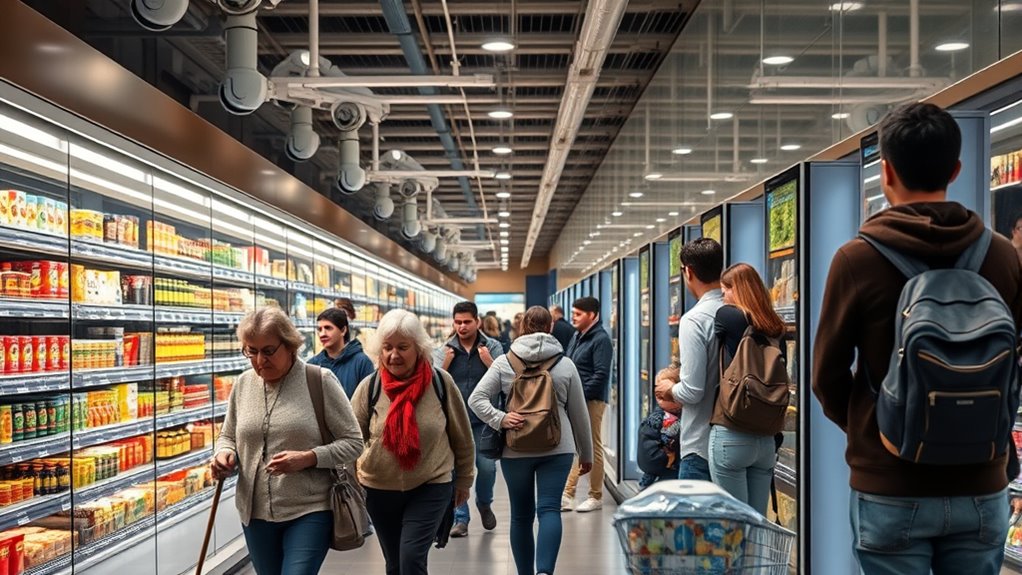

In an automated shopping world, your role is vital in creating personalized experiences that machines alone can’t achieve. You help build detailed consumer profiles by blending online and offline insights and use tools like loyalty apps and facial recognition to tailor services. Human associates handle complex issues and provide authentic interactions that AI can’t fully replicate. If you want to discover how your role continues evolving in this high-tech landscape, keep exploring the possibilities.
Key Takeaways
- Humans build and analyze consumer profiles to enable personalized shopping experiences and targeted marketing efforts.
- In-store staff use AI tools for real-time recommendations and customer support, enhancing automation with human expertise.
- Human employees resolve complex issues and provide authentic service that automation cannot fully replicate.
- Retailers leverage human insights to design seamless omnichannel strategies that integrate online and offline experiences.
- Shopper preferences for personalized, frictionless experiences ensure humans remain vital in creating trust and satisfaction.

As automated shopping continues to expand worldwide, it reshapes how consumers and retailers interact. You’re living in a time when global ecommerce sales are projected to hit $6.9 trillion by 2025, making up nearly a quarter of all retail transactions. This growth means more people like you are shopping online, with the number expected to reach 2.77 billion worldwide. In the U.S. alone, about 285 million people will be shopping digitally by that time, with mobile commerce generating over $700 billion. The trend of digital adoption continues to accelerate, driven by economic recovery and the convenience of online options. Still, despite these advancements, cart abandonment remains high at over 70%, often caused by extra costs or forced account creation—highlighting ongoing friction points that retailers need to address to keep you engaged.
While automation transforms the shopping experience, humans still play an essential role. Retailers rely on staff to build a complete view of your preferences by combining online and offline behaviors through loyalty apps and facial recognition technology. These insights allow them to craft more personalized offers tailored to your habits. In stores, employees use AI-powered tools that analyze your browsing history, purchase patterns, and location to provide real-time recommendations, making your shopping more efficient and engaging. When complex issues arise, human associates step in to resolve problems that AI can’t handle, ensuring you receive personalized service that feels genuine. Retail professionals also design loyalty programs and omnichannel strategies that blend automated systems with personal touchpoints, creating a seamless experience whether you’re shopping online or in-store. Additionally, some hotels offer water parks and amenities that enhance family vacation experiences, which can drive interest in shopping while traveling.
Automated shopping technologies are advancing rapidly, with AI-enabled systems expected to reach $8.65 billion in adoption by 2025. Nearly 90% of retailers are already testing or using AI tools, which speed up your purchase process—checkouts are up to 47% faster when you interact with AI assistants. Conversational chatbots improve your shopping experience by offering tailored product suggestions and instant support, often leading to four times higher conversion rates and a 25% increase in your repeat spending. Autonomous stores, like Amazon Go, use computer vision and sensors to let you walk in, pick up what you want, and leave without stopping at a cashier. Meanwhile, generative AI automates workflows such as demand forecasting and inventory management, ensuring products are available when you need them. The integration of these AI systems is also contributing to a more sustainable retail environment by optimizing inventory and reducing waste.
Your expectations as a shopper are evolving—speed, convenience, and transparency are non-negotiable. You prefer mobile-first interfaces, guest checkout options, and frictionless payments that make shopping quick and easy. As a member of Gen Z, about a quarter of the global population, your influence pushes trends toward social commerce and seamless automation. You want a personalized, AI-driven shopping experience that anticipates your needs before you even voice them, blending the best of technology with human touchpoints. While automation handles much of the process, human roles remain essential in delivering authentic service, resolving complex issues, and designing experiences that keep you connected and satisfied in a world increasingly driven by machines.
AI-powered shopping assistant devices
As an affiliate, we earn on qualifying purchases.
As an affiliate, we earn on qualifying purchases.
Frequently Asked Questions
How Will Automation Impact Employment Opportunities in Retail?
Automation will markedly reduce retail jobs, especially for cashiers, bank tellers, and customer service agents, leading to job losses and fewer opportunities in these roles. However, it also creates new jobs in tech, data analysis, and AI maintenance. To stay competitive, you’ll need to reskill and adapt, focusing on skills that machines can’t easily replicate, like complex problem-solving and interpersonal communication.
What Skills Will Be Most Valuable in Automated Shopping Environments?
In an automated shopping world, your most valuable skills will be your human touch and digital fluency. You’ll excel by mastering AI basics, interpreting real-time data, and troubleshooting systems. Equally important are your emotional intelligence, active listening, and personalized service, which machines can’t replicate. By adapting quickly and embracing continuous learning, you’ll stay ahead, turning technological advances into opportunities for strategic growth and meaningful customer connections.
How Can Small Businesses Compete With Large Automated Retailers?
You can compete with large automated retailers by focusing on personalized customer service, leveraging your local connections, and offering niche products or expertise they can’t easily replicate. Use automation tools to improve efficiency, but emphasize human creativity and problem-solving to create a unique shopping experience. Building strong community relationships and tailoring omnichannel strategies allows you to stand out and foster customer loyalty that big players can’t easily match.
What Ethical Considerations Arise With Automated Shopping Technologies?
You need to address ethical considerations like protecting consumer privacy by being transparent about data collection and usage. Avoid bias in your AI algorithms to ensure fair, inclusive recommendations. Consider the moral impact on users, encouraging responsible interactions. Prioritize transparency and continuous monitoring of your AI systems to build trust and prevent misuse. By doing so, you uphold ethical standards and foster a trustworthy relationship with your customers.
How Will Customer Service Needs Evolve With Automation in Shopping?
You’ll see customer service become more personalized and efficient as automation handles routine tasks, freeing agents for complex issues. Expect faster responses, proactive support, and tailored experiences driven by AI analytics. While automation manages simple inquiries, your need for empathy and nuanced interactions remains essential. Human agents will focus on high-stakes or emotional concerns, ensuring that personalized, compassionate service continues to meet your expectations in an increasingly automated shopping environment.
Conclusion
As automated shopping becomes more common, you might wonder where you fit in. Remember, despite tech advances, a recent study shows 70% of shoppers still value human interaction for personalized service. So, your unique perspective and social skills remain essential. Embrace technology, but don’t underestimate the power of a friendly face or expert advice. You’ll always have a place in this evolving landscape—your human touch is more important than ever.