
📊 Full opportunity report: Preliminary Hardware Design: The Future Of AI Innovation on ThorstenMeyerAI.com — validation score, market gap, and execution plan.

Get tech for your team delivered free — and shop member deals
- Fast, free delivery on millions of items
- Access to Prime Big Deal Days deals on October 6–7
- Prime Video, Amazon Music and more included
TL;DR
New hardware designs focused on AI inference are emerging, emphasizing thermal efficiency, memory interconnects, and specialization. These developments aim to meet the growing demand for scalable, efficient AI deployment. The future of AI hardware is being redefined from the ground up.
Hardware design for AI inference is entering a new phase, with innovations focused on thermal efficiency, memory interconnects, and workload specialization. These advances aim to meet the increasing demand for scalable, efficient AI deployment, marking a significant shift from traditional general-purpose chips.
Recent industry insights reveal that current AI hardware, primarily GPUs, was originally designed for a workload that no longer dominates AI. Instead, inference—serving models to users at scale—has become the primary driver of compute demand. This shift is prompting a reevaluation of hardware architecture, emphasizing throughput, energy efficiency, and scalability.
Key physics levers include thermal management, memory interconnects, and workload specialization. Experts note that current GPUs operate at limited utilization rates due to heat constraints, and future chips will need to run at lower voltages to improve efficiency without overheating. Additionally, the bottleneck in large-scale inference is the latency between chips, not just bandwidth, leading to a focus on creating unified memory pools that span thousands of chips. Specialization involves designing chips tailored to specific inference tasks, breaking away from the general-purpose approach that has dominated the industry.
Almost every chip serving AI today was architected for a world that no longer exists — training-dominant, general-purpose, conceived before the transformer became the only architecture that mattered. The next decade rebuilds silicon around inference at civilizational scale.
Strip away the hype and the gains in purpose-built inference silicon come from exactly three places. Each tells you where the roadmap goes.
Prefill and decode have opposite hardware appetites. Running both on one undifferentiated chip satisfies neither. The answer is disaggregation — a pipeline of specialized chips, each doing the part it was born for.
Today we make tokens the way the Renaissance made screws — one at a time, by hand, on general-purpose machines. The endpoint is fab-like: cost per token falls as the facility grows.
Capital believes the workload is specializing. But the physics bet and the adoption bet are not the same bet.
- Merchant inference ASICs arriving with working silicon, $1B+ in contracts, gigawatt-scale roadmaps
- Groq’s inference tech absorbed into NVIDIA (~$20B)
- Cerebras public at large valuations; custom-chip shipments projected to outgrow GPUs
- Architecture lock-in: a transformer ASIC is obsolete the day a post-transformer design wins. The GPU’s inefficiency is its insurance.
- No independent benchmarks yet — the numbers are vendor-claimed.
- NVIDIA’s moat is software. A proprietary toolchain asks customers to abandon what they know.
If token production becomes a majority of output, and national capacity is measured in agents per gigawatt, the token supply chain becomes the most strategic chokepoint on Earth.
This is the strongest argument I know for the local-first, open-weight posture: keep meaningful capability distributed — models you can run yourself, on hardware you own, close enough to the frontier to matter. Scale pulls one way; sovereignty and resilience pull the other. Both futures get built at once.
It’s who owns the factories when it does, and whether the answer is “many.”
Transforming AI Hardware for Scalability and Efficiency
These hardware innovations are critical because they directly address the limitations of current AI infrastructure, enabling models to serve hundreds of millions of users and agents simultaneously. Improved thermal management and memory interconnects will allow larger, more complex models to run efficiently at scale, reducing costs and energy consumption. Specialization could lead to hardware that is orders of magnitude more efficient for specific AI workloads, fundamentally changing the economics and accessibility of AI deployment.
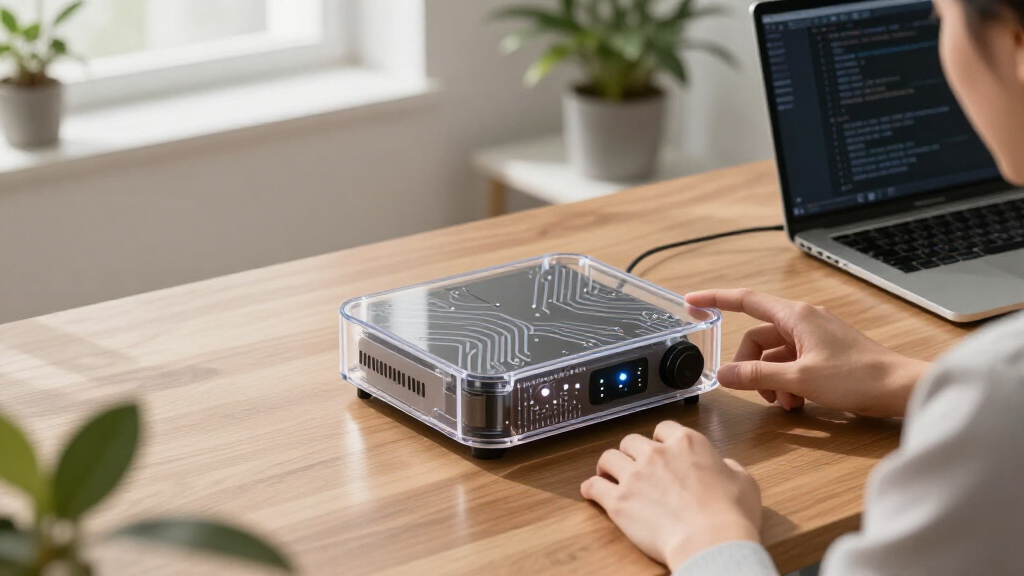
AI inference hardware accelerators
As an affiliate, we earn on qualifying purchases.
As an affiliate, we earn on qualifying purchases.
Industry Shift Toward Workload-Specific AI Hardware
Until now, AI hardware has largely relied on general-purpose GPUs, designed for a broad range of computing tasks. As AI inference demand grows exponentially—driven by user and agent scaling—the industry is recognizing that these chips are no longer optimal. Recent discussions and prototypes indicate a move toward specialized hardware that can better handle the unique physics and workload characteristics of inference, marking a pivotal transition in AI hardware development.
"The current silicon was never designed for the workload it now serves; a fundamental redesign is underway, focusing on thermal efficiency, memory interconnects, and workload specialization."
— Thorsten Meyer
Unanswered Questions About the Hardware Transition
It is still unclear how quickly industry adoption of specialized hardware will accelerate, and whether new designs will outperform existing GPUs in real-world deployments. Details about specific chip architectures, manufacturing timelines, and cost implications remain under development. The extent to which these innovations will be adopted at scale is also uncertain, as existing infrastructure and software ecosystems may pose challenges.
Next Steps for Industry Adoption and Development
Industry players are expected to release prototypes and early hardware based on these principles in 2024. Standardization efforts and ecosystem development will follow, influencing how quickly these designs can replace or complement existing GPU-based infrastructure. Monitoring industry announcements and pilot deployments will be key to understanding the pace and impact of this hardware evolution.
Key Questions
What are the main advantages of new AI inference hardware?
The primary benefits include improved thermal efficiency, reduced latency between chips through advanced memory interconnects, and workload-specific optimization, leading to higher throughput, lower costs, and better energy efficiency.
When can we expect these new hardware designs to be commercially available?
Prototypes and early implementations are anticipated in 2024, with broader industry adoption potentially occurring over the next few years depending on performance, cost, and ecosystem support.
How will specialization impact existing AI infrastructure?
Specialized chips tailored for inference workloads could significantly outperform general-purpose GPUs, but integrating them into current systems may require substantial software and hardware adjustments.
Will this shift affect AI model development or only deployment?
The focus is mainly on inference deployment at scale, but improvements in hardware could also influence model design by enabling larger, more complex models to be efficiently served.
What are the main physics challenges in developing these new chips?
Key challenges include achieving low-voltage operation to improve thermal performance and designing memory interconnects that minimize latency across thousands of chips.
Source: ThorstenMeyerAI.com
Halloween Picks
halloween
As an affiliate, we earn on qualifying purchases.