📊 Full opportunity report: OpenStreetMap Contributions, Simplified: The StreetComplete Approach on IdeaNavigator AI — validation score, market gap, and execution plan.

Get business pricing on tech for your team
- Business-only prices and quantity discounts
- Tax-exempt purchasing
- Multiple users, one account, clear invoices
TL;DR
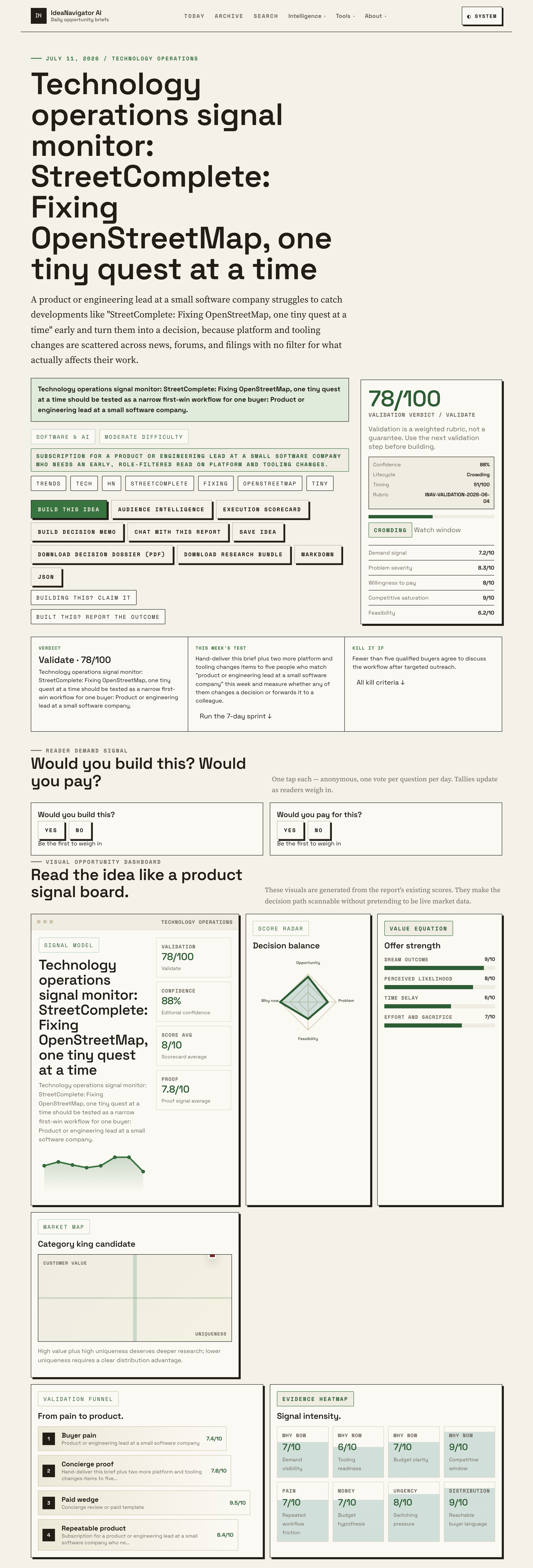
StreetComplete, an open-source mobile app that turns OpenStreetMap contributions into small, guided “quests,” gained renewed attention after surfacing on Hacker News with an 88/100 signal score tracked by IdeaNavigator AI. The app lets users improve map data by answering simple, targeted questions — no full map editing required — offering a model of low-friction crowdsourcing that small engineering teams are watching closely.
The open-source Android app StreetComplete, which lets volunteers improve OpenStreetMap by completing small, guided “quests” rather than editing the map directly, drew renewed attention this week after a discussion titled “StreetComplete: Fixing OpenStreetMap, one tiny quest at a time” surfaced on Hacker News with a high visibility score. IdeaNavigator AI, a signal-monitoring service, rated the item at 88/100, flagging it as a development relevant to product and engineering leads evaluating low-friction contribution workflows.
StreetComplete, maintained as a free and open-source project, is built around a simple premise: instead of asking contributors to learn OpenStreetMap’s full editing tools, the app presents users with localized questions about their surroundings — for example, whether a shop has a wheelchair-accessible entrance, what the surface of a road is, or what the opening hours of a restaurant are. Each answer is submitted directly to OpenStreetMap, updating the underlying map data without the user ever opening a traditional editor.
This approach, often described as micro-contribution, lowers the barrier to participation in what is otherwise a technically demanding crowdsourcing project. OpenStreetMap, the collaborative world map used by platforms including Amazon, Meta, and Microsoft for basemap data, depends entirely on volunteer contributions, and data quality varies widely between regions. Tools like StreetComplete are designed to close those gaps by targeting well-defined, answerable questions at specific locations.
According to IdeaNavigator AI’s monitoring brief, the Hacker News discussion carried an 88/100 signal score, indicating unusually strong engagement relative to typical platform and tooling items in its feed. The service tracks such items specifically for small software companies that need to spot tooling developments early and translate them into decisions, and it identified this discussion as a candidate “narrow first-win workflow” for product or engineering leads testing lightweight monitoring setups.
Why Micro-Contribution Models Matter
The renewed attention to StreetComplete points to a broader pattern that product teams can learn from: reducing contribution friction can dramatically expand participation in crowdsourced systems. Where OpenStreetMap’s traditional editors require users to understand tagging schemes, geometry editing, and community guidelines, StreetComplete reduces each contribution to a single question with a few taps — a design choice that broadens the pool of potential contributors to casual users walking through their neighborhoods.
For engineering and product leads, the relevance is twofold. First, the model demonstrates how task decomposition — breaking a complex workflow into tiny, context-specific units — can be applied to internal tools, data-quality initiatives, and community-driven products. Second, as IdeaNavigator AI’s brief notes, the way this item surfaced (organically on Hacker News, with high engagement) illustrates why role-filtered monitoring of developer communities is increasingly treated as an early-warning input for small teams that cannot afford broad, slow research cycles.
There is also a direct data dimension: improved OpenStreetMap coverage benefits any company that builds on open geodata, from logistics routing to local search features, since fresher attributes like accessibility tags and opening hours flow downstream into dependent applications.
Top picks for "openstreetmap contribution simplifi"
As an affiliate, we earn on qualifying purchases.
How StreetComplete Reached This Point
: “OpenStreetMap has operated since 2004 as a collaborative project to build a free, editable map of the world. Its standard editing tools, while powerful, have historically required training, which has concentrated contributions among a relatively small base of experienced mappers. Mobile-first survey tools emerged as one answer to that imbalance.
StreetComplete has been developed over several years as an open-source project, and its “quest” mechanic has become its defining feature: the app detects nearby map objects with missing or outdated attributes and generates appropriate questions. Contributions are versioned and attributed in OpenStreetMap like any other edit, preserving auditability. The project’s visibility on Hacker News — a community where developer-tooling discussions routinely shape adoption — has repeatedly brought waves of new contributors, according to community discussions over the app’s lifetime.
IdeaNavigator AI’s interest in the item reflects a parallel trend: services that monitor developer and platform feeds, score their relevance, and deliver role-specific briefs. The company’s validation plan for this signal includes hand-delivering briefs on this and similar items to a small group of product and engineering leads to test whether such monitoring changes real decisions.
“StreetComplete: Fixing OpenStreetMap, one tiny quest at a time”
— Hacker News discussion title
What the Signal Does Not Tell Us
Several things remain unclear. The 88/100 signal score is a proprietary measure from IdeaNavigator AI; the methodology behind the score and what baseline it compares against have not been independently verified, so it should be read as a single service’s assessment of Hacker News engagement rather than an objective ranking.
It is also not yet clear whether the current attention will translate into a lasting increase in StreetComplete contributions or OpenStreetMap data quality in specific regions. Past Hacker News waves have driven temporary download spikes, but sustained contribution effects are harder to measure and have not been quantified in the available material. Finally, IdeaNavigator AI’s validation plan — testing whether its briefs change decisions for five targeted leads — is described as a proposal, not a completed study, and its results are not yet available.
Watching the Micro-Contribution Trend
For teams tracking this space, the near-term developments to watch include: whether StreetComplete’s maintainers report measurable contributor or data-quality gains following the current attention cycle; whether similar quest-style contribution patterns appear in other open-data projects; and what comes of IdeaNavigator AI’s validation exercise, which is scheduled to run this week with a handful of matched product and engineering leads.
Readers who want to act on the model directly can evaluate StreetComplete itself — it is free and open source on Android — or pilot an internal “micro-task” decomposition of a data-quality workflow. IdeaNavigator AI’s suggested first step for small teams is deliberately narrow: treat this single item as a test case for whether same-day, role-filtered monitoring of developer feeds earns its keep.
Source: IdeaNavigator AI
Key Questions
What is StreetComplete?
StreetComplete is a free, open-source Android app that lets users contribute to OpenStreetMap by answering simple, location-specific questions — called quests — such as a shop’s opening hours or whether a path is paved. Answers are submitted directly as map edits without using a full editor.
Why did StreetComplete attract attention now?
A discussion titled “StreetComplete: Fixing OpenStreetMap, one tiny quest at a time” surfaced on Hacker News, and IdeaNavigator AI rated the item 88/100 on its signal scale, flagging it as highly relevant to product and engineering leads at small software companies.
What is the 88/100 signal score?
It is a proprietary visibility and relevance score assigned by IdeaNavigator AI, a monitoring service. The exact methodology has not been independently verified, so the score reflects that service’s assessment of Hacker News engagement rather than an objective measure.
Why would a small software company care about this?
Two reasons: the app demonstrates a low-friction contribution model — decomposing complex tasks into tiny, guided units — that can be applied to internal tools and data-quality work, and improved OpenStreetMap data benefits any product built on open geodata.
Is StreetComplete new?
No. It is an established open-source project that has been developed over several years. What is new is the current wave of visibility following its high-signal surfacing on Hacker News.
Source: IdeaNavigator AI
Fall Picks
fall essentials
As an affiliate, we earn on qualifying purchases.