📊 Full opportunity report: Auto Signal Monitor Tracks The EU's Driver Monitoring Camera Requirement on IdeaNavigator AI — validation score, market gap, and execution plan.

Get business pricing on tech for your team
- Business-only prices and quantity discounts
- Tax-exempt purchasing
- Multiple users, one account, clear invoices
TL;DR
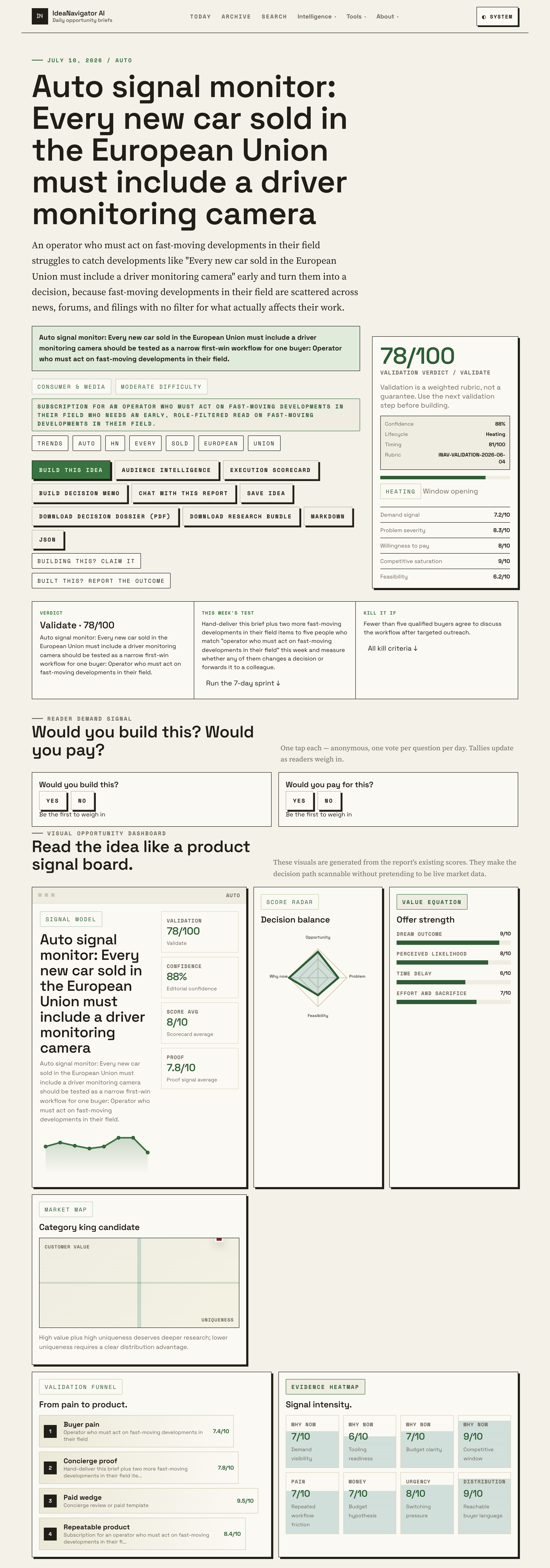
IdeaNavigator AI proposes a focused monitoring service for automotive operators and uses an EU driver monitoring camera requirement as an example. Its material does not identify a law, effective date or official document confirming that every new car sold in the EU must have a camera.
IdeaNavigator AI has proposed a monitoring service that would flag fast-moving automotive developments for industry operators, using the statement that every new car sold in the European Union must include a driver monitoring camera as an example. The material does not cite an EU law or regulatory notice establishing that requirement, so its legal status and scope are unconfirmed.
The proposed service would watch Hacker News and similar feeds, filter stories for their relevance to an operator’s work, and turn selected items into short briefs explaining what changed, why it matters and what action may be needed. The stated problem is that developments are spread across news, forums and filings, making it difficult for professionals to identify relevant changes quickly.
IdeaNavigator AI says Hacker News surfaced the camera claim with an 88/100 signal. It does not explain how that score is calculated, what period it covers or what comparison baseline applies. The figure is therefore a reported signal score, not evidence of the rule’s legal status or of a measured rise in attention.
The suggested initial test is to deliver the brief and two other industry developments to five automotive operators in one week, then track whether any recipient changes a decision or forwards an item to a colleague. The proposal identifies a subscription for operators as the potential business model, but reports no completed interviews, customer commitments, revenue or test results.
A Timely Read for Auto Operators
For people making decisions in the automotive sector, a clear and timely account of regulatory changes can affect vehicle design, supplier planning and compliance work. A monitoring service that separates relevant developments from general industry discussion could help teams decide what merits review, particularly when information appears across several channels.
The practical value depends on the accuracy of both the alert and its interpretation. In this example, the stated camera requirement is not accompanied by a legal reference, so an operator could not rely on the brief alone to determine what vehicles, systems or dates are covered. A useful service would need to link claims to official regulations or regulator communications, distinguish proposals from binding requirements and flag missing evidence.
From Signal Score to Pilot
The proposal frames the idea as a narrow first test for people who need to act on fast-moving developments in their field. Rather than build a broad industry news product at once, the suggested minimum version would monitor selected feeds and produce a short, role-specific account of relevant items.
The claimed camera requirement supplies the example around which the product concept is presented. However, the material gives no regulation number, adoption date, commencement date, vehicle category or link to an EU institution. It also does not establish whether the wording describes a camera specifically, a broader driver monitoring system, or a claim circulating in a discussion forum. Those distinctions matter when assessing a regulatory obligation.
The proposed one-week exercise is a validation plan, not a report of a trial already completed. Its stated measures—whether recipients change a decision or forward a brief—would offer an early indication of practical usefulness, but five responses would not establish broad demand across the automotive market.
The Camera Rule Needs Verification
No legal citation is provided for the assertion that every new car sold in the EU must include a driver monitoring camera. The supplied material does not name an EU act, identify an issuing authority, give a date or explain which vehicles and technologies would be covered. It is not possible from these details to establish whether the statement refers to a binding requirement, a proposed measure or an informal description.
The product concept is also at an early proposal stage. There are no reported pilot findings, customer responses, demonstrated effects on decisions or subscription figures. The calculation behind the 88/100 score remains unexplained, including its time window and baseline. These gaps limit what can be concluded about both the regulatory example and the market opportunity.
Pilot Results and Legal Detail
The next proposed step is to prepare this brief alongside two other automotive developments and deliver all three to five people matching the intended operator profile within a week. The test would record whether recipients change a decision or pass an item to a colleague. No pilot start date or results are reported.
Separately, the camera claim would need to be checked against an identifiable EU legal text or official regulatory notice before it could be presented as an established requirement. Until such evidence is supplied, its scope and timing remain unclear.
Source: IdeaNavigator AI
Key Questions
Has the EU camera requirement been confirmed?
Not by the material provided. It states that every new car sold in the EU must include a driver monitoring camera but supplies no law, official notice or effective date.
What would the proposed monitor do?
It would scan Hacker News and similar feeds, select developments relevant to automotive operators, and produce briefings on what changed, why it matters and possible next steps.
What does the 88/100 score mean?
IdeaNavigator AI reports it as a signal score for the Hacker News item. The scoring method, time window and comparison baseline are not given.
Has the service been tested with customers?
No completed test is reported. The proposal suggests delivering three briefs to five automotive operators in one week and tracking whether they affect decisions or are shared.
Source: IdeaNavigator AI
Fall Picks
fall essentials
As an affiliate, we earn on qualifying purchases.