
📊 Full opportunity report: GLP-1 Price And Stock Data Across US Pharmacy Channels on IdeaNavigator AI — validation score, market gap, and execution plan.

Get business pricing on tech for your team
- Business-only prices and quantity discounts
- Tax-exempt purchasing
- Multiple users, one account, clear invoices
TL;DR
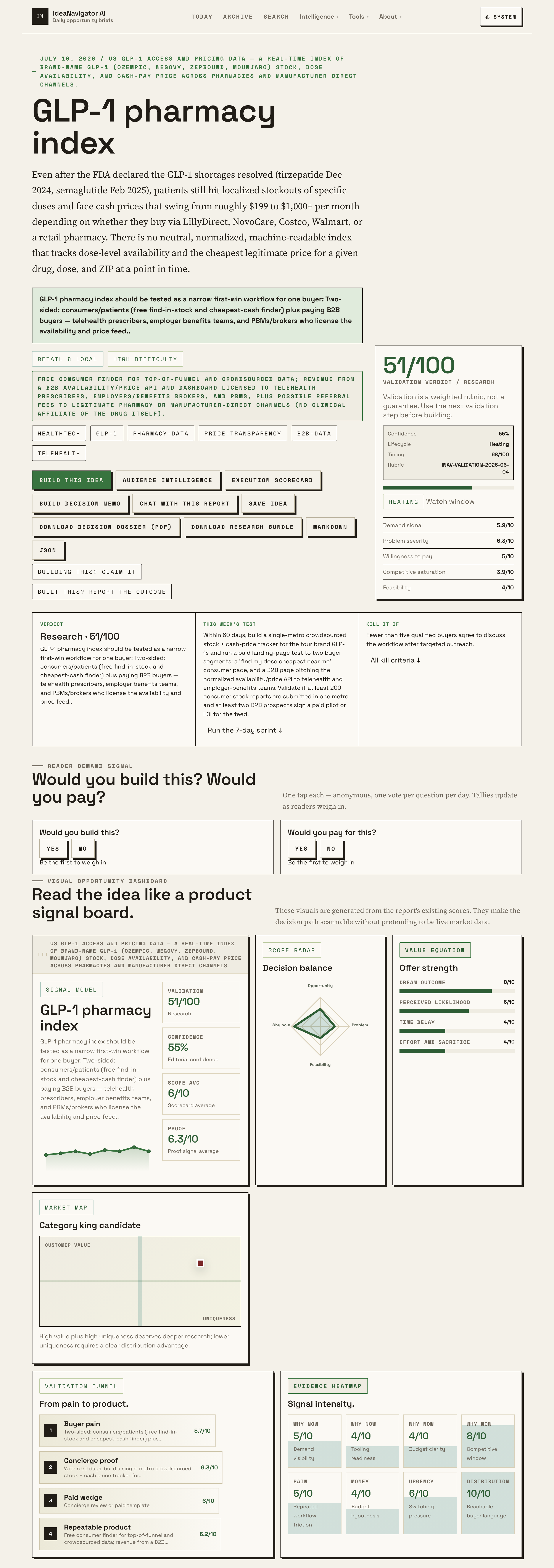
An analysis by IdeaNavigator AI identifies a gap in the US GLP-1 market: no neutral, machine-readable index tracks dose-level availability and cheapest cash prices for Ozempic, Wegovy, Zepbound and Mounjaro. Cash prices swing from roughly $199 to more than $1,000 per month depending on channel, and employers report GLP-1s are about 20% of pharmacy spend.
A new analysis from IdeaNavigator AI argues that the US GLP-1 market has shifted from a shortage problem to a fragmentation problem: even after the FDA declared shortages of tirzepatide (December 2024) and semaglutide (February 2025) resolved, patients still face localized stockouts of specific doses and monthly cash prices ranging from roughly $199 to more than $1,000 depending on where they buy — LillyDirect, NovoCare, Costco, Walmart, or a retail pharmacy. The analysis proposes a neutral, normalized GLP-1 pharmacy index tracking dose-level availability and the cheapest legitimate price by drug, dose, and ZIP code, a dataset that currently does not exist in machine-readable form.
According to the analysis, the four brand GLP-1s at the center of the proposed index are Ozempic, Wegovy, Zepbound, and Mounjaro. The proposed consumer-facing product would be a free web tool allowing patients to find which doses are in stock nearby and identify the cheapest cash price for their prescription. The data layer would combine crowdsourced stock reports with normalized public pricing from manufacturer direct channels (LillyDirect and NovoCare), Costco and Walmart cash programs, and a GoodRx-style price comparison layer.
The commercial model is two-sided. The consumer finder would remain free, serving as top-of-funnel traffic and a source of crowdsourced availability data. Revenue would come from a B2B API and dashboard licensed to telehealth prescribers, employer benefits teams, and PBMs or brokers who need normalized availability and price data. The analysis also floats possible referral fees to legitimate pharmacy or manufacturer-direct channels, while stating the index would carry no clinical affiliation with any drugmaker.
The proposed validation plan is deliberately narrow: within 60 days, build a single-metro crowdsourced stock and cash-price tracker for the four drugs, then run a paid landing-page test targeting both a consumer page (‘find my dose cheapest near me’) and a B2B page pitching the API to telehealth and employer-benefits buyers. The thresholds for proceeding: at least 200 consumer stock reports submitted in one metro, and at least two B2B prospects signing a paid pilot or letter of intent for the feed.
Why Fragmented GLP-1 Pricing Hits Employers
The core of the analysis is a purchasing-power asymmetry. Patients navigating GLP-1 access must currently check multiple channels manually — LillyDirect, NovoCare, Costco, Walmart, retail pharmacies, and, as of February 2026, the TrumpRx portal — with no single source normalizing price and dose availability. A price spread from roughly $199 to more than $1,000 per month means the difference between channels can exceed $9,000 per year for a single patient paying cash.
The employer side is where the analysis sees the clearest demand signal. Employers report GLP-1s account for roughly 20% of pharmacy spend, according to the analysis, creating a need for cost-steering data that tells benefits teams where a covered population can actually fill a specific dose at the lowest price. The analysis positions the B2B feed — not the consumer tool — as the revenue engine, with the consumer finder primarily functioning to generate crowdsourced availability data no licensed dataset currently provides at dose level.
From Shortage Era to Channel Sprawl
The GLP-1 supply landscape changed in two steps. First, the FDA removed tirzepatide from its shortage list in December 2024 and semaglutide in February 2025, ending the period during which compounded versions of the drugs were permitted. Compounding deadlines then forced compounders out of the market, according to the analysis, removing a cheaper gray-market supply channel.
Second, manufacturers and retailers simultaneously launched competing direct cash-pay channels — LillyDirect and NovoCare among them, joined by Costco and Walmart cash programs and the TrumpRx portal in February 2026. The result, per the analysis, is a ‘sprawl of prices and dose-level supply gaps that no single source normalizes.’ Localized stockouts of specific doses persist despite the formal end of shortages, because resolution of an FDA shortage designation does not guarantee uniform distribution of every dose strength at every pharmacy.
Unverified Numbers and Validation Risks
Several figures in the analysis carry caveats. The $199-to-$1,000+ price range is presented as an approximate span of cash prices across channels, not a like-for-like comparison of a single drug and dose; the analysis does not publish an underlying price dataset. The 20% employer pharmacy-spend figure is attributed to employer reports without a named survey or sample, and the referenced TrumpRx portal launch in February 2026 could not be independently confirmed from the analysis itself.
Demand is also unproven by design. The 60-day validation plan — 200 consumer stock reports in one metro and two signed B2B pilots — has not been run, so both sides of the marketplace remain hypothetical. It is not yet clear whether crowdsourced stock reports can reach the density or accuracy needed to compete with commercial availability data, nor whether telehealth prescribers or PBMs would license a third-party feed rather than build or buy equivalents. Whether patients will reliably report stock data for a free tool, and how quickly manufacturer cash prices change, are also open questions that would affect data freshness.
The 60-Day Metro Pilot Test
If the proposal proceeds, the immediate next step is the single-metro pilot: a crowdsourced stock and cash-price tracker for the four brand GLP-1s, paired with paid landing pages targeting consumers and B2B buyers. The decision point comes at the 60-day mark, when the two thresholds — 200 consumer stock reports and two signed B2B pilots or letters of intent — would either validate or kill the concept.
For the broader market, the developments to watch are whether any existing player (GoodRx, a PBM, or a manufacturer direct channel) builds an equivalent normalized index first; whether GLP-1 list prices or cash programs shift materially in 2026; and whether employer pressure over pharmacy spend pushes more benefits teams to seek dose-level price and availability data of the kind the proposed index would supply.
Source: IdeaNavigator AI
Key Questions
Which GLP-1 drugs would the proposed index cover?
The four brand-name GLP-1s: Ozempic and Wegovy (semaglutide, Novo Nordisk) and Zepbound and Mounjaro (tirzepatide, Eli Lilly), tracked by drug, dose, and ZIP code.
Why do GLP-1 cash prices vary so much between pharmacies?
According to the analysis, manufacturers and retailers launched competing direct cash-pay channels — LillyDirect, NovoCare, Costco and Walmart programs, and the TrumpRx portal — each setting its own price. With no neutral index, patients must compare manually, and prices reportedly range from roughly $199 to over $1,000 per month.
Are GLP-1 shortages still a problem after the FDA resolutions?
The FDA declared the tirzepatide shortage resolved in December 2024 and the semaglutide shortage in February 2025. However, the analysis reports that localized stockouts of specific doses persist, since national shortage resolution does not guarantee every dose is available at every pharmacy.
How would the index make money if the consumer tool is free?
Revenue would come from licensing a B2B availability and price API to telehealth prescribers, employer benefits teams, and PBMs or brokers, plus possible referral fees to legitimate pharmacy channels. The free consumer finder mainly generates crowdsourced data and traffic.
What would prove the concept works?
The proposed validation thresholds: at least 200 consumer stock reports submitted in a single metro and at least two B2B prospects signing a paid pilot or letter of intent, both within 60 days.
Source: IdeaNavigator AI
Fall Picks
fall essentials
As an affiliate, we earn on qualifying purchases.