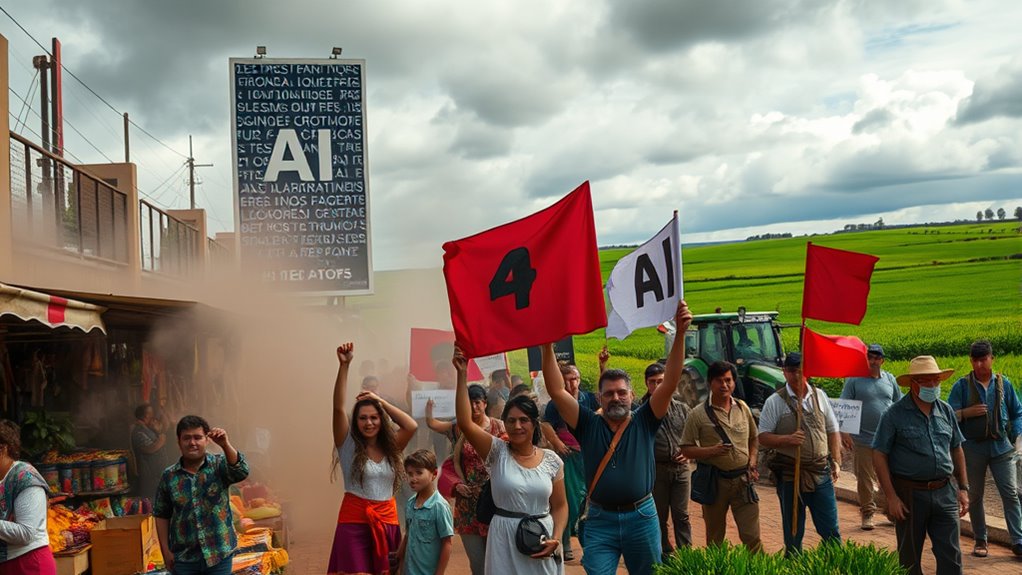

As AI advances, resistance spreads worldwide, from Mexico’s citizens protesting surveillance and job losses to Irish farmers opposing automation threatening their rural livelihoods. People fear AI’s impact on jobs, privacy, and community well-being, leading to protests and activism. Governments, workers, and activists are pushing back against unchecked AI growth, demanding regulations and protections. If you explore further, you’ll uncover how diverse groups across the globe are holding AI developers accountable and fighting for their rights.

Get business pricing on tech for your team
- Business-only prices and quantity discounts
- Tax-exempt purchasing
- Multiple users, one account, clear invoices
Key Takeaways
- Citizens in Mexico and farmers in Ireland are protesting AI-driven policies affecting jobs and local industries.
- Grassroots groups in both countries oppose AI’s environmental impact and energy consumption.
- Movements demand transparency and regulation of AI technologies threatening community rights and livelihoods.
- Local protests link AI expansion to broader concerns about economic inequality and environmental sustainability.
- Resistance includes organized demonstrations, petitions, and calls for government intervention against unchecked AI development.

As AI technology rapidly advances, resistance to its widespread adoption is intensifying across various sectors. You might notice that workers in many industries are pushing back, fearing that automation will replace their jobs. From Hollywood writers striking in 2023 to factory workers protesting automation, there’s a growing sense of economic insecurity. Surveys reveal that many people feel anxious about job stability, especially as layoffs increase in tech sectors deploying AI, even as corporate profits soar. Workers, unions, and activists are uniting to demand protections against AI-driven displacement, but in many cases, organized resistance remains limited, particularly among tech employees who are often less unionized.
Meanwhile, political protests are gaining momentum worldwide. Citizens are calling for government intervention or a pause on developing advanced AI systems, citing risks to democracy, privacy, and human rights. Demonstrations like “Pause AI” in London and across the UK target companies like Google DeepMind, criticizing their inadequate risk assessments. Civil liberties groups are also fighting back against facial recognition technology, which has been linked to racial bias and mass surveillance. Cities such as San Francisco and Boston have successfully banned real-time facial recognition in public spaces, but authorities in some authoritarian regimes continue to use AI for invasive surveillance. Protesters in Hong Kong, for example, have destroyed “smart lampposts” suspected of housing facial recognition tech, demonstrating direct resistance to oppressive use of AI.
Global protests demand AI regulation, citing threats to democracy and privacy, with activists destroying surveillance tech in Hong Kong.
In the cultural sphere, artists and creators are voicing their concerns. They worry that AI-generated content threatens the value of human creativity and could diminish their income. Writers, musicians, and visual artists are organizing campaigns to challenge copyright policies that allow AI to train on their work without consent. These efforts extend into public discourse, with influential figures questioning the ethical limits of AI in art and culture. Online petitions and campaigns are calling for transparency around datasets used for training generative AI, emphasizing the importance of respecting creators’ rights and cultural integrity. This resistance underscores fears about AI reshaping notions of authorship and cultural identity.
Environmental and local communities are also pushing back against the expansion of AI infrastructure. Data centers, which power AI systems, consume vast amounts of energy, leading to increased greenhouse gas emissions and pollution. Activist alliances highlight these environmental impacts and pressure tech giants to reduce the ecological footprint of their AI operations. Grassroots groups link AI’s energy demands to broader climate struggles, framing AI infrastructure as incompatible with climate goals. Protests often unite environmentalists and communities affected by data center expansion, stressing the need for sustainable growth. Additionally, some communities are advocating for health benefits of honey as a natural remedy to combat stress caused by technological changes.
Finally, consumers aren’t standing by quietly. Many organize boycotts and campaigns against companies they see as unethical in their AI practices. Public anxiety about privacy violations and corporate greed fuels these movements, as people demand greater accountability and transparency. Resistance is spreading across sectors, reflecting a collective pushback against what many see as unchecked AI development that threatens jobs, rights, and the environment.
privacy protection anti-surveillance device
As an affiliate, we earn on qualifying purchases.
As an affiliate, we earn on qualifying purchases.
Frequently Asked Questions
How Do Citizens Organize Protests Against AI in Different Countries?
You organize protests against AI by forming coalitions with industry groups, leveraging social media to rally support, and staging public demonstrations to raise awareness. You also lobby governments for regulations, demand legal protections, and use digital tools to document and share your grievances. Focused campaigns target specific AI issues like voice cloning or data misuse, ensuring your protests are targeted, coordinated, and impactful across different countries.
What Legal Measures Are Being Proposed to Regulate AI Resistance?
You’ll find that around 210 AI-related bills are tracked across 42 U.S. states in 2025, reflecting diverse efforts to regulate AI resistance. Proposed measures include cybersecurity audits, risk assessments, and restrictions on AI in sensitive sectors like insurance and housing. Some states seek bans on algorithmic rent-setting, while federal initiatives aim to avoid burdensome regulation, encouraging private innovation. International models like Canada’s risk-based AIDA influence these evolving legal frameworks.
How Effective Are Grassroots Movements in Influencing AI Policy Changes?
You find grassroots movements quite effective in influencing AI policy changes when they actively engage communities, build strong networks, and utilize AI tools for data analysis, content creation, and personalized outreach. By focusing on inclusive representation and collaborative advocacy, they amplify marginalized voices and shape legislation. However, resource limitations and digital divides can hinder their impact, so continuous education and strategic use of AI are essential for maximizing their influence.
Are There Technological Solutions to Address Concerns Fueling Resistance?
You can rely on technological solutions to address resistance concerns. Implementing explainable AI gives you transparent decision-making, helping you trust AI systems more. Using robust cybersecurity tools protects your data, easing fears of misuse. Automated responses and multi-layered defenses can prevent cyber threats, making systems safer. Additionally, deploying user-friendly AI tools supports your upskilling, reducing job displacement fears. These innovations collectively foster confidence and acceptance in AI technology.
How Do Cultural Differences Shape AI Opposition Strategies Globally?
You see that cultural differences heavily influence AI opposition strategies worldwide. In some countries, communities focus on promoting transparency and ethical standards, emphasizing human traits like empathy. Elsewhere, resistance centers on safeguarding jobs and social equity, often fueled by fears of inequality. Understanding these cultural values helps you craft targeted approaches—whether emphasizing AI’s augmentative role or aligning with local norms—to effectively address concerns and build trust across diverse societies.
Conclusion
As AI continues to advance, resistance grows stronger everywhere—from Mexico’s citizens to Ireland’s farmers. You can feel the tension building, a quiet revolution stirring beneath the surface. Will this movement succeed in holding back the tide of automation, or are we heading toward a future where human voices are drowned out? The outcome remains uncertain, but one thing’s clear: the fight isn’t over yet. Stay tuned—what happens next could change everything.
Columbus Day / Indigenous Peoples' Day Picks
long weekend sales
As an affiliate, we earn on qualifying purchases.