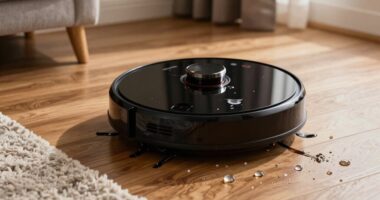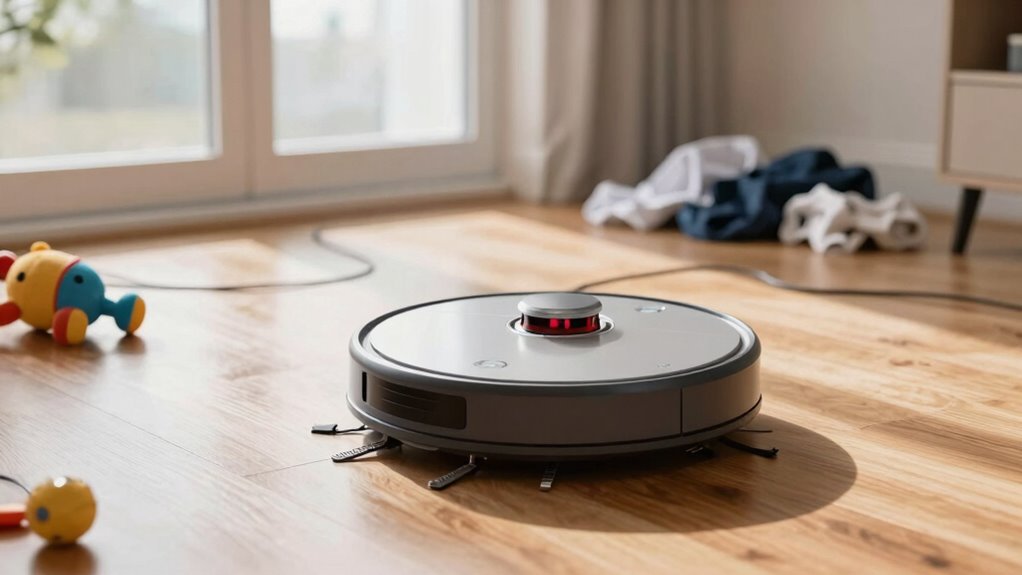

AI obstacle avoidance is transforming your daily cleaning by allowing robotic vacuums to navigate smoothly around your home with little to no input from you. They instantly detect and respond to obstacles like furniture, cords, or toys, preventing mishaps and missed spots. As these systems learn and adapt over time, they become more efficient, saving you effort and ensuring a cleaner space. If you want to discover how this technology can further improve your routines, keep exploring.

Get business pricing on tech for your team
- Business-only prices and quantity discounts
- Tax-exempt purchasing
- Multiple users, one account, clear invoices
Key Takeaways
- Robots efficiently navigate homes, reducing manual repositioning and ensuring thorough cleaning without bumping into furniture.
- Real-time obstacle detection prevents mishaps, minimizing interruptions and potential damage during cleaning sessions.
- Enhanced environmental adaptability allows robots to handle complex, cluttered spaces confidently, improving overall cleaning quality.
- Dynamic route optimization ensures complete coverage with fewer passes, saving time and increasing cleaning effectiveness.
- Continuous learning from each session refines navigation, leading to smarter, more autonomous cleaning routines over time.
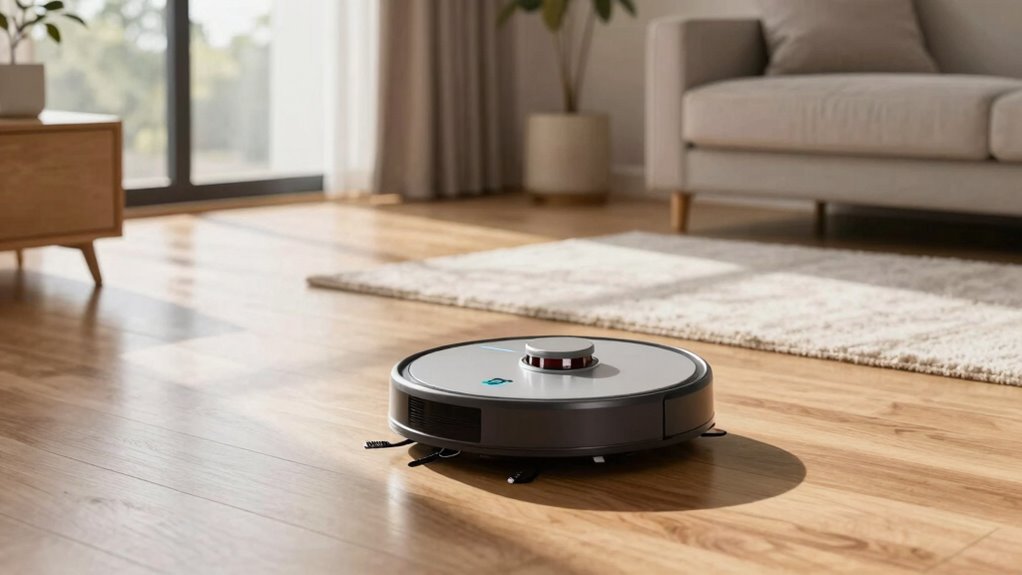
Artificial intelligence has revolutionized how we approach daily cleaning tasks, making them more efficient and hassle-free. One of the most significant advancements is in robot guidance, where AI-powered devices now move smoothly around your home, avoiding obstacles with impressive precision. Instead of manually guiding a vacuum or mop, you can set these robots to work autonomously, trusting that they’ll cover the entire area without getting stuck or causing damage. These robots use sophisticated sensors and algorithms to map out your space, ensuring they know exactly where they are and where they need to go. Thanks to continuous learning and updates, they adapt to changes in your environment, like new furniture or clutter, enhancing their guidance capabilities over time.
AI-powered robots intelligently navigate and adapt, making daily cleaning effortless and more efficient over time.
Obstacle detection plays an essential role in this transformation. These smart devices are equipped with sensors that detect objects in real-time, allowing them to recognize and respond to obstacles instantly. Whether it’s a stray sock, a pet’s toy, or a dropped cord, your cleaning robot can identify and maneuver around these items without knocking them over or stopping unexpectedly. This ability to detect obstacles not only prevents mishaps but also saves you from the frustration of having to reposition your robot repeatedly. With advanced obstacle detection, your cleaning routine becomes seamless—you simply start the robot, and it handles the rest, guiding around obstacles with minimal intervention. Additionally, sensor technology continues to improve, further enhancing detection accuracy and reliability. Moreover, environmental adaptability allows these robots to better understand diverse home layouts and obstacles, making them even more effective. As these systems evolve, they become increasingly capable of navigating complex or cluttered spaces with greater confidence. Developers are also integrating machine learning algorithms, which help robots refine their navigation skills through experience, leading to smarter cleaning patterns. Real-time data processing further enhances their ability to adapt quickly to changing environments, ensuring optimal performance.
Furthermore, AI obstacle avoidance isn’t just about preventing accidents; it also optimizes cleaning efficiency. Robots can plan the most effective routes by analyzing obstacle positions, ensuring they cover every nook and cranny without redundant passes or missed spots. This means your floors get cleaner faster and with fewer battery cycles. Many models also feature multi-sensor systems that work together to create a thorough understanding of their surroundings, further improving their guidance and obstacle detection accuracy. This integration allows your robot to operate more intelligently, adjusting its path dynamically based on real-time data. Additionally, adaptive learning algorithms enable these devices to improve their performance over time by learning from previous cleaning sessions, making future runs even more efficient.
In essence, AI-driven obstacle avoidance transforms daily cleaning from a tedious chore into a smart, automated process. You no longer need to worry about bumping into furniture or missing spots because the robot’s guidance system is constantly updating its environment. It learns from each cleaning session, becoming better at avoiding obstacles and optimizing routes. As a result, your home stays cleaner, and you gain more time for yourself, freed from the routine of manual vacuuming or mopping. AI obstacle avoidance truly makes daily cleaning smarter, safer, and more effective, changing the way you maintain your space forever.
AI obstacle avoidance robotic vacuum
As an affiliate, we earn on qualifying purchases.
As an affiliate, we earn on qualifying purchases.
Frequently Asked Questions
How Does Obstacle Avoidance Learn From New Environments?
You might wonder how obstacle avoidance learns from new environments. It does this through sensor calibration, which updates the sensors to better detect obstacles, and algorithm adaptability, allowing the AI to refine its responses based on new data. As you move through different spaces, the system continuously learns and adjusts, improving its accuracy and efficiency. This dynamic process guarantees your cleaning device navigates unfamiliar areas smoothly and safely.
Can AI Cleaning Robots Identify Different Types of Obstacles?
Yes, AI cleaning robots can identify different types of obstacles through advanced obstacle detection and sensor accuracy. They use a combination of cameras, lidar, and infrared sensors to distinguish objects like furniture, shoes, or cords. Your robot continuously updates its understanding of the environment, ensuring it adapts to new obstacles. This precise sensor data helps it navigate efficiently and avoid collisions, making your cleaning routine smoother and more effective.
What Are the Limitations of AI Obstacle Avoidance Technology?
Think of AI obstacle avoidance as a cautious explorer, but it’s not perfect. Its limitations lie in sensor calibration issues that can cause blind spots and obstacle prediction errors, making it sometimes stumble over unexpected objects. Complex environments with dynamic obstacles challenge its decision-making, and tiny or transparent items can slip past its sensors unnoticed. You might find it a brave helper, yet still prone to occasional missteps in the chaos.
How Does Obstacle Avoidance Impact Cleaning Efficiency?
Obstacle avoidance boosts your cleaning efficiency by allowing your device to navigate seamlessly around obstacles. Proper sensor calibration guarantees accurate detection, preventing missed spots or collisions. Meanwhile, algorithm optimization enhances decision-making, helping the device adapt to different environments quickly. Together, these factors reduce cleaning time, improve coverage, and minimize user intervention, making your daily cleaning routine more effective and hassle-free.
Are There Safety Concerns With AI Obstacle Avoidance Systems?
You might wonder if AI obstacle avoidance systems pose safety concerns. While they generally improve cleaning safety, privacy concerns can arise if data collection isn’t transparent. It’s essential to guarantee the algorithms are transparent, so you know how your data is used. Regular updates and clear privacy policies help, reducing risks. Stay informed about the technology’s capabilities to confidently rely on your AI cleaning devices.
Conclusion
As you embrace AI obstacle avoidance, your cleaning routine becomes smoother and more efficient, almost like having your own personal robot butler from the Jetsons. No more bumping into furniture or missing spots—you can sit back and relax while your robotic cleaner navigates seamlessly around obstacles. It’s like having a modern-day “Roomba” that’s smarter than a supercomputer. Soon, cleaning will be less of a chore and more of a breeze—your future self will thank you!
Halloween Picks
halloween
As an affiliate, we earn on qualifying purchases.