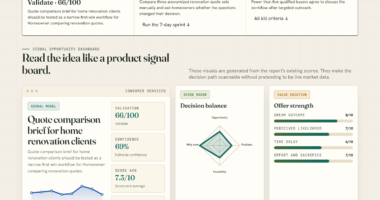

📊 Full opportunity report: The Menu: What Ten Answers Reveal on ThorstenMeyerAI.com — validation score, market gap, and execution plan.

Get business pricing on tech for your team
- Business-only prices and quantity discounts
- Tax-exempt purchasing
- Multiple users, one account, clear invoices
TL;DR
A comprehensive map of ten countries’ policies on automation, AI, and income redistribution shows diverse approaches and shared challenges. Key insights highlight the limits of current models and the importance of state capacity.
Ten jurisdictions have completed a comprehensive mapping of their policies addressing automation, AI, and income redistribution, revealing stark differences and unexpected similarities. This analysis exposes the diverse strategies governments are adopting to manage the transition, highlighting the importance of state capacity and political tradition.
The mapping, conducted by Thorsten Meyer, covers ten jurisdictions, analyzing responses across five key areas: income, capital, work, skills, and institutions. It shows that while most countries agree on the need for income floors, their approaches vary widely—from universal and generous floors in Nordic countries to targeted or citizens-only floors in others. The analysis underscores that nearly all jurisdictions rely on adjusting existing policies rather than creating radical new models.
In the capital column, nearly all democracies leave ownership largely untouched, trusting private markets, while non-democratic regimes like China and the Gulf countries implement state-controlled or dividend-based models. The work responses are similarly cautious, with no jurisdiction pursuing radical reforms such as universal job guarantees or four-day weeks. The only common ground is a consensus on reskilling, though its effectiveness remains uncertain due to assumptions about rapid human adaptation.
Institutional responses are highly varied, with different models of ‘strong institutions’ serving contrasting purposes—from worker protections in the EU to stability control in China. The analysis concludes that the most effective and portable models depend heavily on unique state capacities and resources, making widespread replication difficult. The map also reveals a democratic dilemma: the most aggressive capital and ownership models are found in authoritarian regimes, raising questions about democratic responses to post-labor challenges.
The Menu
The grid is full — now read across. Not a ranking but a menu: each model is a political tradition’s instinct about who should bear the risk. Its real use is to show you the column your own instincts would leave dark.
Each instinct is a strength and, flipped over, a blindness. The EU cushions but won’t touch capital; the US lets the market run but won’t catch the fall; China owns the capital but grants no claim. The map’s use isn’t to crown a winner — it’s to see the column your own instincts would leave dark, because that dark column is where the transition will find you. The levers are known. The grid is full. The choosing — and the blind spots — are ours.
Independent commentary, produced with AI assistance under human editorial oversight. The views are the author’s own and may change. This is analysis, not policy, economic, investment, or legal advice. This synthesis summarizes the ten jurisdictional entries of Phase 2; underlying figures reflect publicly reported information as of mid-2026 and may change. The “Response Matrix” is an interpretive device, not a quantitative index — its strong/partial/minimal ratings are the author’s analytical judgments offered to aid comparison, not to score or rank, and reasonable people will disagree with specific placements. This phase maps differing approaches and endorses none; characterizations of contested arrangements present competing views, not a verdict. Country and program names are referenced for analysis and imply no affiliation.
Implications of Diverse Policy Approaches
This analysis matters because it shows there is no one-size-fits-all solution to managing automation and AI’s economic impacts. The reliance on existing institutions, the limits of reskilling, and the central role of state capacity highlight that effective responses depend heavily on political and resource contexts. For democracies, especially, the findings raise questions about how to address ownership and income distribution without undermining democratic values or stability.
Products Worth Considering

Jackery Solar Generator 1000 V2 with 200W Solar Panel

LG 34GX90SA-W 34-inch Ultragear WQHD OLED Curved Gaming Monitor

Apple iPad Air (4th Generation, 10.9-inch, Wi-Fi, 256GB) – Space Gray
As an affiliate, we earn on qualifying purchases.
Mapping Responses to Automation and AI
This analysis builds on an eleven-entry map tracking how ten jurisdictions are responding to automation, AI, and income risks. It emphasizes that responses are shaped by political traditions, resource wealth, and institutional capacity. The map reveals that most countries are adjusting existing policies rather than reinventing the system, with notable differences in approach and ambition. The findings also reflect broader debates about the feasibility of redistributing income and ownership in democratic societies versus authoritarian regimes.
“The responses are less solutions than expressions of political tradition’s deepest instincts about who bears the risk.”
— Thorsten Meyer
Limits of Transferability and Effectiveness
It remains unclear whether the models that depend on high state capacity, resource wealth, or unique institutional structures can be adapted elsewhere. The effectiveness of reskilling policies is also uncertain, given the assumption that humans can keep pace with machine capabilities. Additionally, the long-term political viability of different models is still under debate, especially in democratic contexts.
Future Policy Developments and Research Needs
Further research is needed to evaluate the effectiveness of different models and to explore how democracies can develop resilient strategies for income and ownership redistribution. Policymakers may also focus on building state capacity and institutional trust to better manage the transition. The ongoing mapping and analysis will continue to inform debates on sustainable and equitable post-labor policies.
Key Questions
What does the ‘menu’ metaphor mean in this analysis?
The ‘menu’ refers to the diverse policy options that governments have chosen in response to automation and AI, illustrating that there is no single solution but a range of approaches reflecting political and institutional differences.
Why is the focus on state capacity important?
Because models that effectively address automation’s challenges often rely on strong institutions, resources, or control mechanisms. Without sufficient capacity, implementing or adapting these models becomes difficult.
Are there any universally effective policies identified?
Not yet. While reskilling is widely supported, its success depends on assumptions about human adaptability. Income floors are common but vary in generosity and scope, and no single approach has emerged as a clear winner.
What are the risks for democracies in responding to automation?
Democracies may struggle to implement models that involve significant redistribution or ownership changes, especially since the most aggressive approaches are found in authoritarian regimes. Balancing innovation with democratic values remains a challenge.
Source: ThorstenMeyerAI.com