
📊 Full opportunity report: A Marketplace Helps Businesses Discover Small-Town Retail Properties on IdeaNavigator AI — validation score, market gap, and execution plan.

Get business pricing on tech for your team
- Business-only prices and quantity discounts
- Tax-exempt purchasing
- Multiple users, one account, clear invoices
TL;DR
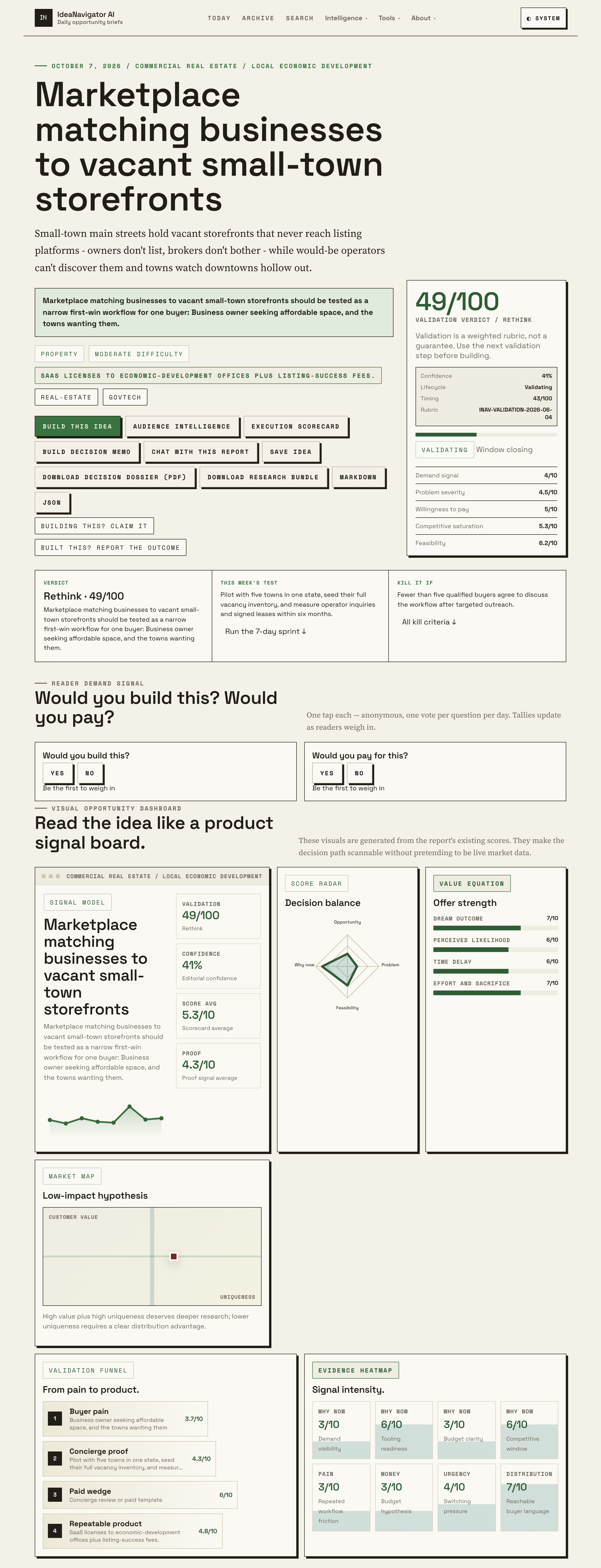
According to IdeaNavigator AI’s proposal, a marketplace could match business owners with vacant small-town storefronts and local economic-development incentives. The proposal recommends testing the concept in five towns in one state, measuring inquiries and signed leases over six months; it does not confirm a launch or pilot.
IdeaNavigator AI has proposed a marketplace that would help business owners find vacant storefronts in small towns and connect with local economic-development offices. The proposal, rather than a reported launch, suggests a six-month pilot in five towns in one state, with results measured by operator inquiries and signed leases.
IdeaNavigator AI’s proposal describes a discovery gap: some storefront owners do not list vacant properties on commercial real-estate platforms, while brokers may not pursue smaller-town vacancies. As a result, the proposal says, prospective operators may not know about spaces that could fit their budgets or business plans. It frames this as a problem for both business owners looking for space and towns seeking new downtown tenants.
For an initial product, IdeaNavigator AI suggests letting towns and property owners post photos, size, rent and available incentives. Operators could browse listings using town profiles and foot-traffic data. Under the proposal, when a business expresses interest, the platform would route the inquiry to the local development office and show any available grants tied to the opportunity.
The proposal’s revenue model combines software licenses for economic-development offices with fees tied to successful listings. To test the service, IdeaNavigator AI recommends entering a participating town’s full vacancy inventory, then tracking inquiries and completed leases during the pilot period. The proposal provides no budget, pricing, named participating towns or evidence that a pilot has been funded or started.
A Test for Main Street Leasing
If built and adopted, the marketplace could give small businesses a single place to find storefronts that are otherwise difficult to discover, while helping towns connect vacancies with prospective tenants. The proposal also suggests that attaching local incentives to listings could make grant programs easier for operators to identify and for development offices to raise during leasing discussions.
The idea’s practical value would depend on whether listings are complete and current, whether owners and towns participate, and whether inquiries lead to leases. A directory alone would not show that the underlying problem is solved. IdeaNavigator AI proposes six-month measures—operator inquiries and signed leases—to test interest and conversion, but does not specify targets or how results would be independently verified.
As an affiliate, we earn on qualifying purchases.
Why Small-Town Listings Can Be Missed
IdeaNavigator AI’s proposal identifies a mismatch between vacant commercial properties and potential users: storefronts may be absent from listing platforms if owners do not list them or brokers do not take them on. In that situation, a business owner searching beyond familiar commercial channels may not know a space exists. The proposal says local officials may have information about vacancies and incentives but lack a shared route to potential tenants.
IdeaNavigator AI frames renewed interest in small-town commercial space alongside remote-work migration and says economic-development offices have grant funding for this kind of matching effort. The proposal provides no figures, locations or named grant programs to quantify those claims. Its suggested response is to begin with one buyer group, one state and five towns rather than attempt a broad commercial property marketplace from the outset.
Pilot Status and Results Unknown
IdeaNavigator AI’s proposal does not confirm an operating marketplace or pilot. It identifies no developer, participating towns, property owners, funding commitments, launch schedule or agreements with local offices. It also provides no evidence that businesses will use the platform or that the suggested fee model would cover operating costs.
Several details would shape any test: how towns verify listing accuracy, how often rent and availability are updated, what qualifies as a successful listing, and how foot-traffic data would be sourced. The proposal does not state whether inquiries would be matched automatically or handled by local staff, or what privacy protections and data-sharing rules would apply. It also provides no baseline against which to compare inquiry or leasing activity, so the suggested outcome measures would need clearer definitions before results could be interpreted.
Five-Town Test Would Set the Next Step
IdeaNavigator AI’s proposed next step is to select five towns in one state, collect their full inventory of vacant storefronts and run the service for six months. The proposal says the test would track how many business operators inquire about listings and how many sign leases. Those results could indicate whether the marketplace improves discovery and whether interest converts into occupancy.
The available proposal names no timetable or participating locations. Before a pilot could begin, organizers would need to recruit towns and property owners, confirm what incentives are available, define the data and success measures, and decide how the software and listing fees would work. Until those steps are reported, the marketplace remains a proposed approach rather than an active service.
Source: IdeaNavigator AI proposal
Key Questions
Has the small-town storefront marketplace launched?
No launch is confirmed. IdeaNavigator AI presents the marketplace as a proposal and suggests a five-town pilot as a way to test it.
Who would use the marketplace?
Under IdeaNavigator AI’s proposal, business operators looking for affordable storefront space could browse listings. Towns and property owners would provide information, while local economic-development offices could receive inquiries and connect businesses with available incentives.
What would storefront listings include?
IdeaNavigator AI’s proposed listing details include photos, property size, rent and incentive programs. The proposal also says operators could browse using town profiles and foot-traffic data.
How would the proposed pilot be evaluated?
IdeaNavigator AI recommends a six-month test in five towns in one state, tracking operator inquiries and signed leases. Its proposal does not specify targets, a comparison baseline or participating towns.
How might the marketplace make money?
IdeaNavigator AI proposes a model combining software licenses paid by economic-development offices with fees tied to successful listings. The proposal provides no pricing or confirmed customers.
Source: IdeaNavigator AI
Halloween Picks
halloween
As an affiliate, we earn on qualifying purchases.