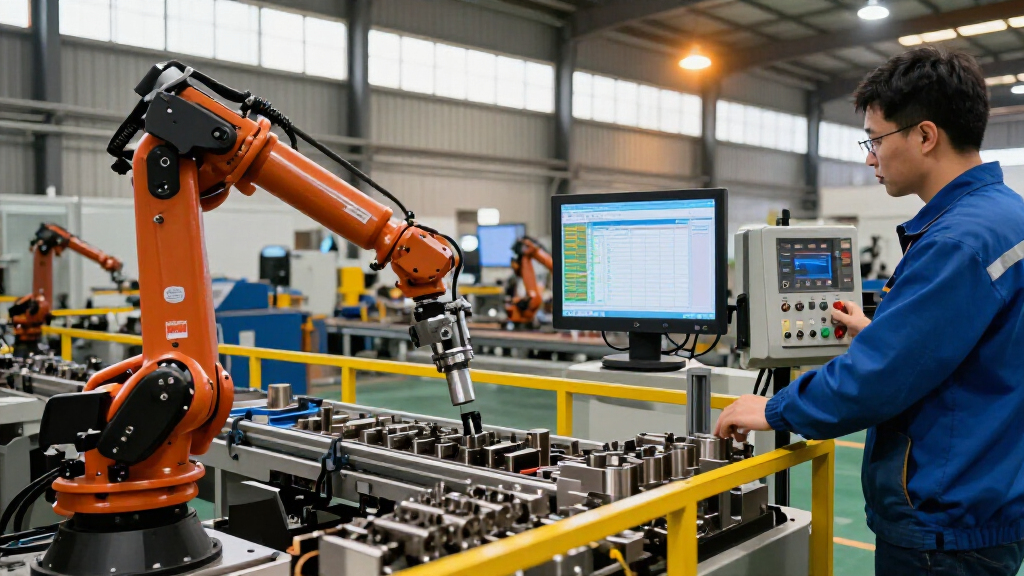
🔍 Read the full analysis: How AI-Powered Machines Help In The Factory on ThorstenMeyerAI.com

Get business pricing on tech for your team
- Business-only prices and quantity discounts
- Tax-exempt purchasing
- Multiple users, one account, clear invoices
TL;DR
A report published Nov. 24 traces industrial robots from General Motors’ 1961 Unimate to an estimated five million factory robots operating worldwide in 2025. Research cited in the report finds that employment effects differ by country and measure: U.S. estimates show job displacement, while German evidence points to service-sector gains offsetting factory losses.
A Nov. 24 report on factory automation says industrial robots were operating in record numbers in 2025, while the evidence on their effect on jobs remains mixed. Citing the International Federation of Robotics (IFR), the report puts the global stock at five million robots, and contrasts U.S. estimates of job displacement with research suggesting Germany’s factory losses were offset by service-sector gains.
The report traces industrial robotics to Unimate, a roughly 4,000-pound machine installed in 1961 at a General Motors plant in Trenton, New Jersey. Its task was to remove hot cast-metal parts from a die-casting press and stack them. The IFR and The Henry Ford museum identify the machine as the first industrial robot used on a production line. It performed work that was hot and physically demanding, illustrating how early automation entered factories through hazardous tasks.
According to the IFR’s World Robotics report, published Sept. 24, 2026, more than 600,000 robots were installed worldwide in 2025, bringing the operating total to five million. That total was 9% higher than in 2024 and more than double the figure seven years earlier. China accounted for 354,000 installations, or 59% of the annual total. The United States installed almost 38,500, up 12%; Japan installed 36,219, down 19%; and Germany installed fewer than 25,000, down 8%.
The report also cites robot-density figures for 2024, defined as industrial robots per 10,000 manufacturing employees. South Korea led with 1,220, followed by Singapore at 818, Germany at 449 and Japan at 446. The United States ranked eighth at 307, while the global average was 132. These figures describe robot use relative to manufacturing employment; they do not, by themselves, establish how many jobs automation created or eliminated.
Infographic 01 · Five million robots
Where the robots work
Sixty-five years after the first Unimate, five million industrial robots work in the world's factories. South Korea has by far the most per worker.
Robots per 10,000 employees in manufacturing · 2024
Where the new robots went · 2025
- China: 354,000 installed, 59% of the world total.
- United States: almost 38,500 (+12%), again the second-largest market.
- Japan 36,219 (−19%) · South Korea 30,000 · Germany fewer than 25,000 (−8%), Europe’s largest market.
Robot density = operational industrial robots per 10,000 employees in manufacturing. China (166 in 2024) is not compared here: the IFR switched to updated Chinese labour data in 2026, which changed the denominator.
Sources: IFR, robot density press release, 8 Apr 2026 (data 2024); IFR, World Robotics 2026 press release, 24 Sep 2026.
Powered by Thorsten Meyer AI
Robot Growth and Factory Employment
The central question is not simply whether robots replace workers. It is which jobs are affected, in which economy, and over what period. A robot can take over a task without eliminating every role around production: factories may still need workers to maintain equipment, move materials, inspect output or perform work machines do not handle. But automation can reduce demand for particular production jobs, and displaced workers may not be the same people who later benefit from new employment.
The report cites economists Daron Acemoglu and Pascual Restrepo, whose U.S. research estimated that each additional industrial robot from 1990 to 2007 replaced about 3.3 workers across the U.S. economy, with an estimated total of roughly 400,000 jobs displaced. For Germany, the report describes a different pattern: nearly two factory jobs lost per added robot, with service employment gains of about the same scale. The reported overall employment effect was about zero. The contrast suggests that labor-market institutions, industry structure and the ability to move into other work can shape the outcome.
For workers and policymakers, the distinction matters because a stable national employment total can conceal substantial losses for particular communities or groups. It also means robot counts are an incomplete measure of social impact. The relevant questions include wages, job quality, who receives training and whether new positions are accessible to workers whose tasks have been automated.
Products Worth Considering

Apple MacBook Air 13-inch Laptop with M5 Chip, 16GB Memory, 512GB SSD, and 12MP Center Stage Camera – Midnight

Amazon Kindle Scribe (16GB) with Premium Pen, Tungsten

Apple Watch SE (2nd Generation) GPS 40mm Smartwatch with Midnight Aluminum Case and Midnight Sport Band (S/M)
As an affiliate, we earn on qualifying purchases.
From Die-Casting to Robot Welding
The report says inventor George C. Devol filed a patent in 1954 for a programmed machine that transferred objects, with the patent granted in 1961. Devol and entrepreneur Joseph Engelberger formed Unimation, which supplied the Trenton machine. The report says it cost $65,000 to make and sold for $18,000.
Robots moved into other factory tasks as the technology developed. In 1969, General Motors installed Unimate spot-welding robots at its Lordstown, Ohio, plant. The IFR says more than 90% of body welding there was automated, compared with 20% to 40% at traditional plants. In Japan, Kawasaki licensed Unimation technology and completed its first Kawasaki-Unimate 2000 in 1969. The company’s history describes a shortage of workers for hard, dirty and dangerous jobs as one reason for interest in automation.
European manufacturers also developed industrial robots in the 1970s. The report identifies Germany’s KUKA Famulus and Sweden’s ASEA IRB 6 among early milestones. This history shows a gradual spread from handling hot castings and welding toward broader factory automation, not a single recent shift caused by artificial intelligence.
What Job Estimates Leave Out
The employment figures are estimates, not a direct count of workers individually replaced by machines. The report’s summary of the U.S. research gives the study period and estimated effects, but does not provide the full methods or enough detail to assess how results vary across industries, regions or worker groups. The Germany comparison is also presented at a broad level; the supplied material does not specify the study period or explain how service-sector gains were measured.
It is also unclear how much of the latest robot growth reflects machines with artificial-intelligence capabilities. The IFR figures cited count industrial robots; the source material does not break them down by AI use or show that AI caused the reported employment effects. Robot density and installation totals show adoption, but cannot alone settle whether automation raises productivity, changes working conditions or reduces total employment over time.
The source report is dated Nov. 24, 2026, but its supplied text ends before giving the full account of the U.S. and German studies. Further detail on methods and caveats is therefore not available here.
Tracking Adoption and Worker Outcomes
The next useful evidence will combine future IFR installation and density data with labor-market research that follows workers and industries over time. That would help distinguish jobs removed from specific tasks from new jobs created elsewhere, and show whether affected workers can reach those openings.
For now, the figures establish that industrial robots are widespread and that installations remain concentrated in a few major manufacturing economies. They do not establish that every robot is AI-powered, or that a rise in robot numbers produces the same employment outcome everywhere. The report’s main finding is more limited: automation’s job effects depend on where and how it is introduced, and the available national estimates differ.
Key Questions
How many industrial robots were operating worldwide in 2025?
The IFR figure cited in the report is five million, 9% above 2024 and more than double the total seven years earlier.
Which country installed the most robots in 2025?
China installed 354,000 robots, representing 59% of the more than 600,000 installations worldwide that year, according to the IFR.
Do the figures show that AI is taking factory jobs?
No. The source reports industrial-robot totals but does not identify how many machines use AI or isolate AI’s effect on employment. Robot adoption and AI-specific job effects are different questions.
What does the cited research say about robots and employment?
The report says Acemoglu and Restrepo estimated that each additional industrial robot in the United States from 1990 to 2007 replaced about 3.3 workers across the economy. It contrasts that estimate with a German pattern in which service-sector gains roughly offset factory job losses; the supplied material does not provide the full study details.
Source: ThorstenMeyerAI.com