
🔍 Read the full analysis: Could Ring’s Patrol Robot And Home Drone Make Monitoring More Personal? on ThorstenMeyerAI.com

Get business pricing on tech for your team
- Business-only prices and quantity discounts
- Tax-exempt purchasing
- Multiple users, one account, clear invoices
TL;DR
Amazon’s Ring announced two mobile security cameras on November 10, 2026: a flying camera for homes and a wheeled patrol robot for businesses. The Rover is listed at $999.99 and the Drone at $249.99, but the Drone cannot be sold until it receives required FCC authorization. Ring describes privacy controls, while critics question its encryption and the company’s record.
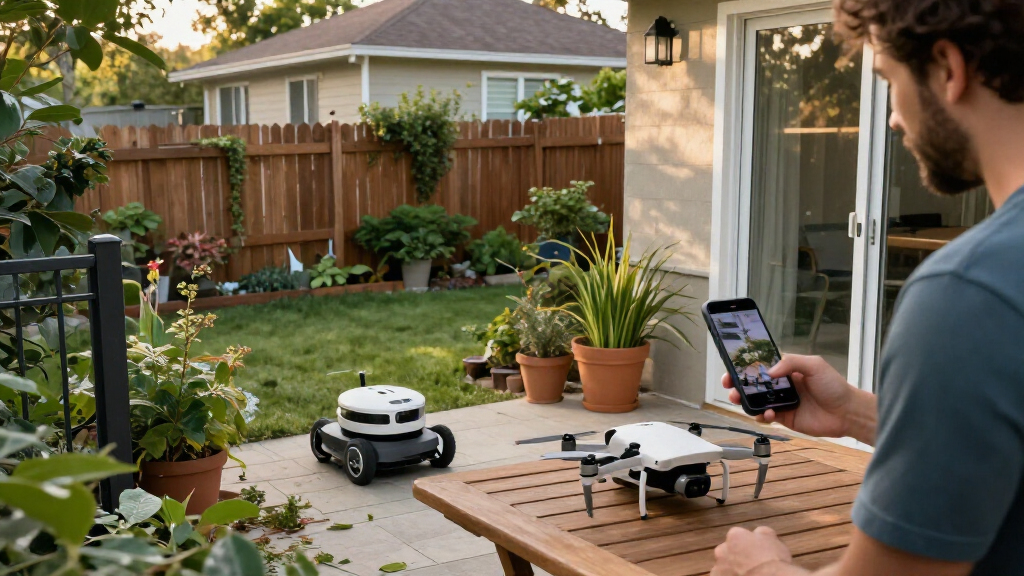
Amazon’s Ring announced Ring Robotics on November 10, introducing two cameras that move to investigate security alerts: a flying Drone Cam for homes and a wheeled Rover Cam for businesses. Ring lists Rover at $999.99, with US shipping scheduled for December 16, 2026, and Drone at $249.99, scheduled for January 27, 2027, but says the drone has not received required FCC authorization and may not be sold until it does.
Ring says both devices use AI Pilot, a system that maps a space, proposes patrol points and guides the device around obstacles. The cameras can respond when another Ring camera, sensor or alarm is triggered. Ring describes the products as autonomous security devices that patrol and investigate; the performance details are company claims, not independent test results.
The Drone Cam is designed to fly scheduled routes or respond to an alert inside a home. Ring lists 2K video, a 148-degree field of view, 360-degree rotation and two LED lights. The Verge reported that the drone weighs 165 grams and quoted Ring’s estimate of five to eight minutes of flight per charge. The Verge also reported that the device relies on an internet connection; without Wi-Fi, it can land but cannot perform its normal functions.
The business-focused Rover Cam patrols on a schedule, goes to designated points after alerts and can scan 360 degrees on arrival, according to Ring. It has an adjustable camera mast, siren, light tower and two-way audio. Ring says it can stream and record up to 4K video while moving or patrolling. The Verge reported limits of about 30 minutes of battery life, roughly 5,000 square feet of estimated coverage and operation on one floor. Scheduled patrols require a compatible Ring Protect plan.
Mobile cameras follow alerts into homes and businesses
Ring introduced a home drone and a business patrol robot. They could extend camera coverage, while raising questions about privacy, reliability and approval.
Two devices, different settings
Both can move to investigate alerts, according to Ring.
- Flies scheduled routes or responds to alerts inside a home.
- Camera is off while docked, Ring says.
- Patrols on a schedule and visits designated points after alerts.
- Sleep mode retracts its camera mast and turns off its microphone, Ring says.
How mobile coverage works
Ring says AI Pilot maps spaces, proposes patrol points and guides devices around obstacles.
A Ring camera, sensor or alarm can prompt a device to move.
It follows a route or goes to a designated point, according to Ring.
A moving camera may see rooms or work areas a fixed camera cannot.
Privacy protections and open questions
Ring describes safeguards, but real-world performance and video handling remain unassessed.
Visible recording
Ring says both devices show recording indicators and use TAKE encryption. Full end-to-end encryption remains optional.
More places in view
Customers, employees and visitors may be recorded as devices move through homes and workplaces.
Performance in daily use
Reliability, battery life, cloud dependence and how controls work for recorded people have not been established.
Mobile Cameras Change Security Coverage
Ring is shifting its security pitch from cameras fixed in chosen locations to devices that can move toward an alert. In principle, a roaming camera could check a room or business area that a stationary camera cannot see. That could appeal to households seeking coverage across multiple rooms and businesses that want patrols after closing.
The trade-off is that mobile cameras can observe more than a fixed device. A drone entering different rooms or a robot moving through a shop raises questions about who is recorded, when recording starts and where footage is processed. These concerns matter to customers, employees and visitors, particularly when the devices operate automatically or depend on cloud services. Ring’s product claims and privacy controls have not yet been independently assessed in real-world use.
Products Worth Considering

Bose QuietComfort Ultra Earbuds (2nd Gen), Wireless Noise-Cancelling Earbuds with Immersive Audio and Wireless Charging Case, Black

Logitech MX Mechanical Wireless Illuminated Keyboard, Clicky Switches

Jackery Explorer 1000 v2 Portable Power Station
As an affiliate, we earn on qualifying purchases.
Earlier Ring and Amazon Robot Efforts
The announcement builds on a concept Ring has been developing for years. Ring first previewed an indoor drone, then called the Always Home Cam, in 2020. The Verge reported that founder Jamie Siminoff said work on the idea began in 2016. Ring now presents the drone alongside Rover as part of a broader line of mobile security devices.
Rover also draws on Amazon’s earlier home-robot work. Ring says it developed the business product after hearing from Amazon Astro customers who valued its mobile security features. The Verge reported that Amazon launched Astro for Business in 2023 and discontinued it a year later. That history offers relevant context, but it does not establish how Rover will perform or how long it will be supported.
Privacy is a central part of Ring’s announcement. The company says the drone’s camera is off while docked, Rover has a sleep mode that retracts its camera mast and turns off its microphone, and both devices use visible recording indicators. Ring also says videos receive its Throw Away the Key encryption, or TAKE, which it announced in August 2026.
“For years, customers told us they wanted eyes in the places a fixed camera couldn’t reach, and peace of mind in the spots they’d never want one.”
— Jamie Siminoff, Ring founder and chief inventor, in Ring’s announcement
Approval, Privacy and Performance Questions
The most immediate issue is FCC authorization for Drone Cam. Ring says the device has not been authorized as required by FCC rules and may not be sold before approval; the announcement does not establish when authorization might be granted. The listed January 27, 2027, US shipping date is therefore subject to that condition.
Ring’s stated privacy protections have not removed criticism. The FTC said in a May 2023 complaint that Ring had compromised customer privacy by allowing employees or contractors access to private videos and by failing to implement basic privacy and security protections. That is an allegation in the FTC complaint, not a finding described here. The EFF has also argued that TAKE falls short of end-to-end encryption. Ring says its servers can temporarily access keys to support cloud features and then delete them, while full end-to-end encryption remains an optional setting.
Further details about real-world reliability, battery performance, cloud dependence and the handling of video have not been established by the announcement. It is also unclear what subscription features and costs beyond the stated requirement for scheduled patrols will apply, or how the devices’ controls will work for people who are recorded in homes and workplaces.
Launch Dates and FCC Decision
Ring lists Rover Cam for US shipping on December 16, 2026, at $999.99. The company lists Drone Cam at $249.99, with US shipping planned for January 27, 2027, but sales depend on the required FCC authorization. Ring has not provided an authorization date in the supplied announcement.
Customers and businesses will have more information to weigh as the products approach launch, including whether scheduled patrol features require a paid plan beyond the compatible Ring Protect subscription, and how the devices perform outside demonstrations. The status of FCC approval, product availability and any additional privacy or technical details remain the next developments to watch.
Key Questions
What did Ring announce?
Ring announced Ring Robotics, a line of mobile security cameras that begins with Drone Cam, a home drone, and Rover Cam, a wheeled patrol robot for businesses.
How much do the devices cost, and when are they due?
Ring lists Rover Cam at $999.99, with US shipping planned for December 16, 2026. Drone Cam is listed at $249.99, with US shipping planned for January 27, 2027, subject to required FCC authorization.
Can customers buy Drone Cam now?
No. Ring says Drone Cam has not received required FCC authorization and may not be sold until it does. The planned shipping date could depend on that approval.
What privacy protections does Ring describe?
Ring says Drone Cam’s camera is off while docked, Rover has a sleep mode that retracts its camera and turns off its microphone, and both devices show recording indicators. Ring says videos use TAKE encryption, while full end-to-end encryption remains optional.
What is still unknown about the products?
The timing of the drone’s FCC authorization, real-world performance and reliability, and further details about cloud video handling and subscription costs are not established in the announcement. Independent experience with the products is also not yet available.
Source: ThorstenMeyerAI.com