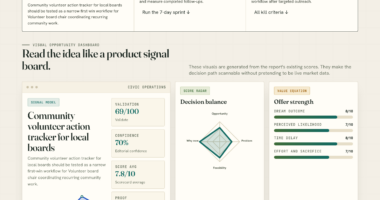

📊 Full opportunity report: Singapore: Engineer the Transition on ThorstenMeyerAI.com — validation score, market gap, and execution plan.

Get tech for your team delivered free — and shop member deals
- Fast, free delivery on millions of items
- Access to Prime Big Deal Days deals on October 6–7
- Prime Video, Amazon Music and more included
TL;DR
Singapore is using a diverse set of targeted, well-funded policies to manage workforce transition amid automation and resource constraints. The country’s approach emphasizes continuous reskilling and state-led innovation, aiming to pre-empt displacement.
Singapore has unveiled a comprehensive, multi-pronged strategy to manage its workforce transition, emphasizing continuous reskilling and state-led innovation amid technological and resource constraints. This approach aims to pre-empt displacement caused by automation and AI, setting it apart from other jurisdictions that rely on singular policies.
The country’s strategy involves a suite of calibrated, well-funded programs, including SkillsFuture for lifelong skills development, Workfare for targeted income support, the Central Provident Fund (CPF) for savings and asset accumulation, and a National AI Strategy overseen by an AI Council chaired by the Prime Minister. Singapore’s focus is on relentless reskilling, with initiatives like the Level-Up Programme and Mid-Career Training Allowance designed to help workers upgrade and adapt proactively.
Additionally, Singapore’s AI strategy, refreshed in 2026, combines significant public research funding with regional AI hubs and pragmatic governance frameworks, despite land and energy constraints. The government’s approach is characterized by precision policy design, continuous tuning, and a belief that a capable, meritocratic state can engineer the transition more effectively than relying solely on market forces or universal safety nets.
Engineer the Transition
Where others pick one lever, Singapore engineers all of them — a calibrated, well-funded instrument for each — and bets hardest that a high-capacity state can keep workers perpetually ahead of the machine.
Independent commentary, produced with AI assistance under human editorial oversight. The views are the author’s own and may change. This is analysis, not policy, economic, investment, or legal advice. Descriptions of SkillsFuture, Workfare, the CPF, the Progressive Wage Model, Singapore’s National AI Strategy and AI Council, and Temasek/GIC reflect publicly reported information as of mid-2026 and may change; figures are indicative. This phase maps differing approaches and endorses none; characterizations of contested arrangements present competing views, not a verdict. Country, program, and company names are referenced for analysis and imply no affiliation.
Why Singapore’s Multi-Program Strategy Matters
Singapore’s approach demonstrates a model of comprehensive, state-driven workforce management that could influence other small, resource-constrained economies. You can learn more about Forward-Deployed Engineer Economics 2.0 and its implications. Its emphasis on continuous reskilling and technological innovation seeks to stay ahead of automation, potentially setting a blueprint for managing technological transitions without heavy dependency on universal income or large-scale welfare programs. This approach underscores the importance of state capacity and policy calibration in shaping economic resilience amid rapid change.
SkillsFuture learning subscription
As an affiliate, we earn on qualifying purchases.
As an affiliate, we earn on qualifying purchases.
Singapore’s Workforce Policies and Innovation Efforts in 2026
Singapore’s unique approach stems from its recognition that no single policy can address the complex challenges of automation and resource limits. Historically, the country has built a highly capable, meritocratic government capable of designing and executing precise policy instruments. Its strategies include SkillsFuture, Workfare, and the CPF, all aimed at promoting active participation, upskilling, and asset building. The recent refresh of its AI strategy reflects a broader ambition to become a regional AI hub while managing constraints through efficiency and outward investment. For insights on the economic aspects of AI deployment, see this detailed analysis of unit economics.
Unlike many jurisdictions that focus on social safety nets post-displacement, Singapore’s model emphasizes preemptive measures—continuous reskilling and technological innovation—coupled with a pragmatic governance posture that tests and refines policies iteratively.
“Singapore’s strategy is to engineer the transition through calibrated, well-funded programs that keep workers ahead of automation.”
— Singapore Prime Minister’s Office
What Aspects of the Strategy Are Still Unclear
While the policies have been announced and are being implemented, it remains unclear how effective they will be in practice, especially in terms of long-term impact on employment and social equity. The precise outcomes of the AI governance framework and its regional influence are still developing. Additionally, the scalability of Singapore’s model to larger or less capable states remains uncertain.
Next Steps in Monitoring Singapore’s Workforce Transition
Monitoring will focus on the effectiveness of reskilling programs, employment outcomes, and AI deployment impacts over the coming years. For a deeper dive into the economics of deploying engineers and AI, check out this comprehensive guide. The government is expected to publish regular assessments of policy performance, and international observers will watch how Singapore’s model influences regional practices. Further refinements are likely as new challenges and technological developments emerge.
Key Questions
How does Singapore ensure workers are continuously reskilled?
Through programs like SkillsFuture, Level-Up, and Mid-Career Training Allowance, which provide credits, subsidies, and income support to encourage ongoing upskilling and adaptation to new technologies.
What role does AI play in Singapore’s overall strategy?
AI is central to Singapore’s innovation push, with a dedicated national strategy, public research funding, and regional AI hubs. The country aims to deploy AI across sectors while simultaneously reskilling its workforce to work alongside automation.
Can Singapore’s approach be applied in larger or less capable countries?
Singapore’s model relies heavily on its strong, capable state and targeted policies. While elements could inform other contexts, its success depends on institutional capacity and resource availability, which may not be replicable everywhere.
What are the main challenges Singapore faces in this transition?
Potential challenges include measuring long-term policy effectiveness, ensuring equitable access to reskilling, and managing technological risks. The country also faces constraints related to land and energy, which it addresses through efficiency and outward investments.
Source: ThorstenMeyerAI.com
Halloween Picks
halloween
As an affiliate, we earn on qualifying purchases.