
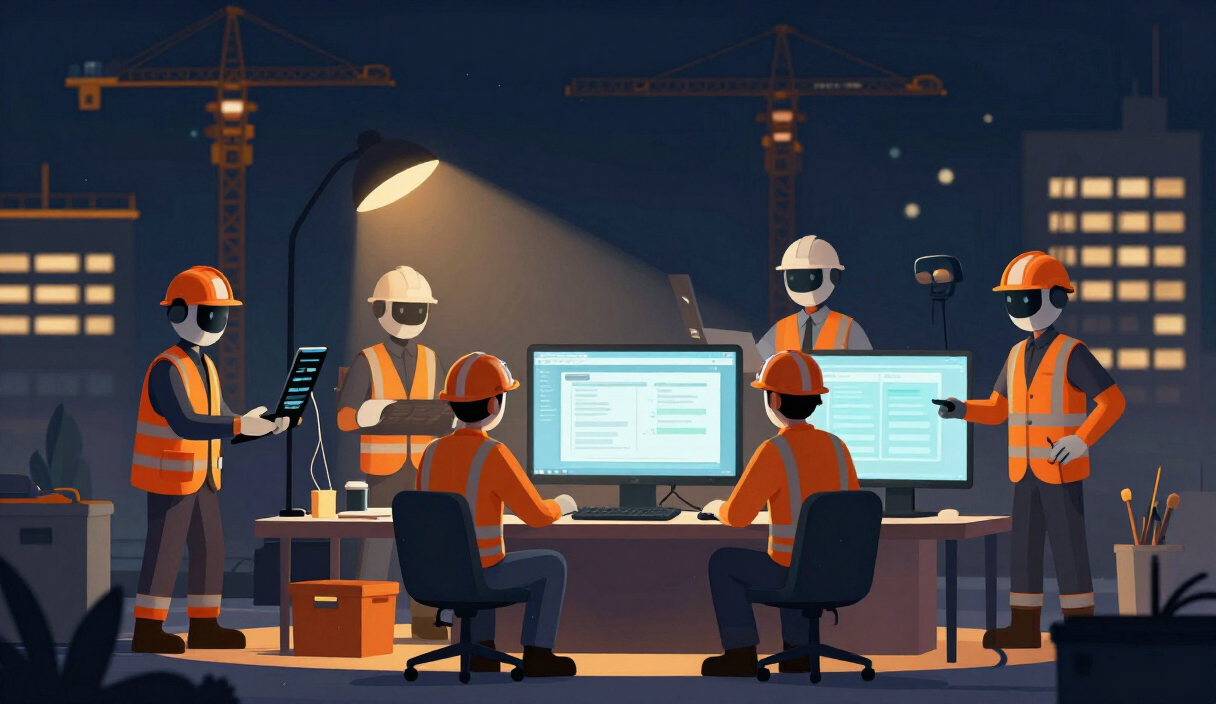
A solo founder directs a fleet of coding agents through the night. Codex and Claude do the implementation work. By morning, the fleet has shipped 21 software packages. The result is not accepted because it looks plausible or produces an impressive demo. It is verified with negative controls and mutation tests.
Open a free Amazon Business account
Business pricing, bulk buying and tax-exempt orders.
Create a free accountAs an affiliate, we earn on qualifying purchases.
AI Tools & ML · Gewerkton build story
One founder.
One agent fleet.
One night.
Codex and Claude supplied the implementation leverage. Negative controls and mutation tests supplied the boundary: shipped code had to demonstrate genuine behaviour, not merely look plausible.
The overnight production model
A solo founder directed multiple coding agents across a platform—not an isolated prototype.
The work spanned field capture, browser-based project work and cloud coordination. Speed compressed production time; verification challenged the output.
01 · Verification standard
Tests designed to recognise failure
controls
tests
Acceptance did not rest on an impressive demo. The tests had to detect meaningful changes and distinguish real behaviour from reassuring appearances.
02 · Product architecture
One brand, three connected lines
03 · Global operating layer
Language reach plus infrastructure choice
Teams bring their own keys and select providers by region, while the evidence original remains unambiguous.
04 · Local depth, wider scope
Born in Germany, designed for distributed sites
Its deepest commercial integration is German: GAEB, REB, XRechnung and DATEV. Deployment can use an EU cloud or the customer’s own infrastructure.
“On site, what counts is what’s proven.”
05 · The honest milestone
An unusually compressed build—not a finished-platform retrospective
Gewerkton remains in beta. The defining story is the pairing of rapid agent production with explicit attempts to challenge what the agents produced.
That is the development story behind Gewerkton, a voice-first construction documentation and defect management platform for global markets. The project was born in the German market, where its commercial integration runs deepest, but its scope extends across international construction teams, distributed sites and regional technology requirements.
The combination is worth examining because the familiar story about AI-assisted software development usually stops at speed. Gewerkton’s story does not. Shipping 21 packages in one night is the striking number, but the more consequential detail is the verification standard applied to that output. Coding agents were not treated as infallible substitutes for engineering judgement. Their work had to survive tests designed to distinguish genuine behaviour from reassuring appearances.
That same resistance to easy assumptions runs through the product itself. Gewerkton does not assume that every project team speaks one language, works in one region, uses one AI provider or starts with a complete digital model. It connects voice capture on site with plans, models, reports and operational coordination while preserving a clear evidence original.
As an affiliate, we earn on qualifying purchases.
The night the agent fleet shipped 21 packages
There is a practical difference between asking an AI system to generate code and directing multiple coding agents as a coordinated production fleet. Gewerkton was built through the latter approach: a solo founder directing Codex and Claude, with the agents contributing across a body of software rather than producing a single isolated prototype.
In one night, that fleet shipped 21 software packages. The scale matters because a platform spanning field capture, browser-based work and cloud coordination is not a single-screen exercise. Yet the number alone says little about whether the result behaves correctly. Speed without verification simply compresses the time required to create uncertainty.
The verification standards are therefore central to the story. The packages were checked with negative controls and mutation tests. Those terms place the emphasis where it belongs: not on whether the software can pass through an ideal demonstration, but on whether the tests can recognise failure and detect meaningful changes.
This is a more mature account of coding agents than the usual overnight-build narrative. The achievement is not merely that agents produced a large volume of software quickly. It is that rapid production was paired with explicit attempts to challenge the result. The agents supplied leverage; verification supplied a boundary around that leverage.
Gewerkton remains in beta now, with a public beta planned for fall 2026. That status should frame any assessment of both the product and the build process. This is not a retrospective about a finished, settled platform. It is an account of an unusually compressed development effort producing a beta product with a clearly stated public-beta milestone.
Voice as the starting point for site evidence
Gewerkton begins with a straightforward observation embedded in its marketing line: “On site, what counts is what’s proven.” Construction work generates a constant stream of observations, instructions, defects, changes, decisions and handovers. The useful record is the one that can move from the moment of capture into the project’s working documentation without losing its meaning.
The platform’s voice-first approach makes dictation the entry point. Gewerkton Field is the construction site app, covering dictation to evidence, defects, daywork reports, takt and a portal. The product line is designed around the realities of work happening away from a desk, including offline capture in dead zones.
The distinction between a voice note and structured project evidence is important. A recording left in a messaging thread may preserve words, but it does not automatically become part of the project workflow. Gewerkton’s proposition is to connect spoken capture with the records and actions that teams need to coordinate.
That is particularly relevant on projects where crews rotate, trades overlap and decisions accumulate quickly. On wind farms and renewable-energy projects, sites may be distributed across a wide area, with rotating crews, field acceptance work and unreliable connectivity. Offline capture gives the site team a way to record information in dead zones rather than waiting for a connection.
In housing and building construction, the same voice-first workflow applies to defects recorded with a photo and deadline, dictated daywork reports, and signatures collected on the device during handover. The emphasis remains on capturing the event while the people, place and work are still immediately available.
One brand, three connected product lines
Gewerkton is structured as a branded house with three product lines: Field, Studio and Cloud. Each covers a distinct working context, but the division is not intended to split a project into separate information islands.
Field is the on-site layer. Gewerkton Studio is the browser workspace for plans and models. Where no model exists, the site team can create one in the browser. That last capability addresses a common starting condition without requiring the project to pretend it already has a complete model.

Gewerkton Cloud handles operations and model or data coordination between Field, Studio and third parties. It is the connective product line in the story: the layer through which site capture and browser-based project work can be coordinated beyond their original context.
For data residency, customers can choose an EU cloud or their own infrastructure. That choice sits alongside Gewerkton’s broader regional approach to AI providers. The platform does not reduce international deployment to interface translation while leaving every underlying technology decision fixed.
The German foundation remains visible. Gewerkton has its deepest German commercial integration through GAEB, REB, XRechnung and DATEV. At the same time, the platform supports 27 content languages and is positioned for global markets. The result is not a choice between local commercial depth and international use; both are part of the stated product scope.
BYO-AI means choosing the provider and the region
The platform’s bring-your-own-AI model supports 13 AI providers. Teams bring their own keys and select providers by region, with choices across the EU, the US and Asia, including mainland China. The explicit aim is no vendor lock-in.
That matters because AI procurement is not a universal decision made once for every geography and project participant. A company operating across regions may have different provider requirements depending on where the work happens, where data should reside or which infrastructure it chooses to operate.
Gewerkton’s approach separates the product workflow from dependence on one AI supplier. The platform provides the construction context, while the customer retains regional provider choice. Combined with the option of an EU cloud or deployment on the customer’s own infrastructure, BYO-AI turns infrastructure selection into a project decision rather than a fixed platform assumption.
The regional breadth is specific: EU, US and Asian providers, including providers in mainland China. That supports projects in Asia where Chinese, Korean and Vietnamese crews may need multilingual handling from capture through to report, while data residency remains a choice.
This is also where the product’s international angle becomes more than a language count. Twenty-seven content languages can help people participate in the same workflow, but provider choice and deployment choice address a different layer of the problem. Global software has to account for both how people communicate and how organisations choose to run the technology behind that communication.
One project, several regions, each team in its own language
Consider a cross-border project involving teams in the EU, the US and APAC. Each team works in its own language, while the evidence original stays unambiguous. That final condition is the anchor. Multilingual processing is useful only if it does not blur what was originally captured.
For infrastructure and tunnel projects, where work can continue over long durations and generate many change orders, instructions can be backed by the original audio. The platform can support multilingual participation without treating a translated or processed version as a replacement for the underlying evidence.
On data-centre and industrial-plant projects, many trades work in parallel under tight deadlines. Meeting decisions can become trade-sorted task lists, connecting discussion with the groups responsible for action. The international challenge here is not simply translating words; it is keeping decisions usable while multiple trades and teams move at once.

For projects in Asia, multilingual operation runs from capture to report for Chinese, Korean and Vietnamese crews. Teams can also choose data residency and select among regional AI providers, including providers in mainland China. Those choices acknowledge that a project’s language, infrastructure and provider requirements may be related without being identical.
Across these settings, Gewerkton’s promise is not that language differences disappear. It is that participants can work in their own languages while the project retains an unambiguous evidence original. That is a more grounded goal than pretending every participant should operate through one imposed language or that a translated record is automatically sufficient on its own.
A deliberately quiet marketing stack
The public-facing technology choices mirror some of the restraint in the product story. Gewerkton’s marketing site is available in 27 languages, uses zero trackers and requires no cookie banner. Its architecture is fully egress-free.
The company has also built a media bank containing more than 51 self-produced clips and posters. That provides its own body of product material without changing the central message: the interesting part of Gewerkton is the connection between site evidence, multilingual work and coordinated project operations.
There is an editorial lesson here for the wider AI-tools market. The strongest demonstration of an agent-built product is not a breathless account of how much code appeared overnight. It is a clear explanation of what was shipped, how it was challenged and what boundaries remain. Gewerkton can point to 21 packages in one night, but it also points to negative controls, mutation tests and beta status.
Why the verification story matters
Coding agents make speed visible. Verification makes reliability discussable. The difference is especially important for software intended to handle construction evidence, field observations and operational coordination, where a polished interface cannot by itself demonstrate that underlying behaviour is correct.
Negative controls and mutation tests do not turn a beta into a finished product, and Gewerkton does not need them to support that claim. Their significance is more disciplined: the founder’s use of coding agents included methods intended to test whether the checks themselves could recognise incorrect behaviour and meaningful alterations.
That provides a better model for discussing agentic software development. A fleet can create breadth quickly. A solo founder can direct work that previously would have demanded a larger implementation effort. But the value of that leverage depends on whether the resulting system is subjected to standards stronger than visual plausibility.
Gewerkton is therefore two stories at once. It is a voice-first construction documentation and defect management platform connecting Field, Studio and Cloud across languages, providers and regions. It is also evidence that the serious question about coding agents is moving beyond whether they can ship. The next question is whether the work can withstand deliberate attempts to prove it wrong.
The product is in beta now, and the public beta is planned for fall 2026. For teams assessing the direction rather than pretending the journey is complete, the clearest starting points are the main Gewerkton platform and Gewerkton Cloud: one presents the full voice-first system, while the other carries coordination between Field, Studio and third parties.
Flea & tick season Picks
flea and tick prevention
As an affiliate, we earn on qualifying purchases.