
Like a historian tracing every chapter of a story, you can now track each mile driven in a supercar with unprecedented precision. Digital twins paired with blockchain technology turn this vision into reality, creating a permanent record of a vehicle’s journey. But how does this impact ownership, resale value, and maintenance? The possibilities are vast, and understanding them could reshape the way you think about high-performance cars.
Key Takeaways
- Digital twins record real-time supercar data on blockchain, ensuring an immutable and transparent mile-tracking history.
- On-chain data links vehicle performance and mileage directly to its digital twin for secure ownership verification.
- Blockchain integration enables tamper-proof tracking of every mile driven, enhancing resale confidence and authenticity.
- Smart contracts automate maintenance and service milestones based on miles logged in the digital twin.
- Continuous on-chain data updates improve vehicle lifespan management and provide verifiable ownership records.
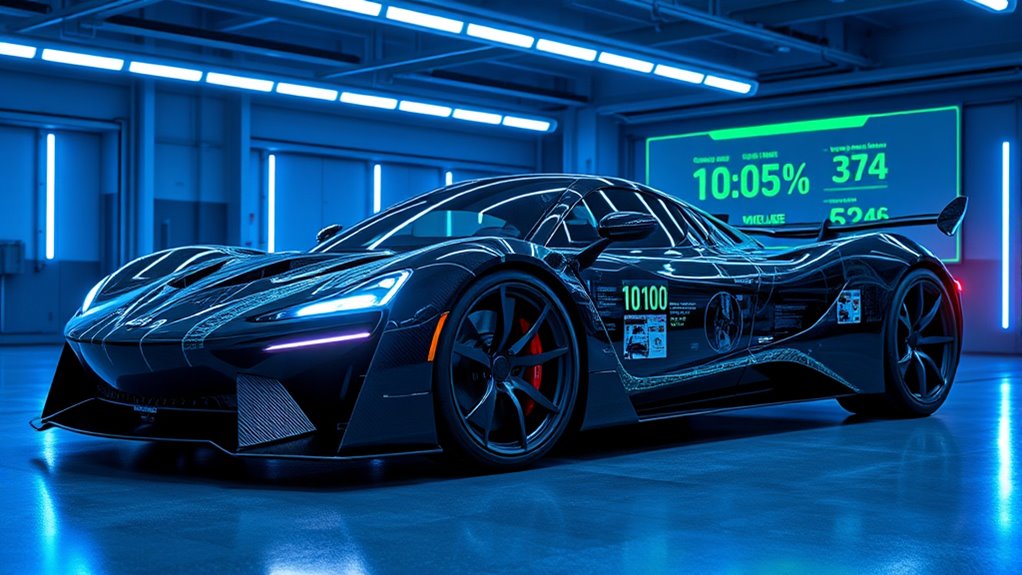
Digital twins are revolutionizing the way supercars are designed, built, and maintained. They serve as virtual replicas of physical vehicles, created by digitizing every component, from the engine parts to the smallest sensors. In the automotive world, these digital twins are often developed before the physical supercar even exists, allowing manufacturers to model and simulate every aspect of the vehicle digitally. This means you get a thorough digital model that mimics the real car’s performance, condition, and behavior in real-time. By continuously syncing with the actual supercar, the digital twin reflects live data, such as performance metrics, maintenance needs, and wear and tear, providing an ongoing, real-time broadcast of the vehicle’s state. This constant connection creates a feedback loop where real-world usage updates the digital model, helping optimize future design, safety features, and maintenance strategies. Digital twins can also incorporate AI-driven predictive analytics to anticipate potential failures before they occur, further enhancing vehicle reliability and safety.
Digital twins enable real-time monitoring, simulation, and optimization of supercars, enhancing design, safety, and maintenance efficiency.
As you explore supercar design, you’ll notice that digital twins enable virtual testing of components under a variety of conditions — extreme temperatures, high speeds, or stress scenarios — without building physical prototypes. This accelerates development, reduces costs, and streamlines approval processes. Engineers can evaluate safety and performance early in the design phase, cutting weeks or even months off traditional development timelines. For example, some supercar manufacturers have slashed development cycles from a year to just a few months using these digital simulations. Furthermore, digital twins ensure that vehicles meet strict regulatory standards before they hit the road, making compliance more efficient and reliable. The ability to simulate and analyze designs digitally leads to safer, higher-quality vehicles that are cheaper to produce. Additionally, the integration of digital twin data with manufacturing systems enables real-time adjustments during production, improving overall quality control.
When you own or operate a supercar equipped with a digital twin, sensors continuously gather data on performance, mileage, service history, and configuration changes. This data streams in real-time, allowing for precise monitoring of the vehicle’s condition. If mechanical issues or signs of wear emerge, the digital twin can alert you or your maintenance team proactively. This predictive maintenance reduces breakdown risks, extends the vehicle’s lifespan, and preserves its value. The detailed tracking of every mile, part replacement, and service event provides a thorough digital history, which is invaluable during resale or for maintaining the supercar’s integrity over time. Implementing blockchain technology in this process ensures that the digital record remains secure and tamper-proof, adding an extra layer of trust and authenticity.
Integrating blockchain technology with digital twins takes this process further. Recording all data on a blockchain ensures an unchangeable, transparent record of every mile driven and service performed. This tamper-proof history verifies the vehicle’s provenance, boosting buyer confidence and safeguarding against fraud. For collectors and enthusiasts, this means an authenticated, unalterable record of the supercar’s journey. Smart contracts can automate notifications for maintenance schedules or warranty claims, making ownership more seamless. Overall, on-chain digital twin data enhances trust, security, and transparency, establishing a new standard for supercar ownership and resale in the digital age.

Tracki Pro GPS Tracker for Vehicles – Magnetic Waterproof 4G LTE Car Tracker, Long-Life Battery Up to 7 Months, Unlimited Distance, Smart Alerts, Hidden Tracking Device (Subscription Required)
Compact, Undetectable Vehicle Tracker – Tracki Pro is a small GPS tracker with a strong magnet, hiding easily…
As an affiliate, we earn on qualifying purchases.
As an affiliate, we earn on qualifying purchases.
Conclusion
So, now you can boast about your supercar’s every mile—on-chain, no less—while secretly wondering if your digital twin’s keeping tabs on your Sunday drives. Ironically, this high-tech tracking might just make your vintage car feel more “alive” than ever, knowing it’s permanently etched into blockchain history. Who knew that in the quest for ultimate transparency, we’d end up with a digital guardian watching every twist and turn? Welcome to the future of car ownership.

GPS Tracker for Vehicles, No Subscription with Real-Time Location, Mileage Tracking, Speeding Monitoring, Route History, Geofence, OBD, for Fleets & Families, USA, Moto Watchdog
[No Subscriptions] – Avoid adding another subscription you might forget about. We are the only company that offers…
As an affiliate, we earn on qualifying purchases.
As an affiliate, we earn on qualifying purchases.
supercar maintenance smart contract
As an affiliate, we earn on qualifying purchases.
As an affiliate, we earn on qualifying purchases.
![[1760558206] [9781760558208]Extreme Ownership: How U.S. Navy SEALs Lead and Win-Paperback](https://m.media-amazon.com/images/I/41yDxOMYQwL._SL500_.jpg)
[1760558206] [9781760558208]Extreme Ownership: How U.S. Navy SEALs Lead and Win-Paperback
As an affiliate, we earn on qualifying purchases.
As an affiliate, we earn on qualifying purchases.