

Imagine participating in an auction where trust isn’t just assumed but built into the system itself. Smart contracts on blockchain technology enable this by automating bidding rules and ensuring transparency without relying on intermediaries. As a bidder, you can verify every detail independently, reducing disputes and increasing confidence. But how exactly do these digital agreements change the way we bid? The answer could redefine the future of auction houses in ways you might not expect.
Key Takeaways
- Smart contracts automate bid validation, updates, and refunds, reducing reliance on trust and manual oversight.
- Blockchain transparency allows participants to independently verify auction data and outcomes.
- Automated enforcement of rules prevents fraudulent bids and ensures fair bidding processes.
- Secure, immutable records eliminate disputes and enhance trust among participants.
- Reduced need for intermediaries lowers costs and streamlines the auction experience.
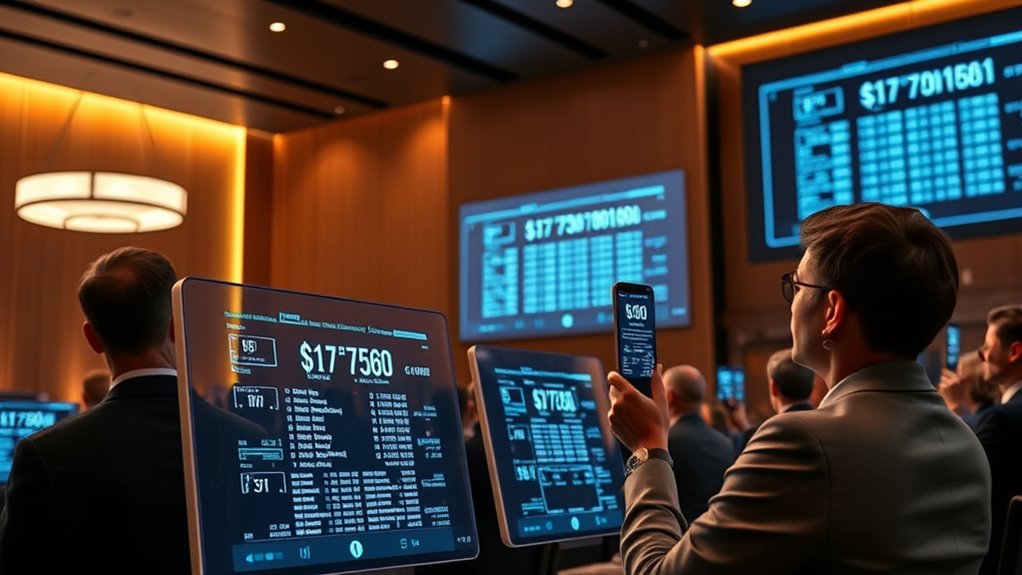
Auction houses are transforming by leveraging smart contracts to create more transparent, efficient, and secure bidding processes. When you participate in an auction powered by blockchain technology, you benefit from a system that enforces rules automatically, removing the need to trust a third party. These smart contracts are coded with clear logic for bidding, ensuring that every bid you place exceeds the current highest bid by a predetermined increment. This eliminates disputes over bid validity and guarantees fair play. The contracts also keep track of critical auction states, such as the current highest bidder, the highest bid, and the scheduled end time, all stored securely on-chain. Because this data is immutable and publicly accessible, everyone can verify the auction’s progress and outcome, fostering trust among participants.
Smart contracts make auctions transparent, secure, and fair by automating rules and providing immutable, verifiable on-chain data.
As you place bids, the smart contract updates the highest bid and bidder automatically, broadcasting events to notify all bidders of new bids or the auction’s conclusion. When the auction ends, the contract can be closed by the auctioneer, but only if the specified conditions are met, like the scheduled end time. This automation reduces manual oversight, minimizing chances for manipulation or disputes. Additionally, the contract maintains a mapping of addresses to bid amounts, allowing losing bidders to be refunded securely without delays. This automatic refund process encourages participation, as you know your funds are protected if you don’t win. Blockchain transparency enhances trust and accountability in these processes.
To ensure operational security, these smart contracts are designed to separate condition checks, state updates, and external interactions. This approach prevents reentrancy attacks and other vulnerabilities. For example, bid placements can only occur when the auction rules are satisfied, such as the bid being sufficiently higher than the current highest bid and within the auction timeframe. The system also enforces bid increments to prevent arbitrary or fraudulent bids. Moreover, all auction data, including bids and outcomes, are recorded permanently on the blockchain, providing an immutable trail that supports transparency and compliance. Smart contracts enforce bidding rules automatically, ensuring consistent and fair auction processes.
In real-world applications like real estate, smart contracts streamline auctions by automating title transfers and payments simultaneously, reducing escrow delays and administrative overhead. Blockchain-based property auctions enable international buyers and sellers to transact seamlessly, cutting out intermediaries and lowering costs. Companies like Propy have already facilitated billions in real estate transactions via blockchain, issuing NFTs as proof of ownership. For you as a buyer or seller, this means faster, more transparent, and more secure transactions, with a clear record of all actions.
Compared to traditional auction houses, smart contracts offer numerous advantages. They enforce bidding rules automatically, reducing disputes and trust issues. Costs drop because intermediaries are eliminated, and transparency into bidding history builds confidence. Automation allows auctions to run 24/7 without human intervention, and the blockchain’s immutable records ensure regulatory compliance and protect your interests. As a participant, you gain a more open, trustworthy, and efficient auction experience, powered by technology that eliminates many of the uncertainties and inefficiencies of traditional systems.
smart contract auction platform
As an affiliate, we earn on qualifying purchases.
As an affiliate, we earn on qualifying purchases.
Conclusion
Embracing smart contracts is like opening a vault of trust, where every bid is etched in unbreakable stone. You no longer need to rely on shadows or whispers—transparency becomes your guiding star. As the digital dawn rises, your confidence blossoms, knowing fairness is woven into every transaction. This isn’t just technology; it’s a beacon leading you toward a future where honesty and integrity shine brighter than ever, illuminating the path to true trust.
blockchain bidding system
As an affiliate, we earn on qualifying purchases.
As an affiliate, we earn on qualifying purchases.
automated auction software
As an affiliate, we earn on qualifying purchases.
As an affiliate, we earn on qualifying purchases.
trustless bidding app
As an affiliate, we earn on qualifying purchases.
As an affiliate, we earn on qualifying purchases.