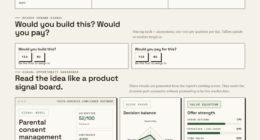

📊 Full opportunity report: What’s The Deal With Claude’s Hidden Watermark? Tech Community Wants Answers on ThorstenMeyerAI.com — validation score, market gap, and execution plan.

Get business pricing on tech for your team
- Business-only prices and quantity discounts
- Tax-exempt purchasing
- Multiple users, one account, clear invoices
TL;DR
Anthropic has addressed questions about a suspected hidden watermark in Claude, but technical details and capabilities are still unverified. The controversy raises questions about AI content detection and user privacy.
Anthropic has officially responded to concerns among technologists and developers regarding a reported hidden watermark in its AI model, Claude. The company’s brief statement addresses questions about whether the watermark exists, how it functions, and its scope, but leaves many technical details unconfirmed. This development matters because it touches on issues of AI content attribution, user privacy, and transparency.
The controversy began when some technologists claimed to detect a hidden marker in Claude outputs, suggesting the presence of a watermark that could identify generated content. For more details, see the original analysis on this site. Anthropic responded by acknowledging questions but did not provide a comprehensive technical explanation. The company’s statement confirms that concerns have been raised but does not specify whether the marker is a visible pattern, metadata, or an invisible character embedded in responses.
Furthermore, Anthropic did not clarify whether the watermark is active across all Claude products, such as the API, consumer interface, or coding tools, nor whether it can be disabled by users. The company’s response also did not specify whether the marker can track individual users, link content to specific conversations, or transmit data back to Anthropic. The lack of detailed documentation or reproducible tests leaves the technical nature and scope of the watermark unverified.
Industry experts note that the existence of a watermark could impact developers, publishers, and researchers who rely on Claude for content generation, raising questions about privacy and content attribution. However, without concrete evidence or technical specifications, the actual capabilities and limitations of the purported watermark remain uncertain.
Implications for AI Content Transparency and Privacy
The response to the watermark concern underscores the growing importance of content attribution in AI systems. If a watermark exists, it could serve as a tool for platform moderation, misuse prevention, or intellectual property protection. Conversely, the lack of transparency about its design and function raises privacy concerns, especially if the marker could potentially identify individual users or conversations without their knowledge. The controversy highlights the need for clear disclosure and independent verification in AI content marking technologies, which are increasingly relevant as AI-generated content proliferates across platforms and industries.
As an affiliate, we earn on qualifying purchases.
Background of AI Watermarking and Content Identification
The debate over AI content attribution has intensified as models like Claude, GPT, and others become integral to workflows in education, publishing, and software development. Various methods for watermarking AI outputs have been proposed, including visible labels, metadata tagging, and pattern-based markers. However, these methods face challenges such as removal, editing, or detection inaccuracies. The controversy around Claude’s alleged watermark fits into this broader context, where companies seek reliable ways to identify AI-generated content without compromising user privacy or system performance.
Previous efforts by AI firms and policymakers have emphasized transparency and auditability, but technical implementations vary widely. The limited information available about Claude’s watermark, if it exists, adds to ongoing debates about standardization and regulation of AI content identification tools.
“The absence of detailed technical documentation makes it difficult to assess whether Claude’s watermark is effective or even exists as claimed.”
— Thorsten Meyer, AI researcher
Unconfirmed Aspects of Claude’s Watermark Capabilities
Many key details remain unverified, including the technical design of the purported watermark, whether it is active across all Claude outputs, and if it can be disabled. It is also unclear whether the marker can reliably identify individual users, link content to specific conversations, or transmit data back to Anthropic. Additionally, the effectiveness and robustness of detection methods remain untested and undocumented, raising questions about false positives and negatives. Independent audits or peer-reviewed research on the watermark’s efficacy have not been published.
Next Steps for Transparency and Verification
Expectations now focus on whether Anthropic will publish detailed technical documentation or conduct independent audits of the watermark. Researchers and developers will likely seek reproducible tests to verify claims, while industry observers will monitor how the company addresses transparency concerns. Clarifying the scope, capabilities, and user controls related to the watermark will be critical in shaping trust and regulatory discussions around AI content attribution.
Key Questions
Does Claude’s watermark identify individual users?
It is currently unconfirmed whether the reported watermark can track or identify individual users or conversations. Anthropic has not provided technical details to clarify this point.
Can users disable or remove the watermark?
There is no publicly available information indicating whether the watermark can be disabled or removed by users. Anthropic has not disclosed such options.
Does the watermark affect all Claude outputs?
It remains unclear whether the watermark is present across all Claude products and output formats, or if it is limited to specific applications or testing scenarios.
Could the watermark impact privacy or security?
Potential privacy or security implications depend on the design of the watermark. Without technical specifics, the risks cannot be fully assessed.
Will Anthropic release technical documentation?
Anthropic has indicated plans to provide further technical details, but no specific timeline has been announced.
Source: ThorstenMeyerAI.com
Fall Picks
fall essentials
As an affiliate, we earn on qualifying purchases.