
TL;DR
SpaceX announced plans on Nov. 12 for two AI computing projects: a more than $24 billion site in Starbase, Texas, and a roughly $50 billion campus in Cochise County, Arizona. Both face local proceedings on Dec. 9, while important details about water use, tax relief and Arizona power arrangements remain unresolved.
SpaceX said Nov. 12 it is advancing plans for two large AI computing campuses, one in Starbase, Texas, and another in Cochise County, Arizona. The company describes the projects as more than $74 billion in planned American investment; both now face local proceedings scheduled for Dec. 9, though key details about water, tax relief and power arrangements remain unsettled.

Get business pricing on tech for your team
- Business-only prices and quantity discounts
- Tax-exempt purchasing
- Multiple users, one account, clear invoices
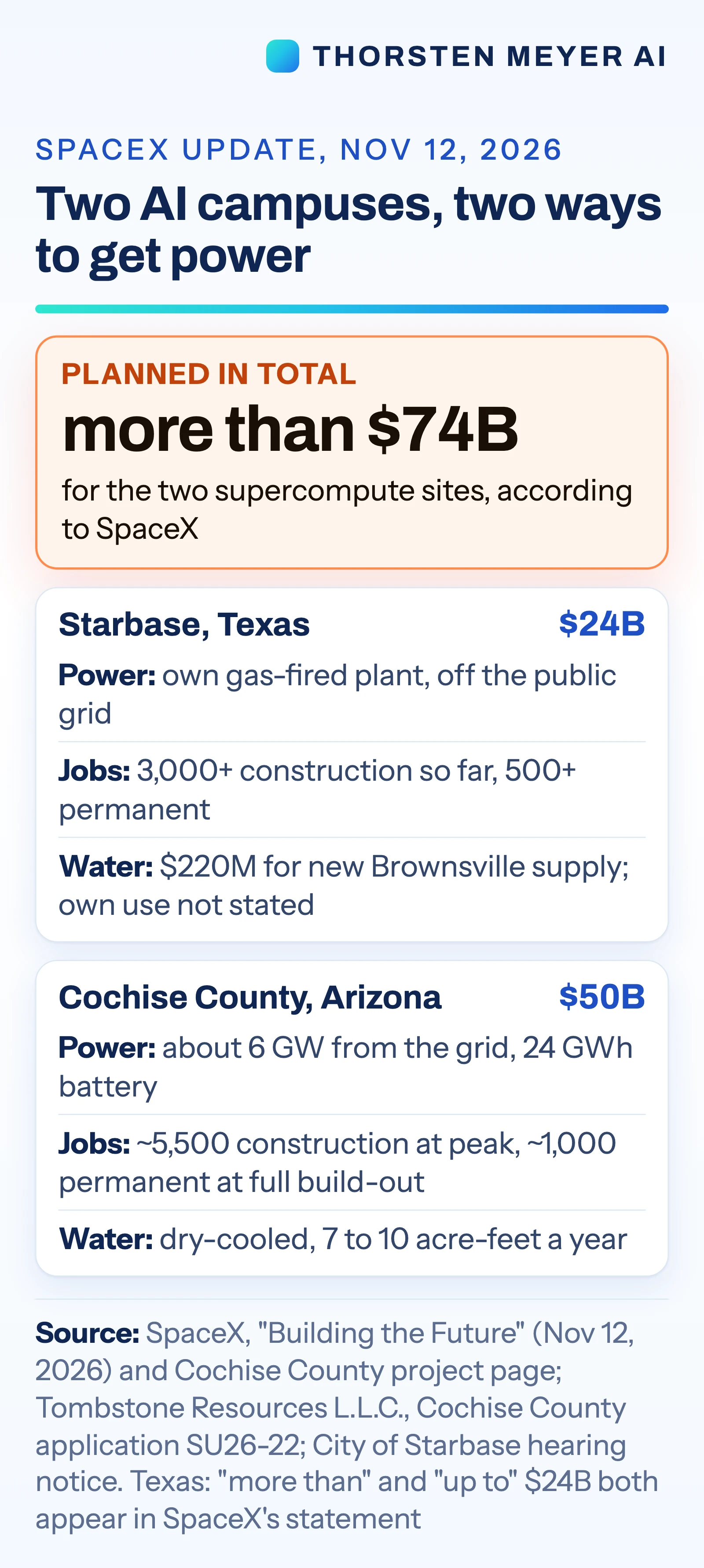
In Starbase, the company says it plans to invest more than $24 billion in computing infrastructure on an approximately 444-acre site between Boca Chica Boulevard and the Port of Brownsville. A city notice describes the initial capital investment as approximately $24 billion, with possible later expansion. It identifies the project as a gas-fired power plant and super-compute facility. SpaceX says the site will generate its own electricity rather than draw from the public grid.
SpaceX says the Texas project is intended to train frontier AI systems and test technologies that could support future space-based computing. The company reports more than 3,000 construction jobs so far and expects more than 500 permanent jobs once the facility is operating. Those figures are company statements; the materials provided do not include independent verification or a completion schedule.
In Arizona, SpaceX describes a roughly $50 billion campus on about 747 acres near Cochise. The county application, filed by Tombstone Resources L.L.C., proposes as many as nine single-story computing buildings, each about 493,000 square feet, in four phases. It specifies roughly 1,500 megawatts for the first phase and about 6 gigawatts at full build-out, plus a 24-gigawatt-hour battery system. The county documents cited do not name SpaceX; the company link comes from SpaceX’s project page and Tombstone Resources’ statement about a community meeting hosted by SpaceX.
Two Campuses, Two Power Models
The plans show SpaceX proposing substantial computing infrastructure on the ground while the company has also promoted space-based computing. In February, when announcing its acquisition of xAI, SpaceX argued that terrestrial electricity demand for AI could burden communities and the environment. The Texas campus is described as having its own gas-fired generation; the Arizona plan would take power from the grid through local utilities. The projects therefore raise distinct questions about how new computing demand will be supplied and what local communities may experience.
The scale also gives local decisions practical weight. The Arizona application describes a campus that could require about 6 gigawatts at full build-out, while the Starbase city notice puts the Texas project’s initial investment at approximately $24 billion. SpaceX says it will help expand regional water and wastewater infrastructure in Texas and lower electricity bills for Arizona cooperative members. Those are company commitments, and their eventual effects depend on implementation and, in Arizona, the relevant utility arrangements.
Reuters reported that SpaceX’s AI segment generated more than half of the company’s revenue in the third quarter. That figure, as reported by Reuters, places the campus plans within a business where AI has become a major source of revenue. It does not establish how much revenue either proposed campus would generate or when either facility could begin operating.
Products Worth Considering

Bose TV Speaker (2nd Gen) – Compact Soundbar with Bluetooth and HDMI‑ARC Connectivity, Clear Dialogue, Dolby Atmos, Deep Bass, Remote Contro

Apple Watch Series 12 GPS 42mm

Samsung 32-inch Odyssey G5 G51F QHD 180Hz Gaming Monitor
As an affiliate, we earn on qualifying purchases.
From Orbital Computing to Local Sites
SpaceX announced on Feb. 2 that it had acquired xAI and used the announcement to argue that terrestrial power demand would not be enough to meet AI needs without hardship for communities and the environment. The company presented orbital data centers as an answer. The two newly announced projects are terrestrial facilities, though SpaceX says the Texas site will also help develop and test technology for future space-based computing.
The projects have different document trails. Starbase’s city notice describes the Texas site and its gas-fired power plant. In Arizona, the county application is under the name Tombstone Resources L.L.C., and the county materials described in the source do not identify SpaceX. SpaceX’s project page and the company’s connection to a community town hall provide the stated link between the campus and SpaceX.
SpaceX says it has committed $220 million to water and wastewater infrastructure for Brownsville and Cameron County, including $40 million it says it has already provided. The company says the projects would add about 20 million gallons per day from sources independent of the Rio Grande. It also says it is not acquiring water rights, prepaying utility rates or receiving preferential access to regional water. Those statements concern regional infrastructure and access; they do not specify the Texas computing facility’s own water use.
““Together, they represent more than $74 billion in planned American investment.””
— SpaceX
Power, Water and Tax Questions
Several material details are not established in the source materials. Starbase’s city notice identifies a gas-fired plant but does not state its generation capacity, and SpaceX has not specified how much water the Texas computing facility itself would use. The size of any Texas property tax abatement is also not provided.
A local outlet, The 956 Report, said it obtained an air registration filed with the Texas Commission on Environmental Quality on Sept. 8. It reported that an initial temporary setup would use 35 natural gas turbines totaling about 748 megawatts, later replaced by eight larger turbines totaling about 708 megawatts. The outlet also reported an annual nitrogen oxide cap of 248.86 tons. These particulars are attributed to that outlet’s account of the filing; the city notice cited here does not give plant capacity.
In Arizona, SpaceX promises dry cooling, no industrial groundwater use and lower power bills for local cooperative members. The application describes grid power delivered through Sulphur Springs Valley Electric Cooperative and Arizona Electric Power Cooperative to a utility-owned substation on the site. It also lists natural gas standby generators of about 10 megawatts per building. Whether the utility arrangement and proposed bill reductions receive the necessary regulatory approval is not clear from the available information.
Dec. 9 Local Decisions
On Dec. 9, 2026, the Cochise County Planning and Zoning Commission is scheduled to hold a hearing on the Arizona proposal. The Starbase City Commission is scheduled to consider a property tax abatement related to the Texas project. These proceedings are upcoming; the source material does not establish their outcomes or say that either project has received all required approvals.
Further public documents and decisions may clarify the Arizona campus application, its utility power arrangement and the proposed tax treatment in Starbase. The available material does not provide a full construction timetable or operating start date for either project. Until local proceedings and other approvals advance, the announced investment amounts and planned capacities describe proposals and company plans rather than completed facilities.
Key Questions
What did SpaceX announce?
SpaceX said it is advancing two AI computing campus projects: one in Starbase, Texas, and one in Cochise County, Arizona. It describes their planned combined investment as more than $74 billion.
How large is the Arizona campus proposal?
The county application proposes up to nine computing buildings on about 747 acres. It lists approximately 1,500 megawatts for the first phase and about 6 gigawatts at full build-out. Those are planned figures in the application, not operating capacity.
How would the two sites get electricity?
SpaceX says the Starbase site would generate its own electricity at a gas-fired plant. The Arizona application describes grid power delivered through local cooperatives to a utility-owned substation, with natural gas generators for standby use.
When will local officials consider the projects?
The Cochise County Planning and Zoning Commission hearing and a Starbase City Commission consideration of a property tax abatement are both scheduled for Dec. 9, 2026. Their outcomes are not yet known.
What details are still unknown?
The available materials do not state the Texas facility’s own water use, the size of the proposed Texas tax break or whether Arizona’s utility arrangement behind promised bill cuts will be approved. The source also gives no operating start date for either campus.
Source: Thorsten Meyer AI