
🔍 Read the full analysis: How AI Automation Tools May Support Your Small Business on ThorstenMeyerAI.com

Get business pricing on tech for your team
- Business-only prices and quantity discounts
- Tax-exempt purchasing
- Multiple users, one account, clear invoices
TL;DR
A roundup from ThorstenMeyerAI.com compares 15 books that may help small-business owners learn about AI automation. The titles are learning resources, not automation software, and the source says its comparisons rely on titles and stated positioning rather than verified contents or results.
ThorstenMeyerAI.com has published a roundup of 15 books for small-business owners considering AI automation, comparing guides positioned around marketing, sales, customer service, operations, no-code workflows and ChatGPT. The books are learning resources, not software platforms, so readers still need to select and configure the tools that would run any workflow.
The roundup names AI Automation for Small Businesses: A Practical Guide to Automating Marketing, Sales, Customer Service, Operations, and Everyday Work as its best overall pick, citing its stated coverage across several business functions. It describes AI Automation Made Simple for Small Business as a possible beginner route because its title emphasizes no-code workflows, and ChatGPT for Business: The 10X Playbook as a source of workflow ideas that readers can adapt.
The source frames the central choice as breadth versus a more guided starting point. Other titles in the 15-book list are presented as potentially relevant to owners seeking an entrepreneur-focused perspective, a set-up-yourself approach, everyday work ideas or a structured plan. The supplied material does not provide the full titles or individual assessments for all 15 picks, so a complete title-by-title comparison cannot be established from it.
The roundup says it assessed the books as business learning resources, using their titles, stated audiences, promised formats and named topics. It says it gave weight to practical workflow coverage, accessibility for nontechnical owners and relevance to common business functions. Those criteria describe the publisher’s selection approach; they are not independent tests of the books’ advice or results.
The 15 picks
- 1
 Smart AI for Small Business: 50 Simple Hacks to Grow Revenue, Cut Costs, and…View on Amazon →
- 2
 The Small Business Owner’s AI Handbook: How to Use Artificial Intelligence to…View on Amazon →
- 3
 AI Tools for Small Business: A Practical Guide to Automation, Saving Time, an…View on Amazon →
- 4
 AI-Powered Automation and Workflows for Small Business OwnersView on Amazon →
- 5
 ChatGPT for Business: The 10X Playbook — 100 AI Workflows to Save Time, Grow…View on Amazon →
- 6
 AI Automation for Small Businesses: Build Smarter Workflows, Save Time, Reduc…View on Amazon →
- 7
 Claude AI Made Practical: A Beginner’s Guide to Everyday Work, Small-Business…View on Amazon →
- 8
 AI Automation for Small Businesses: A Practical Guide to Save Time, Work Smar…View on Amazon →
- 9
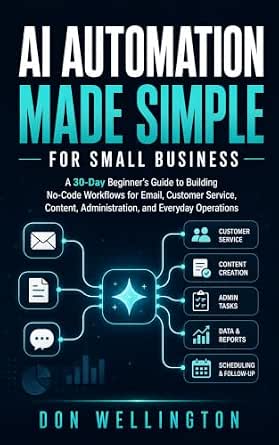 AI Automation Made Simple for Small Business: A 30-Day Beginner’s Guide to No…View on Amazon →
- 10
 AI Automation for Small Business: Simple AI Workflows for Everyday TasksView on Amazon →
- 11
 AI Automation for Small Business: A Practical Guide to Automating Marketing,…View on Amazon →
- 12
 AI for Small Business, Volume I: Getting Started — Set It Up Yourself, No Tec…View on Amazon →
- 13
 AI for Small Business: From Marketing and Sales to HR and OperationsView on Amazon →
- 14
 AI Automation for Small Businesses: Build Semi-Passive Income Systems Without…View on Amazon →
- 15
 AI for Entrepreneurs and Small Business Owners: How to Compete with Larger Bu…View on Amazon →
Choosing a Practical Starting Point
For a small business, automation decisions can affect staff time, customer communication and routine records. A guide that matches a recurring task may help an owner plan a manageable experiment, but a book alone does not connect software, check the accuracy of AI-generated output or establish oversight rules.
The distinction matters because the roundup’s title refers to AI automation tools, while its products are books about learning automation. Readers should not expect a purchase to provide functioning workflows. Before adopting a process, they need to check whether the proposed tools work with their existing email, calendar, customer database and other software, and decide when a person must review outputs.
Products Worth Considering

Sony WH-1000XM6 Wireless Noise-Canceling Headphones, Black

Bose QuietComfort Ultra Earbuds (2nd Gen), Wireless Noise-Cancelling Earbuds, Black

DJI Mic 2 Wireless Microphone System (2 Transmitters, 1 Receiver, Charging Case)
As an affiliate, we earn on qualifying purchases.
How the 15 Books Were Compared
The source says it compared the 15 titles by their stated scope and intended learning path, rather than by testing software. Broad titles naming marketing, sales, customer service and operations were treated as wider in scope than books centered on everyday tasks or a single AI assistant. Titles promising no-code setup or a plan were treated as signals of structure, not proof that the books contain detailed instructions.
For readers choosing among guides, the source recommends identifying a repetitive task that consumes time and checking whether a book’s described focus matches it. It also advises reviewing descriptions or sample pages for examples and setup detail, and verifying software compatibility separately. These are selection suggestions in the roundup, not evidence that any particular guide will deliver a specific business outcome.
“These are learning resources, not automation platforms.”
— ThorstenMeyerAI.com roundup
What the Book Descriptions Cannot Confirm
The supplied source material gives limited information about the books and says its assessments are based on titles and stated positioning. It does not establish how detailed the instructions are, which software integrations each book covers, whether the content is current, or what results readers have achieved. It also does not provide enough information here to identify and assess every title in the 15-book roundup individually.
No independent review, sales data, effectiveness test or comparison of automation platforms is included. A title suggesting a beginner plan, no-code setup or business growth should not be treated as proof of ease of use or measurable returns. Owners will need to check publisher descriptions, sample pages and software-provider documentation before relying on a guide for implementation.
Checks Before Putting a Workflow Live
The next step for a business owner is to choose one repeatable process, document its current steps and decide what a successful result would look like. Then compare that need with a guide’s available description and verify that the recommended approach fits the business’s existing software.
Before any customer-facing or sensitive workflow goes live, set rules for human review and error handling. The source recommends more oversight for customer service, financial details, hiring and personal information than for low-risk internal summaries. The roundup does not specify a product release, implementation timetable or follow-up evaluation, so whether it will be updated or independently tested remains unknown.
Key Questions
Are the 15 picks AI automation software?
No. The roundup describes them as books and learning resources, not platforms that run workflows. Readers must choose and configure suitable software separately.
Which book does the roundup rank as its best overall pick?
It names AI Automation for Small Businesses: A Practical Guide to Automating Marketing, Sales, Customer Service, Operations, and Everyday Work, citing the broad range of functions named in its title.
Which titles are presented as possible beginner options?
The source points to AI Automation Made Simple for Small Business for its no-code positioning and a clear beginner path. Its title alone does not confirm how much setup detail the book provides.
Does the roundup prove that these books save time or increase revenue?
No. The supplied material gives no measured results or independent tests. It compares stated topics and intended audiences, so readers should treat business outcomes as unverified.
What should a business check before automating a task?
Identify the process and desired result, check compatibility with existing software, and set human review rules for outputs—especially those involving customers, finances or sensitive information.
Source: ThorstenMeyerAI.com