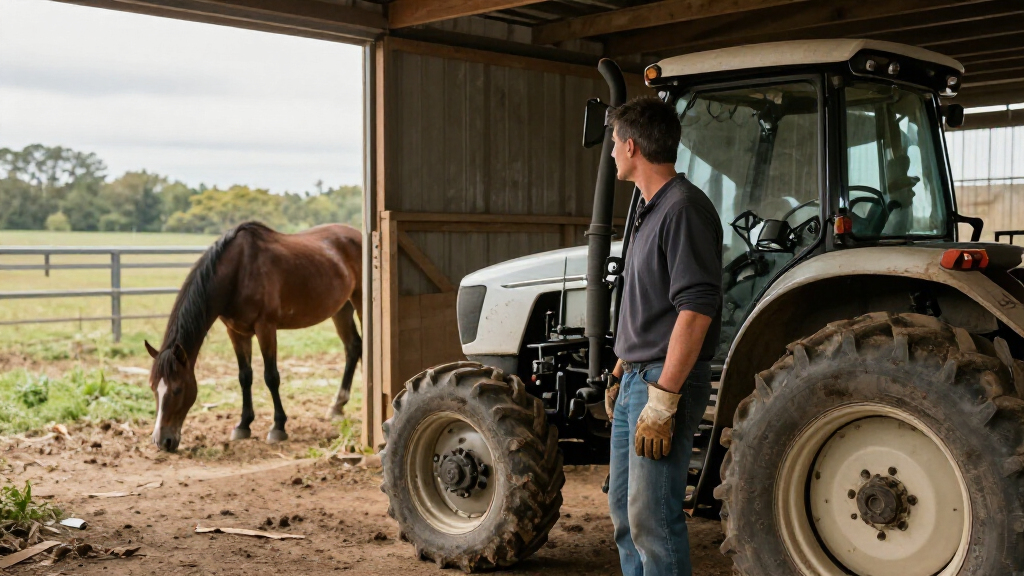

🔍 Read the full analysis: Horsepower To Engine Power: The Farm's Changing Workforce on ThorstenMeyerAI.com

Get business pricing on tech for your team
- Business-only prices and quantity discounts
- Tax-exempt purchasing
- Multiple users, one account, clear invoices
TL;DR
A November 4, 2026, report revisits the replacement of horses and mules by tractors on U.S. farms, a shift that cut the working-animal count from 26.7 million in 1918 to 3.1 million in 1960. It argues that the episode offers a useful but limited comparison for current farm automation, while noting that the effects on workers involved changes in employment and migration.
A report published November 4 by ThorstenMeyerAI.com traces how tractors displaced horses and mules as the main source of farm power in the United States, with the working-animal population falling from 26.7 million in 1918 to 3.1 million by 1960. The account matters beyond agricultural history because it examines how mechanization changed farm work and asks how far that experience can inform debate over today’s farm robots.
The figures cited in the report come from the U.S. Census Bureau’s 1975 volume Historical Statistics of the United States, Colonial Times to 1970, which reprints Department of Agriculture estimates. Horses alone peaked at 21.4 million in 1915; the combined count of horses and mules reached 26.7 million on January 1, 1918. In 1915, about 93 million acres of harvested cropland—more than a quarter of the total—grew feed for the animals.
Tractor numbers rose as the animal population declined: the report lists about 1,000 tractors in 1910, 246,000 in 1920 and 4.69 million in 1960. Around 1955, tractors first outnumbered horses and mules, according to the series cited. By 1960, the animal count had fallen to 3.1 million, while land devoted to their feed had dropped to about five million acres.
Mechanization extended beyond tractors. The report says U.S. farms had about 4,000 combine harvesters in 1920, 190,000 in 1940 and more than one million in 1960. It also cites a rise in the number of people supplied by one farm worker, from 7.1 in 1910 to 47.1 in 1970. That measure includes people overseas supplied through exports.
How Mechanization Reshaped Farm Work
The historical shift shows that replacing a source of labor does not happen in isolation: it changes how land is used, how much output a worker can produce and where people find work. The report says U.S. farm employment fell from a peak of 13.6 million in 1916 to 4.5 million in 1970, even as the national labor force doubled. It describes new employment as concentrated in cities, requiring many people to move.
That account gives readers a concrete historical comparison for discussions about automation. But the numbers describe a long transformation across farming, including the spread of combines and other equipment, fertilizer and improved seed—not a single machine replacing a single job. The figures alone do not establish how much of the employment decline resulted from tractors, or what happened to each displaced worker.
Products Worth Considering

Bose QuietComfort Wireless Noise-Cancelling Over-Ear Headphones, Black

Amazon Kindle Paperwhite (2024), 16 GB, 7-inch Display, Black

EcoFlow Delta 3 Portable Power Station – 1024 Wh, 1800 W
As an affiliate, we earn on qualifying purchases.
From Fordson Tractors to Farm Robots
Tractors were available before World War I, but the report says early models were heavy, costly and better suited to large farms. In 1917, Ford introduced the Fordson. The Henry Ford museum describes it as the “first mass-produced and inexpensive lightweight tractor” and says it was built for small farmers. The report notes that the 100,000th Fordson left the assembly line on February 21, 1920.
The account also puts the horse analogy in perspective. In 1983, economist Wassily Leontief compared human workers with horses displaced by tractors, while identifying a key difference: horses could not vote. The report describes current agricultural autonomy as more limited than that historical replacement. It cites John Deere’s February 2025 16-camera autonomy kit for tillage on select large tractors, and says China reported that about 74% of ploughing, sowing and harvesting was mechanized in 2023. These are specific examples, not evidence that all farm work is automated.
““The first mass-produced and inexpensive lightweight tractor.””
— The Henry Ford museum, as quoted in the report
Limits of the Horse Comparison
The historical data establish the scale and timing of the decline in farm horses and mules, but they do not show exactly how individual workers adjusted or separate the effects of tractors from other changes in agriculture. The report says farmers stopped breeding replacement animals and the population aged out; it does not provide a detailed account of what happened to every animal or farm household.
It is also unclear from the examples cited how quickly today’s autonomous systems will spread, which tasks they can handle beyond the specified uses, or how adoption will affect farm employment. The report’s comparison is an analogy, not a prediction or a rule that technology will produce the same outcome in every industry.
Tracking Automation on Today’s Farms
The report’s next step is to compare the historical evidence with the capabilities and limits of current driverless farm equipment. Further evidence about adoption, costs, the range of tasks performed and changes in agricultural employment would help show whether the tractor-era analogy fits. The figures cited here do not establish what the long-term workforce effects of current systems will be.
Key Questions
When did horses and mules peak on U.S. farms?
The combined farm population reached 26.7 million on January 1, 1918, according to the historical estimates cited in the report. Horses alone peaked earlier, at 21.4 million in 1915.
When did tractors outnumber horses and mules?
The report places the crossover around 1955, when its figures show 4.35 million tractors and 4.31 million horses and mules.
What happened to the farm horses?
The report says farmers stopped breeding replacements and the working population declined over time. It does not describe a single mass event or provide individual outcomes for the animals.
Does the horse analogy predict what AI will do to workers?
No. The report presents it as a comparison, not a law or forecast. It points to differences between animals and people, as well as uncertainty about how today’s farm automation will affect jobs.
How widespread is farm automation today?
The examples cited are specific rather than a full measure of adoption: a 2025 autonomy kit for tillage on select large tractors and a Chinese government figure saying 74% of ploughing, sowing and harvesting was mechanized in 2023.
Source: ThorstenMeyerAI.com