

TL;DR
Diffusion models are trained by adding noise to images and learning to predict it. During generation, they reverse the process, gradually shaping random noise into an image guided by a text prompt. The method helps explain both their capabilities and persistent limits, including difficulty with lettering and spatial relationships.
Thorsten Meyer AI published an explainer on November 23, 2026, describing how image diffusion models turn random noise into pictures and how prompts guide that process. The account connects the models’ step-by-step generation method to familiar weaknesses such as misspelled text, misplaced objects and possible reproduction of training images.

Get business pricing on tech for your team
- Business-only prices and quantity discounts
- Tax-exempt purchasing
- Multiple users, one account, clear invoices
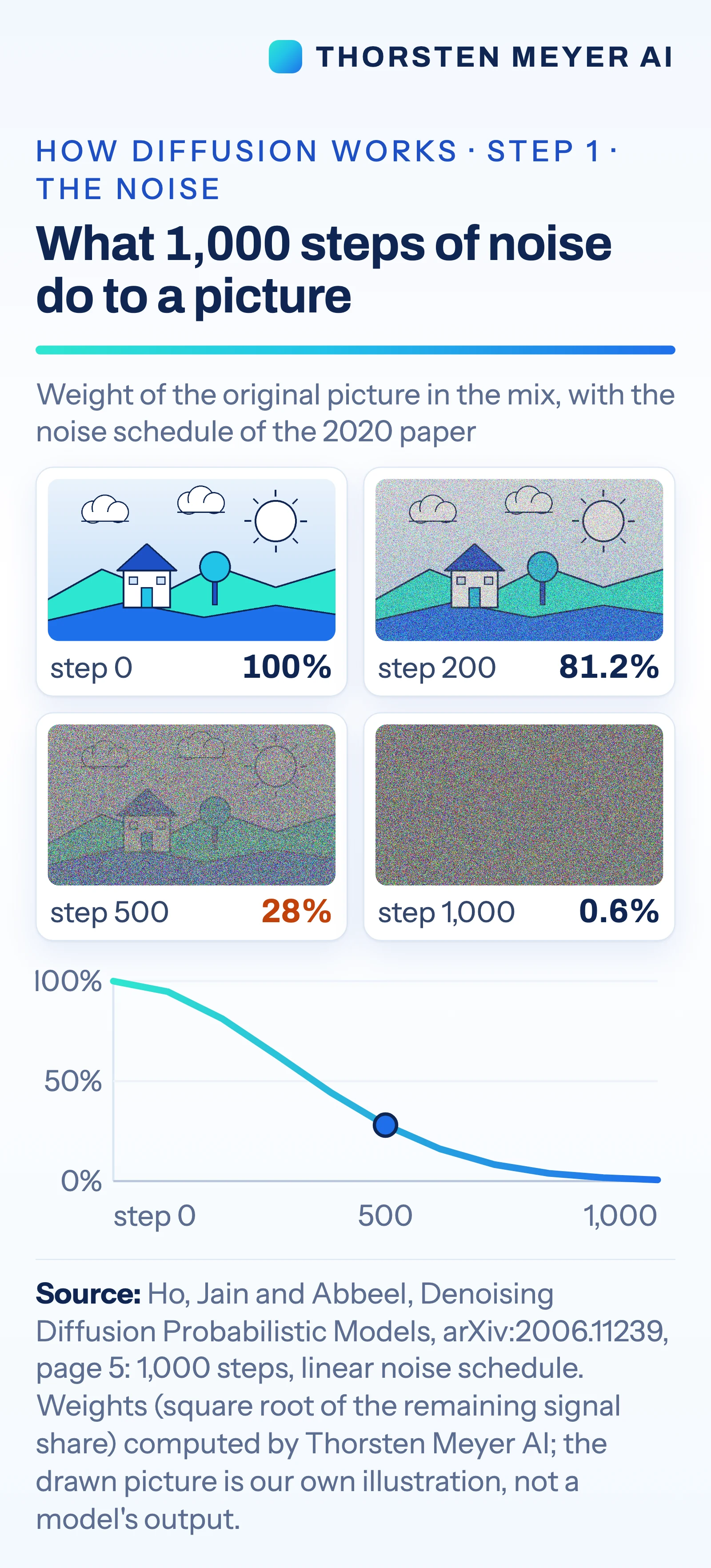
During training, a model receives real images altered by adding noise in successive steps. It learns to estimate the noise in each altered image. In the 2020 paper Denoising Diffusion Probabilistic Models, researchers Jonathan Ho, Ajay Jain and Pieter Abbeel used 1,000 steps in their experiments. The original image’s signal gradually fades until the result is effectively noise.
Image generation runs the learned process in reverse: the system starts with random noise and removes estimated noise over successive steps. The explainer says a widely used open-source pipeline commonly runs 50 steps by default, with broad shapes emerging before finer details. That figure describes a pipeline default, not a rule for every model.
Many systems use latent diffusion, which performs the denoising in a compressed representation rather than directly on every image pixel. The article says a 512-by-512 image in Stable Diffusion v1 is represented with 48 times fewer numbers. A text encoder converts a prompt into numbers, and guidance steers the denoising toward those text features. The article describes a trade-off: stronger guidance can improve prompt alignment while reducing image quality.
Why Noise Shapes Image Quality
The process explains why a prompt is an influence on image creation rather than a precise set of instructions. The system repeatedly predicts and removes noise while using text-derived signals to guide the result. That design can produce convincing scenes, yet it does not guarantee accurate lettering, object counts or spatial relationships.
The same training process also raises questions about similarity to source images. The explainer says researchers have extracted near-copies of training images from models. That finding is relevant to discussion of how models memorize data, but it does not establish that every generated image copies a particular work or resolve legal questions about training and output.
Products Worth Considering

DJI Mini 4 Pro Drone Fly More Combo with RC 2 Controller and 128GB Memory Card

Samsung Galaxy Tab S10 Lite, 10.9-Inch LCD Tablet, 6GB RAM, 128GB Storage, Expandable up to 2TB, Gray

LG UltraGear 27-inch 4K UHD IPS Gaming Monitor, Dual Mode 180Hz/360Hz, 1ms, G-SYNC Compatible
As an affiliate, we earn on qualifying purchases.
From Early Theory to Latent Diffusion
The basic approach predates current image generators. In 2015, Jascha Sohl-Dickstein and colleagues described gradually destroying structure in data, then learning a reverse process to restore it. Their paper framed the method as an iterative forward diffusion process followed by a learned reverse process.
Ho, Jain and Abbeel’s 2020 paper helped make the technique practical. It described adding noise through a Markov chain and used 1,000 steps in its experiments. Later latent diffusion systems reduced the computational burden by doing much of the work in a compressed space. The explainer cites Stable Diffusion v1 as an example, while noting that text encoding and guidance are the mechanisms that connect prompts to image generation.
The article also cites a 2025 UK court finding that Stable Diffusion itself is not an “infringing copy.” That specific finding does not settle every question about copyright, training data or individual outputs.
“systematically and slowly destroy structure in a data distribution through an iterative forward diffusion process”
— Jascha Sohl-Dickstein and colleagues, 2015 paper, as quoted by Thorsten Meyer AI
Open Questions on Copying and Control
The explainer does not establish how often models reproduce training images, or what conditions make a near-copy more likely. It also does not specify whether the 50-step default applies across model versions or configurations. The cited 2025 UK court finding addresses Stable Diffusion itself as an “infringing copy”; the article says other questions remain open. The source material does not detail those proceedings or identify which further legal questions have been resolved.
What Further Evidence Could Show
The article presents the process as an explainer rather than a report of a new model release or research result. Further clarity on memorization and copyright would depend on additional research, legal decisions and details about the systems and images involved. For readers, the practical point is to treat generated images as probabilistic results: prompts can steer a model, but the process does not guarantee exact text, counts or object placement.
Key Questions
How does a diffusion model generate an image?
It starts from random noise and repeatedly predicts and removes some of that noise. A text prompt can guide the process toward the described subject.
Why do these models struggle with words and object placement?
The process builds an image through iterative denoising rather than following a precise drawing plan. The explainer identifies lettering and spatial relationships as common weaknesses.
What is latent diffusion?
It is a method that performs much of the denoising in a compressed representation of an image. The explainer says Stable Diffusion v1 uses 48 times fewer numbers for a 512-by-512 picture.
Does the UK court finding settle copyright questions about AI images?
No. The explainer says a UK court found in 2025 that Stable Diffusion itself is not an “infringing copy,” while other questions remain open. That statement alone does not resolve every issue involving training data or generated images.
Source: Thorsten Meyer AI