📊 Full opportunity report: How Kid-Facing Companies Can Structure Consent Management on IdeaNavigator AI — validation score, market gap, and execution plan.

Get business pricing on tech for your team
- Business-only prices and quantity discounts
- Tax-exempt purchasing
- Multiple users, one account, clear invoices
TL;DR
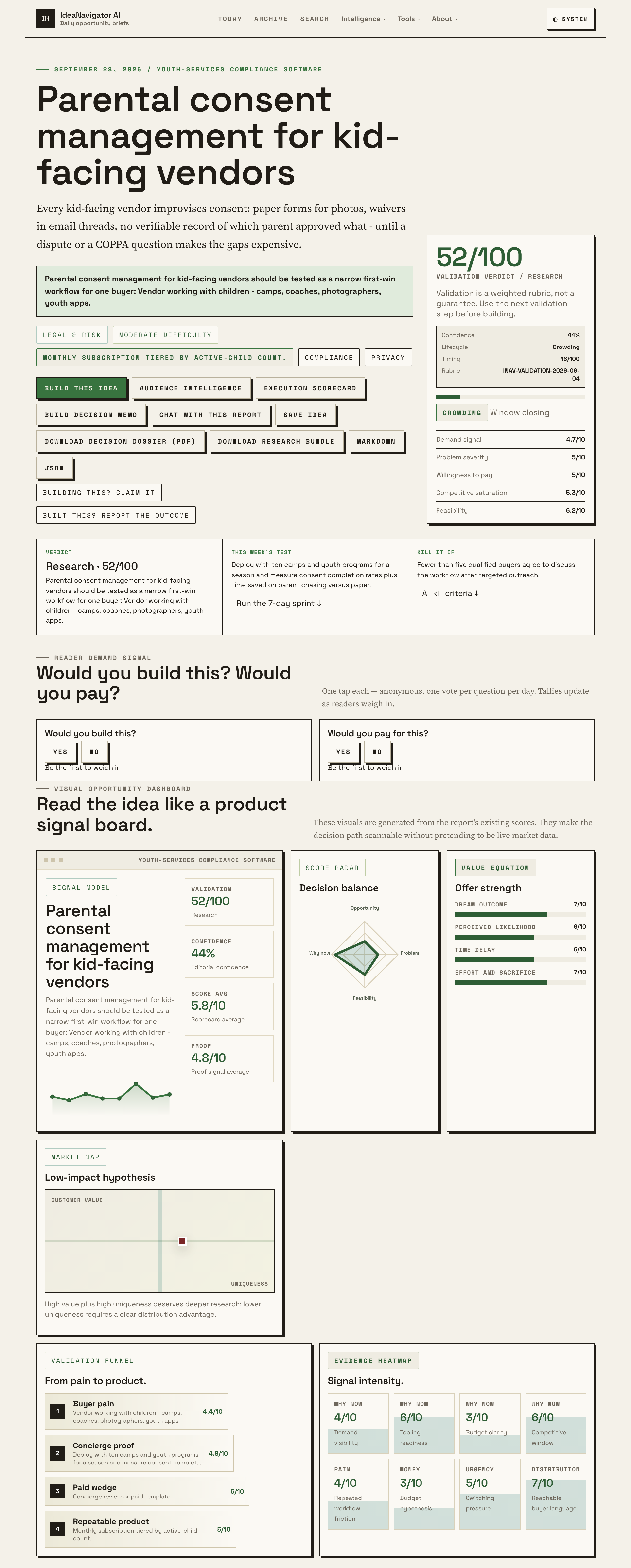
IdeaNavigator AI proposes parental consent management as a focused software play for vendors working with children — camps, coaches, photographers and youth apps. The idea responds to expanding children’s privacy enforcement, including COPPA updates and state laws, that makes improvised paper and email consent increasingly costly.
A product proposal from IdeaNavigator AI argues that businesses serving children — camps, coaches, photographers and youth apps — should move from improvised paper forms and email waivers to structured parental consent management, as children’s privacy enforcement expands and disputes over photo and data use expose gaps in vendors’ records. The proposal outlines a specific software blueprint: vendor-branded consent flows parents complete on their phones, per-child consent ledgers, expiry tracking and audit export.
The proposal identifies a specific buyer rather than a broad market: any vendor working with children, including seasonal camps, private coaches, event photographers and youth-focused applications. According to the analysis, these businesses currently handle consent in an ad hoc way — paper forms for photo permission, waivers buried in email threads, and no verifiable record of which parent approved what. The gaps become expensive, the proposal states, when a dispute arises or a regulator asks COPPA-related questions.
The proposed minimum viable product centers on vendor-branded consent flows that parents complete on their own phones. Consent types would cover photo use, data collection, medical authorization and liability, each paired with identity verification scaled to the risk tier of the decision being made. Every approval would feed a per-child consent ledger with expiry tracking, and vendors could export an audit record on demand.
The commercial model proposed is a monthly subscription tiered by active-child count, placing the product in the youth-services compliance software category. Validation is deliberately narrow: deploy with ten camps and youth programs for a season, then measure consent completion rates and time saved chasing parents compared with paper-based processes.
Why Consent Records Now Carry Legal Weight
The timing argument rests on two converging pressures. First, according to the proposal, children’s privacy enforcement is expanding, citing COPPA updates and a growing patchwork of state laws that reach smaller operators. Second, parents are increasingly likely to challenge how photos and data about their children are used, turning vague or lost paper records into a liability rather than an administrative nuisance.
For small vendors, the practical stakes are operational. A camp that cannot produce a dated, attributable record of which parent approved photo publication — and when that approval expired — has little defense in a dispute. The proposal’s emphasis on defensible consent records frames the software less as convenience and more as risk reduction for businesses that rarely have legal staff.
The Paper-and-Email Status Quo Being Replaced
Consent collection at youth-serving businesses has historically been handled through printed permission slips, signed waivers collected at check-in, and permissions negotiated over email. This approach creates several recurring problems: records are scattered, signatures are hard to verify against the actual parent or guardian, and expiry is rarely tracked, so a photo approval from one season can silently carry into the next.
Regulatory context reinforces the shift. The Children’s Online Privacy Protection Act (COPPA) governs data collection from children online and has been the subject of updated rulemaking, while a number of states have enacted their own children’s privacy statutes. The proposal positions parental consent management as a compliance-adjacent tool that serves both regulatory demands and everyday parental expectations.
What the Proposal Leaves Unproven
The analysis is a product proposal, not a deployed or validated business. No pilot results, consent completion rates, or customer adoption figures exist yet — the ten-camp deployment is a recommended next step, not a completed one. Whether vendors will pay a recurring subscription tiered by active-child count remains untested.
Several practical questions are also unresolved in the proposal: what level of identity verification satisfies regulators at each risk tier, how consent records would hold up in an actual enforcement action, and whether small seasonal businesses will adopt a new system mid-operation or only at enrollment time. The competitive landscape — established camp management and waiver platforms that already include some consent features — is not addressed.
The Ten-Camp Season Test
The stated next step is a single-season pilot with ten camps and youth programs, tracking two metrics: consent completion rates and administrative time saved compared with paper workflows. Those results would determine whether the narrow, single-buyer approach justifies building out a broader product for the youth-services compliance market.
Separately, the regulatory environment will continue to shape demand: further COPPA rulemaking and state-level children’s privacy laws could either widen the pool of vendors needing defensible records or clarify standards that existing tools already meet.
Source: IdeaNavigator AI
Key Questions
What is parental consent management for kid-facing vendors?
It is a structured system for collecting, recording and tracking parental approvals — for photo use, data collection, medical authorization and liability — so a vendor can produce a verifiable, dated record of which parent approved what, and when that approval expires.
Which businesses does the proposal target?
The proposal names a single narrow buyer: vendors working with children, specifically camps, coaches, photographers and youth apps. It deliberately excludes broader enterprise privacy compliance as a starting point.
How would the proposed product make money?
Through a monthly subscription priced by active-child count, so a small camp with fewer enrolled children pays less than a large youth program.
What regulations are driving the demand?
According to the proposal, expanding children’s privacy enforcement — including COPPA updates and state-level children’s privacy laws — plus growing parental challenges to photo and data use are pushing even small vendors toward defensible consent records.
Has the product been validated with real customers?
No. The proposal recommends a validation step — deploying with ten camps and youth programs for one season and measuring consent completion rates and time saved versus paper — but no results from that test exist yet.
Source: IdeaNavigator AI
Fall Picks
fall essentials
As an affiliate, we earn on qualifying purchases.