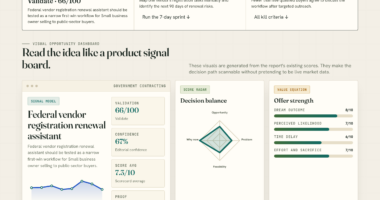

📊 Full opportunity report: Top Tools For Implementing Blended Billing In Agencies on IdeaNavigator AI — validation score, market gap, and execution plan.

Get business pricing on tech for your team
- Business-only prices and quantity discounts
- Tax-exempt purchasing
- Multiple users, one account, clear invoices
TL;DR
Agencies are testing new billing tools to combine retainer, usage, and project charges into single invoices. This shift aims to reduce errors and improve revenue tracking. The development focuses on a minimal viable product for hybrid billing workflows.
Agencies are actively testing new billing tools designed to consolidate retainer, usage-based, and project charges into a single invoice, addressing a long-standing challenge in hybrid billing management. This development is significant for operations managers at digital and AI services agencies seeking to reduce billing errors and revenue leakage.
According to recent insights from IdeaNavigator AI, the primary focus is on creating a billing workspace where an operations manager can define a client with multiple billing components—retainer, usage meter, and ad hoc charges—and generate a consolidated invoice automatically. This approach aims to replace manual, spreadsheet-based invoicing, which often results in errors and inefficiencies.
Early validation involves recruiting eight agencies to model real hybrid billing scenarios, generate invoices, and compare accuracy against their traditional methods. The goal is to demonstrate that automated, consolidated billing can be more accurate and appealing enough for agencies to switch from manual processes.
The proposed tool operates on a tiered subscription model, charging agencies based on the number of clients and a small percentage of invoiced volume. This aligns with the market’s need for scalable, flexible billing solutions tailored for agencies managing complex client arrangements.
Why Hybrid Billing Tools Are a Game Changer for Agencies
This development matters because it addresses a core pain point for agencies managing multiple billing models. Automating hybrid invoicing reduces manual errors, improves revenue accuracy, and saves time spent reconciling spreadsheets. As agencies increasingly bundle AI and digital services into retainers with usage-based fees, such tools are becoming essential for operational efficiency and financial clarity.
Adopting these tools can lead to better cash flow management and client transparency, which are critical in competitive agency markets. The success of early testing could accelerate broader adoption across the industry, transforming how agencies handle complex billing scenarios.
hybrid billing software for agencies
As an affiliate, we earn on qualifying purchases.
As an affiliate, we earn on qualifying purchases.
Growing Need for Flexible, Automated Billing Solutions in Agencies
Over recent years, agencies have shifted toward hybrid billing models, combining fixed retainers with usage-based and project-based charges. However, existing subscription billing platforms lack the flexibility to model these complex arrangements within a single invoice, leading to manual workarounds.
According to industry observations, the challenge has been compounded by the increasing integration of AI and digital services, which often require usage tracking and variable billing. This has created a gap in the market for specialized tools that can automate and simplify hybrid billing management.
Early prototypes and pilot programs, such as those referenced by IdeaNavigator AI, are testing the viability of consolidated billing workflows, with initial results indicating promising improvements in accuracy and efficiency.
“The key benefit of these new tools is the ability to generate a single, accurate invoice from multiple billing components, reducing manual errors and saving time for agency operations teams.”
— an anonymous researcher
Unclear Aspects of Tool Adoption and Long-term Impact
It is not yet confirmed how widely agencies will adopt these new billing tools after initial testing, or how they will perform at scale. Further, the long-term impact on revenue management and client relationships remains to be seen as more agencies trial and refine these solutions.
Details about the final feature set, pricing, and integration capabilities of the MVP are still emerging, and broader industry feedback is awaited.
Next Steps for Validation and Industry Adoption
Following the pilot phase with eight agencies, developers plan to analyze accuracy, usability, and client feedback. If results are positive, the next step will be broader deployment and refinement of the tool, with potential expansion into additional billing features.
Industry observers expect further case studies to emerge over the coming months, providing insight into the scalability and real-world benefits of hybrid billing automation for agencies.
Key Questions
What are blended retainer-plus-usage billing models?
Blended retainer-plus-usage billing combines fixed monthly fees with variable charges based on actual usage or additional services, allowing agencies to bill more accurately for complex client arrangements.
How do these new tools improve agency billing processes?
They automate the creation of consolidated invoices that include multiple billing components, reducing manual work, errors, and reconciliation time.
Are these tools suitable for all agencies?
Initially, these tools are aimed at agencies managing hybrid billing models, particularly those integrating AI or digital services. Broader applicability will depend on further development and industry feedback.
When can agencies expect to see these tools widely available?
Following successful pilot testing, broader availability could occur within the next 6 to 12 months, depending on adoption and further development outcomes.
What are the main challenges in implementing hybrid billing tools?
Challenges include integrating with existing agency systems, ensuring billing accuracy across diverse client setups, and gaining industry trust in automated solutions.
Source: IdeaNavigator AI
Fall Picks
fall essentials
As an affiliate, we earn on qualifying purchases.