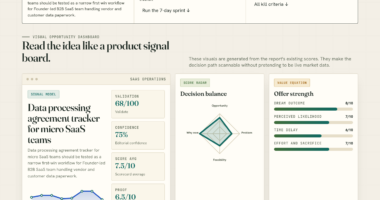

📊 Full opportunity report: Briefro: A Document That Tells The Truth on ThorstenMeyerAI.com — validation score, market gap, and execution plan.

Get tech for your team delivered free — and shop member deals
- Fast, free delivery on millions of items
- Access to Prime Big Deal Days deals on October 6–7
- Prime Video, Amazon Music and more included
TL;DR
Briefro, an AI-powered document tool, is now available in its first version, emphasizing data accuracy, privacy, and brand consistency by running entirely on local hardware. It aims to address trust issues in AI-generated documents.
Briefro has officially shipped its first version, a document generation tool designed to produce accurate, branded, and privacy-preserving documents entirely on local hardware. This development marks a significant step in addressing trust and compliance concerns associated with AI-generated content, especially in regulated industries.
The product is built around three core commitments: it runs entirely on the user’s hardware, ensuring data privacy and IP security; it binds figures directly to real data sources, preventing divergence or errors; and it maintains consistent branding across outputs through automated styling. These features aim to make AI-generated documents more trustworthy and compliant, particularly for finance, legal, healthcare, and client-facing work.
According to the company, Briefro’s current release is a functional v1, capable of generating proposals, reports, and decks with live data links, locked legal language, and brand customization. Some advanced features, such as the ‘what-if’ scenario engine, are still in development and not yet fully integrated, but the foundational trust architecture is operational and proven to work.
A Document That Tells the Truth
A prompt becomes a polished, branded deck, document, or proposal — where every figure is bound to your actual data, the regulated language is locked, the export is reproducible, and the whole thing is generated on hardware you own.
re-upload the data and this figure updates itself. A pasted number drifts; a bound one can’t.
The v1 contract deliberately killed the marketing site — spec written, then archived with “do not build any of it now.” The app shipped; briefro.com served nothing; four legal pages 404’d to an empty /. Subtraction taken to its end — refused until the product was real. This is the work of finally building it.
main, staged as one clean concern, committed once, and merged by PR — the dirty branch never touched.stdin, never on the command line, so the password never hit the process list.- Rotate the FTP password. It was pasted into a setup transcript, so it’s flagged for rotation as a precaution — noted, not buried.
- One-command redeploy pending. A deploy script that bakes in the control-only-TLS font trick is still to be written.
- What-if is unmerged and broken. The scenario engine reaches the KPIs but not yet the chart’s value labels; it lives on a local branch until the bug is fixed.
- Frontier vs. core. The trust architecture — local generation, data-binding, locked clauses, deterministic export — is load-bearing; some features around it are still evolving.
Independent commentary, produced with AI assistance under human editorial oversight. The views are the author’s own and may change. This is not business, financial, legal, or technical advice. Briefro is an early-stage product; some capabilities are shipped while others are in development or unmerged. Legal-page references describe templates, not advice. Infrastructure identifiers and credentials have been deliberately omitted. Product, model, and company names are trademarks of their respective owners; mention does not imply endorsement.
Impact of Local, Data-Bound Document Generation
This development is significant because it addresses longstanding issues of data drift, confidentiality, and compliance in enterprise document workflows. By ensuring that figures are directly linked to source data and never leave the local environment, Briefro offers a solution to the privacy and legal risks posed by cloud-based AI tools. This could reshape how regulated industries adopt AI for document creation, reducing barriers related to data security and auditability.
local AI document generation software
As an affiliate, we earn on qualifying purchases.
As an affiliate, we earn on qualifying purchases.
Background on Trust Challenges in AI Document Tools
Traditionally, AI tools for document creation rely on cloud services, raising concerns about data privacy, intellectual property, and accuracy. Many organizations avoid cloud AI due to regulatory restrictions, especially in finance, healthcare, and legal sectors. Existing solutions often involve manual updates, copying, and pasting, which can introduce errors or inconsistencies. Briefro’s approach — running entirely on local hardware and binding figures to real data — directly addresses these issues, representing a shift toward more secure, reliable AI-assisted documentation.
“Our product is designed to make AI-generated documents trustworthy by ensuring they are grounded in real data, run locally, and maintain brand consistency without exposing sensitive information.”
— Thorsten Meyer, CEO of Briefro
Unresolved Aspects of the Current Release
While the core features are operational, some advanced capabilities, such as the ‘what-if’ scenario engine, are still under development and have known bugs. It is not yet clear how the product will scale in complex enterprise environments or how it will perform with very large datasets. The long-term roadmap and user adoption are still to be seen, and there is no information yet on broader deployment or integrations.
Upcoming Features and Deployment Plans
Briefro plans to release the full ‘what-if’ scenario engine and enhance integration capabilities in the coming months. The company will likely seek early adopters in regulated industries for pilot programs and gather feedback to refine features. Wider availability and potential enterprise licensing options are expected after initial testing phases.
Key Questions
How does Briefro ensure document accuracy?
Briefro binds figures directly to live data sources, updating automatically when data changes, which prevents divergence and transcription errors.
Is data really kept on local hardware?
Yes, all document generation occurs entirely on the user’s hardware, ensuring sensitive data never leaves the local environment.
What industries will benefit most from Briefro?
Regulated industries such as finance, legal, healthcare, and enterprise client services are primary targets due to their strict data privacy and compliance requirements.
Are advanced features like ‘what-if’ scenarios available now?
The core product is shipped, but some advanced features, including the ‘what-if’ engine, are still in development and not yet fully functional.
Source: ThorstenMeyerAI.com
Halloween Picks
halloween
As an affiliate, we earn on qualifying purchases.