
TL;DR

Get business pricing on tech for your team
- Business-only prices and quantity discounts
- Tax-exempt purchasing
- Multiple users, one account, clear invoices
IdeaClyst is a local-first, AI-powered war room designed for founders to rigorously test, debate, and refine ideas. It replaces hope and gut feeling with structured analysis, saving time and money while increasing the chance of success.
Imagine having a dedicated war room where every idea is challenged, dissected, and refined — without leaving your laptop. That’s the promise of IdeaClyst. This isn’t just another brainstorming app; it’s a structured environment that mimics the most intense, productive meetings you’ve ever had with your team, but powered by AI and grounded in real research.
Why does this matter? Because most startup failures come from building the wrong thing — not poor execution or bad luck, but a lack of clear, evidence-based decision-making. With IdeaClyst, you get a local-first, debate-driven workspace that helps you cut through the noise, evaluate ideas critically, and make smarter bets faster.
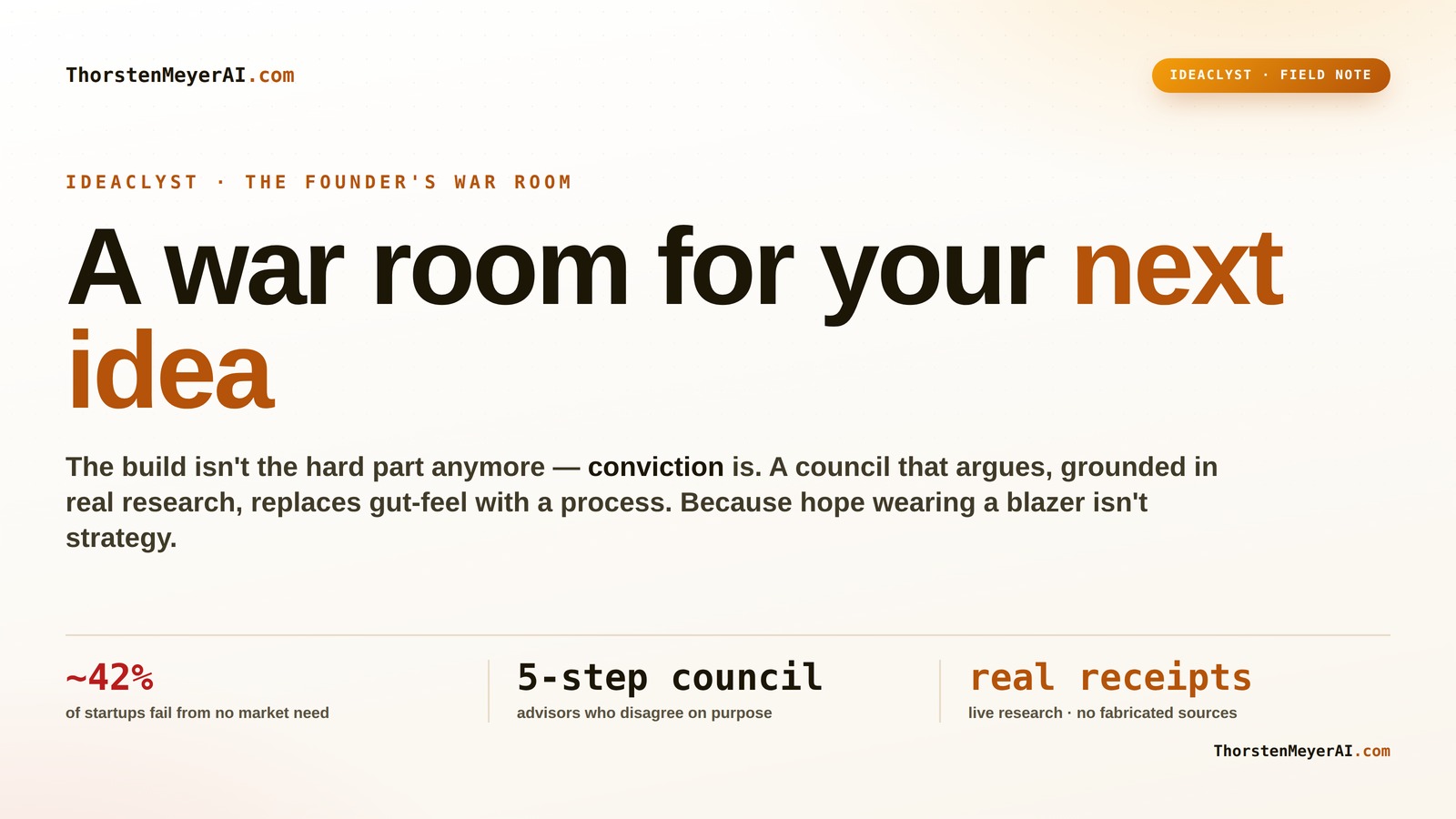
.A war room for your next idea
The build isn’t the hard part anymore — conviction is. Knowing which idea deserves the next six months, and being able to defend it. Most founders answer with gut feel and optimistic math. That’s hope wearing a blazer. IdeaClyst replaces it with a process.
The most expensive decision is what to build
The single most valuable thing a tool can do is talk you out of the wrong six months. The numbers make the case better than any pitch.
Three tools in one — on your own machine
Strip away the framing and IdeaClyst is three things at once, all running locally with nothing leaving your laptop.
An AI council
Pressure-tests an idea you bring it — advisors who argue on purpose.
A discovery engine
Finds ideas you didn’t know to look for by hunting real demand signals.
A founder’s workspace
Carries winners from “interesting” all the way to “ready to build.”
Advisors who disagree on purpose
Not one confident, agreeable answer — a structured five-step deliberation where models play different roles and turn on their own work. The disagreement is the feature.
The five-step deliberation
A council that leads with the bad news surfaces the objections you’d otherwise find the expensive way, on month five.
Product strategy
Who’s it for, what’s the wedge, why now, what’s the business model.
Technical architecture
What would it actually take to build — and where’s the risk.
Critique pass
The council turns on its own work. Where’s the hand-waving? What kills this?
Second, independent critique
A different voice, a different angle — so blind spots don’t survive.
Final synthesis
Everything into one coherent founder packet: strategy, architecture, validation, plan.
When IdeaClyst cites a source, it actually fetched it
The hard departure from “ask an AI what it thinks of my startup.” It runs in a strict, real-data-only mode — if it can’t gather genuine evidence, it says so plainly rather than inventing a plausible paragraph.
Confidence with receipts
No fabricated statistics, no imaginary competitors, no made-up citations. The packet survives a skeptical co-founder or a sharp investor because the reasoning has receipts.
Market research first
Scouts the landscape before the council reasons about anything.
Competitor read
Real positioning, pricing signals, feature claims — differentiation vs. reality.
Validation with links
Not “talk to customers” — concrete signals & sources you can click.
From the blank page to build-ready
Evaluation is half the problem; the blank page is the other half. And a plan is worthless if it dies in a tab you never reopen.
Bring a space, not an idea
“AI for accountants,” “tools for indie game studios” — plus your goal and real capacity. It hunts demand signals across HN, Reddit, Product Hunt, GitHub, pricing pages.
- An honest market read — leads with the bad news when a space is hard
- An opportunity map — high pain, thin competition
- Ranked candidates — wedge, who pays, effort, risk, confidence
- each with KILL CRITERIA — when to walk away
A home and a forward path
Every promising idea gets carried forward, with every artifact in plain files on your disk.
- Validation tooling — sprint board, interview list, evidence browser
- Founder profile — a personal-fit lens; same discovery, different advice
- Build workspaces — funnel, personas, landing draft, version history
- “Build this idea” → a PRD + task queue, ready for a coding agent
Key Takeaways
- IdeaClyst’s structured debate process surfaces flaws early, saving time and money.
- Grounding advice in live web research makes recommendations reliable, not just confident guesses.
- The local-first architecture keeps your ideas private and secure, especially for sensitive projects.
- The five-step process turns fuzzy ideas into detailed, actionable plans stored on your own disk.
- Perfect for founders and teams who want faster, smarter decision-making grounded in evidence.
AI-powered idea validation software
As an affiliate, we earn on qualifying purchases.
As an affiliate, we earn on qualifying purchases.
What makes IdeaClyst a true ‘war room’ for your ideas?
Think of a war room as your strategic command center — a place where every move is scrutinized, and conflicting opinions clash to reveal the truth. IdeaClyst recreates that environment digitally. It hosts a structured debate between AI models playing different roles — product strategist, technical architect, critic, and reconcilor.
This setup forces your idea to face its own weaknesses. Discover how AI tools can help in strategic planning. For example, you might bring a new app concept. The council asks: Who’s the target? What’s the unique wedge? What are the technical risks? It’s like a team of advisors grilling your idea from every angle, leaving no stone unturned. Learn more about AI-powered war rooms.
This process doesn’t produce vague feedback. Instead, it generates a detailed, organized report — a founder packet — that includes strategy, architecture, critiques, and validation plans, all saved as Markdown files on your local machine. It’s like having a team of skeptics and strategists working 24/7 inside your laptop.
How the AI council sparks honest debate and uncovers hidden flaws
The real power of IdeaClyst lies in its structured debate process, which goes beyond surface-level feedback. By orchestrating five distinct stages—strategy, architecture, critique, second critique, and synthesis—it encourages a comprehensive exploration of ideas. Each stage involves AI models assuming different roles, such as skeptics, advocates, or analysts, creating a multi-faceted examination of your concept.
This layered approach is crucial because it mimics the natural tension and dialectic of real-world debates, where conflicting viewpoints expose blind spots and challenge assumptions. For example, the critique models will question your market size or technical feasibility, forcing you to confront potential weaknesses early. This process matters because unchallenged assumptions are often the root of costly failures; uncovering them beforehand can save months and thousands of dollars.
The structured disagreement pushes founders to consider alternative perspectives and identify risks they might have overlooked. It’s akin to having a panel of experts dissect your idea from every angle, ensuring that what survives this process is more resilient and better validated. The tradeoff, however, is that this process requires honest engagement and interpretation—founders must be willing to confront uncomfortable truths and act on the insights generated.
Grounding ideas in real research, not just model vibes
One of the biggest pitfalls in early-stage idea validation is relying on AI’s confidence without concrete evidence, which can lead to false assurance. IdeaClyst counters this by anchoring its assessments in live web research, pulling in current, real-world data to support or challenge assumptions. This approach transforms subjective guesses into evidence-backed insights, which are far more reliable for critical decision-making.
For example, instead of vaguely stating “the market is growing fast,” the platform provides recent statistics, competitor movements, and customer trends from trusted sources. This depth of research is vital because it helps founders understand the actual landscape and avoid building on outdated or overly optimistic assumptions. Check out espionage and intelligence tools for strategic insights. The implication is that decisions are based on facts, not just intuition or superficial analysis, which significantly reduces the risk of costly missteps.
According to industry data, building a product that doesn’t meet market needs can cost over $150,000 within six months. Many founders skip rigorous validation due to time constraints, but IdeaClyst compresses this process from months to hours, giving you a solid foundation to decide whether to proceed, pivot, or abandon an idea. This evidence-based approach ultimately means fewer wasted resources and more confident, informed choices.
The local-first approach: why keeping everything on your machine matters
Unlike most AI tools that run in the cloud, IdeaClyst works entirely on your own computer. All your ideas, reports, and plans are stored as plain files on your disk — no cloud account, no API keys, no subscription.
This local-first design isn’t just a technical choice. It’s a strategic decision that prioritizes your control over your intellectual property and data security. Learn more about AI content creation and security. In an era where data breaches and privacy concerns are escalating, keeping your sensitive ideas on your own device minimizes exposure and risk. It also ensures that your work remains accessible even without internet access, providing continuity and peace of mind.
For example, a founder developing a confidential health-tech application can run IdeaClyst without worrying about leaks or GDPR compliance. This approach empowers innovators to work freely, knowing their proprietary concepts are protected. The tradeoff is that you must manage your own data security, but for many, the peace of mind and privacy benefits outweigh the inconvenience. Ultimately, this design choice aligns with the needs of serious innovators who prioritize privacy and control over convenience.
Inside the structured process: turning raw ideas into actionable plans
The real magic happens when raw, half-formed ideas go through IdeaClyst’s five-step process. Each step acts as a filter, challenge, and refinement cycle, progressively transforming vague concepts into clear, detailed strategies. This systematic approach ensures that no critical aspect is overlooked, and the final output is a comprehensive plan ready for implementation.
Starting with a simple idea—such as a one-sentence problem statement—the process guides you through defining strategy, assessing technical feasibility, exposing weaknesses, challenging assumptions from multiple angles, and synthesizing insights into a coherent plan.
Here’s a quick look at the process:
| Step | What Happens | Outcome |
|---|---|---|
| 1. Strategy | Define target, value proposition, and market fit | Clear strategic focus |
| 2. Architecture | Assess technical risks and build plan | Feasible tech roadmap |
| 3. Critique | Identify flaws and assumptions | Weak points exposed |
| 4. Second Critique | Different angles challenge the plan | Robust, balanced view |
| 5. Synthesis | Combine insights into final plan | Ready-to-build document |
This structured process is crucial because it prevents impulsive decisions based on incomplete information. Instead, it ensures that each idea is examined thoroughly from multiple perspectives, reducing risks and increasing confidence. The final product is a vetted, evidence-backed plan stored locally, ready for presentation or development. The tradeoff is that it requires deliberate engagement, but the payoff is a much higher likelihood of success and fewer costly surprises down the line.
Frequently Asked Questions
What exactly is IdeaClyst?
IdeaClyst is a local-first AI-powered platform that acts as a structured war room for your ideas. It stages debates, validates assumptions with real web research, and helps turn fuzzy concepts into detailed, actionable plans — all stored securely on your own machine.Is IdeaClyst a tool, framework, or service?
It’s primarily a software tool designed around a framework of structured debate and validation. It’s open-source, runs entirely locally, and provides a repeatable process to refine and validate ideas efficiently.How does the war room differ from normal brainstorming?
Unlike casual brainstorming, the war room forces structured disagreement among AI models playing different roles. This pushes your idea through rigorous critique, surfacing risks and flaws that might otherwise be overlooked.Who can use IdeaClyst, and is it for individuals or teams?
It’s ideal for solo founders, product teams, and innovation groups who want to make smarter decisions faster. Its structured, evidence-based process scales from one person to collaborative teams.What are the biggest strengths and limitations?
Strengths include grounded research, local control, and structured debate. Limitations involve reliance on the quality of input and the need for founders to interpret and act on the reports generated.Conclusion
Building your next big thing doesn’t have to be a leap into the unknown. With IdeaClyst, you craft a battlefield of honest debate, rigorous research, and disciplined planning — all on your own machine. It’s a revolution in how founders turn raw ideas into validated, ready-to-build strategies.
Next time you’re stuck between three options, remember: your best decision is the one you’ve challenged the most. And with IdeaClyst, that challenge is just a few clicks away.
Evergreen bestsellers Picks
bestsellers
As an affiliate, we earn on qualifying purchases.