
TL;DR

Get business pricing on tech for your team
- Business-only prices and quantity discounts
- Tax-exempt purchasing
- Multiple users, one account, clear invoices
Mistral is betting on sovereignty, control, and open weights to stand out in Europe’s regulated markets. While this appeals to certain customers, critics argue it may lag behind in technical benchmarks. The real question: is it a strategic edge or a retreat?
When a company positions itself as a defender of sovereignty in AI, it raises eyebrows. Is this a clever strategic play or a sign it’s already falling behind the front-runners? Mistral’s recent summit in Paris made it clear: they’re betting on control, transparency, and European independence. But the question remains—are they building a different game, or just playing from behind?
Understanding Mistral’s move requires peeling back the layers—what they say, what critics argue, and the reality of the AI market today. This isn’t about hype. It’s about real choices, real trade-offs, and what they mean for the future of AI in regulated markets. Learn more about AI industry insights.
Different game, or already lost?
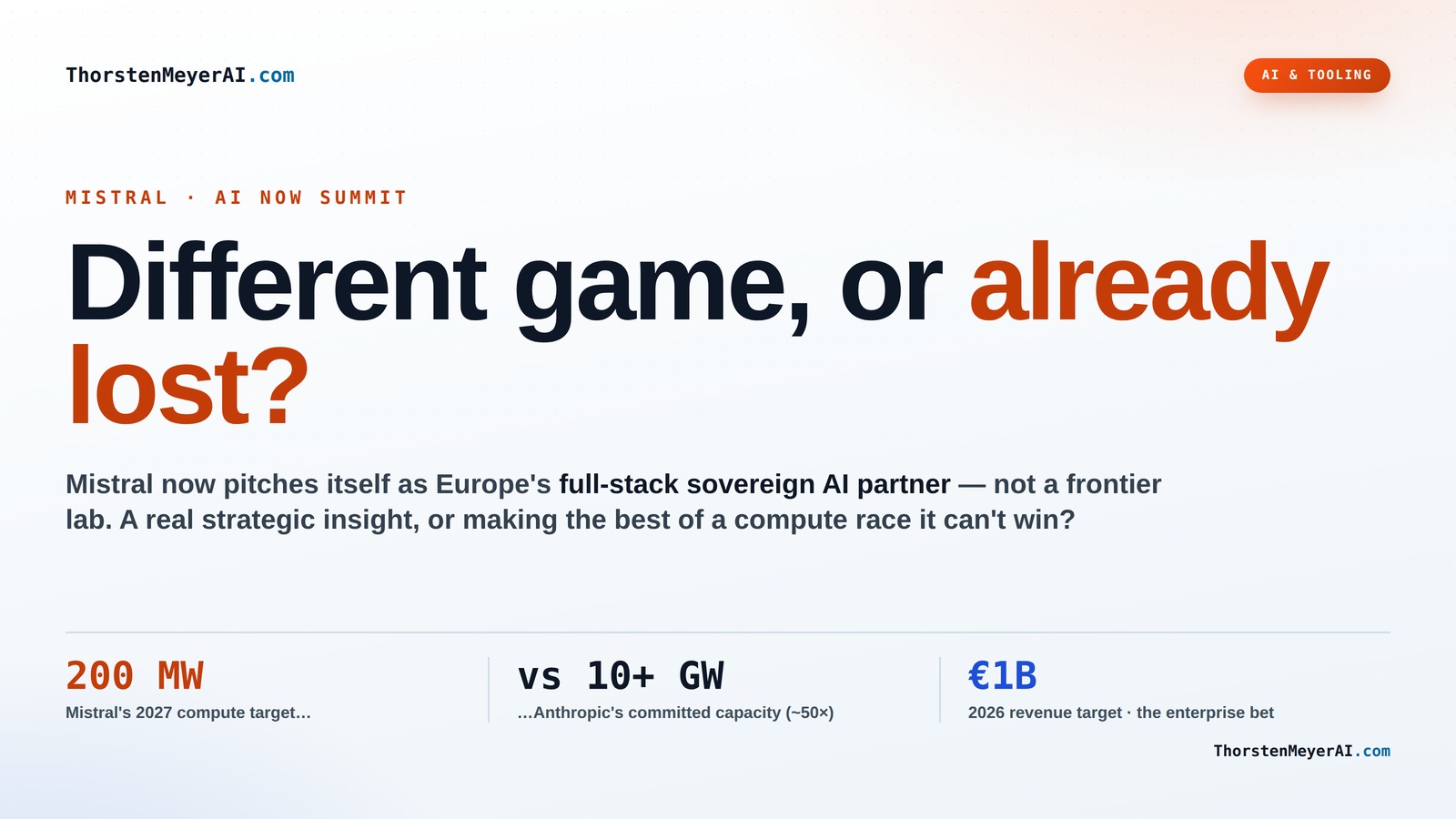
Mistral now pitches itself as Europe’s full-stack AI provider — compute, models, platform, consultancy — not a frontier-model lab. Is that a real strategic insight, or making the best of a race it can’t win? Both readings fit the same facts.
From model lab to full-stack provider
The clearest signal from the summit wasn’t a model — it was a posture. Heavy on enterprise logos and partnerships (ASML, BNP Paribas, Alexa+), light on new-model announcements. That absence is exactly what skeptics seized on.
Compute
40MW Paris DC + Sweden build · 200MW target by 2027
Models
Open & custom · efficient · you own and run them
Platform
Forge for custom models · Vibe for Work agent
Consultancy
Sales teams, integrators, EU provenance & support
Small & focused, or large & general?
Mistral bets on specialized small models. The claim isn’t that they win a reasoning leaderboard — they don’t. It’s that on the metrics that matter in production agent systems, a purpose-built small model wins. Flip the metric to see the case reverse.
Small specialized vs large general — by what you measure
In token-heavy agentic apps making hundreds of calls, speed/energy/cost compound. Toggle the metric.
Narrow models doing real work
Each is one model doing one thing efficiently — the tangible version of the strategy. Strong on their own terms; the open question is whether the bundle beats a free Chinese open-weight download.
On-prem KYC compliance
Mistral models run inside the bank’s walls for know-your-customer checks. Sensitive financial data never leaves. (BNP was Mistral’s first customer, 2023.)
Voxtral multilingual voice
A focused voice model powering Alexa+ across Europe — speed and efficiency over raw size.
Robostral industrial robotics
Plus a “physics AI” push (via the Emmi acquisition) into aerospace, automotive & semiconductor design and simulation.
Document AI / OCR at scale
Large-scale text extraction — the unglamorous, high-volume enterprise work small models excel at.
The strategy is downstream of the compute gap
Once you see the raw numbers, “why is Mistral behind?” answers itself — and the specialized-small-model strategy starts looking partly like a smart adaptation to a binding constraint, not a pure philosophical choice.
Compute & capital · Mistral vs a frontier leader, this same week
Not a knock — it’s the constraint that forces the efficiency-first, sovereignty-wedge strategy. Adapting intelligently to your position is what good strategy is.
“I want them to win, but I’m worried”
That ambivalence is the most accurate read of where Mistral sits. The enterprise pivot gets read two opposite ways — and both deserve airing.
On-prem, real sales teams, the Koyeb deployment acquisition, EU provenance — exactly what regulated enterprises want, and stickier than consumer mindshare. Targeting €1B revenue in 2026 with 1,000 staff, up from 15 people and one customer in 2023. US closed-API labs structurally can’t match the sovereignty axis.
“Software consultancy with a data center,” not a foundation-model moat. Enterprise B2B is where European startups go when they can’t win consumer or world-scale SaaS. Why pay Mistral on-prem when you could run Qwen free? One paying Le Chat Pro user said the quality gap with frontier labs is now hard to ignore.
Key Takeaways
- Mistral’s sovereignty-first strategy focuses on open weights, self-hosting, and European control, appealing to regulated sectors.
- Tradeoff: they prioritize deployment control and compliance over beating giants on reasoning benchmarks.
- Small, purpose-built models can outperform larger ones in real-world applications where speed and cost matter.
- Their approach suits European data laws, but scaling globally may require balancing technical performance with control.
- The big question: is this a strategic edge or a retreat in the AI race? Both views have merit—depends what markets matter most to you.
European AI model hosting platform
As an affiliate, we earn on qualifying purchases.
As an affiliate, we earn on qualifying purchases.
What Does ‘Sovereign’ Really Mean for Mistral?
Mistral’s sovereignty isn’t just a buzzword; it’s their core identity. It means giving European customers control over their AI weights, data, and deployment. Think of a bank or government holding its own keys to sensitive info, instead of trusting US or Chinese cloud giants. Explore security and espionage tech.
For example, BNP Paribas runs Mistral models on-prem, keeping financial data inside their own walls. This isn’t just about security—it's about compliance, trust, and independence. This approach appeals to regulated sectors where control over data is non-negotiable.
By emphasizing sovereignty, Mistral aims to differentiate itself in a crowded AI landscape, where data laws and trust are increasingly critical. This focus on control not only mitigates geopolitical risks but also allows European clients to innovate without relying on external cloud providers that may be subject to different jurisdictional laws. However, this tradeoff often means sacrificing the raw performance and scale that cloud-based giants can offer, which could impact their competitiveness in certain benchmarks or rapid innovation cycles.

Is Mistral Competing on Quality or Control? The Big Tradeoff
Mistral’s strategy is clear: prioritize control, customization, and compliance over raw model performance. They’re not trying to beat OpenAI or Google on reasoning benchmarks. Instead, they focus on open weights, self-hosting, and European support.
This creates a fundamental tradeoff that impacts their competitive positioning. By choosing control, they limit their models’ size and complexity, which often correlates with reasoning power. This means that in benchmarks designed to measure reasoning, comprehension, and scale, Mistral’s models might lag behind the giants. But the implication of this tradeoff is profound: for certain sectors—like finance, healthcare, or government—control and compliance are non-negotiable, and the performance gap in benchmarks might be an acceptable sacrifice for increased trustworthiness and legal compliance. Stay updated on AI news and tools.
In essence, Mistral is betting that a controlled, transparent, and sovereign AI environment will be more valuable in regulated markets than raw performance metrics alone. This strategic choice could redefine what success looks like in niche markets where security, trust, and legal adherence outweigh headline benchmark scores.

Why Smaller, Faster Models Are a Big Deal in Production
Mistral’s focus on small, purpose-built models isn’t about chasing the biggest headline scores. It’s about real-world efficiency—speed, energy use, and cost per token. These factors matter more in daily use, especially for enterprise apps.
Imagine a voice assistant that needs thousands of tiny model calls. A small, optimized model can do this faster and cheaper than a giant model that’s overkill. Mistral’s Voxtral for multilingual voice and Robostral for industrial robotics are perfect examples. Discover more about AI deployment strategies.
One expert summarized it well: 'In production, speed and cost matter more than how well you do on reasoning tests.' That’s why Mistral’s small models are gaining ground in practical deployments. This approach underscores an important shift in AI deployment: that scale and raw accuracy, while impressive, are not the sole drivers of value. Instead, efficiency, responsiveness, and cost-effectiveness are increasingly critical, especially in enterprise settings where operational constraints are tight. Smaller models can be deployed more widely, updated more frequently, and integrated into real-time systems, giving them a tangible edge in practical applications.

The Real Edge: European Regulated Markets and Data Control
Mistral’s on-prem, open-weight approach resonates with European regulators and enterprises. They want to keep their AI weights, control upgrades, and ensure compliance. This isn’t just a market trend—it's a strategic niche.
For example, Abanca uses Mistral’s agent orchestration for sensitive customer data, avoiding the need to send info outside their secure environment. That’s a game changer for regulated sectors.
This approach gives Mistral a distinct advantage in Europe, where laws demand strict data sovereignty and where trust in US giants is shaky. By enabling clients to self-host and maintain control over their models, Mistral provides a compelling alternative to cloud-dependent solutions. Explore advanced AI and industry insights.

Are They Falling Behind or Playing a Different Game?
Is Mistral losing ground in the technical race, or are they just choosing a different path? Critics point to recent benchmarks showing smaller models lagging behind the latest giants on reasoning and comprehension. They worry Mistral’s model quality might not keep up. Read more about the sovereignty debate.
But supporters argue that for their target market—regulated enterprises—speed, control, and compliance matter more. It’s a different game, not necessarily a losing one. The key implication is that success isn’t solely measured by benchmark scores; it also depends on the ability to meet strict legal, security, and operational requirements that larger models might struggle to satisfy. In certain sectors, the value of a controllable, transparent, and compliant AI can outweigh the raw reasoning power of the largest models. Moreover, recent evidence suggests Mistral’s models excel in specialized tasks like OCR, multilingual voice, and industrial AI—areas where smaller, optimized models can outperform larger, more general-purpose ones—highlighting a strategic differentiation rather than a weakness.
Therefore, whether Mistral is falling behind or playing a different game depends on the metrics and markets you prioritize. In niche, regulated sectors, their approach might be more aligned with actual needs than headline benchmark performance.

What the Future Holds for Mistral and Sovereignty AI
The future of Mistral hinges on whether European enterprises and governments prioritize control and compliance over raw AI power. Their sovereignty-first approach might lock in a niche market, but scaling beyond that requires balancing technical competitiveness.
With growing concerns over data privacy and regulation, their strategy could become more relevant—even globally. But if larger models continue to outpace small ones on reasoning, Mistral must innovate faster.
One thing’s clear: the sovereignty debate isn’t going away. It’s reshaping how AI companies define success—beyond just benchmark scores.
Frequently Asked Questions
What does ‘sovereign’ mean in Mistral’s case?
In Mistral’s context, sovereignty means giving European clients full control over their AI models, weights, and data—often by hosting models on-premises—so they can meet strict data laws and maintain independence from US or Chinese cloud providers.Is Mistral competing on model quality or control?
They’re mainly competing on deployment control, customization, and compliance. Their models may lag behind giants in reasoning tests, but they excel in environments where security, privacy, and local control are paramount.How is open-weight AI different from closed API models?
Open-weight AI allows you to download and run the model locally, giving full control and customization. Closed API models are hosted externally, limiting access to the API provider’s infrastructure, which means less control but easier deployment.Why would European enterprises choose Mistral over US providers?
Because Mistral offers control over data and models, compliance with strict EU laws, and the ability to self-host, making them attractive for regulated sectors wary of US data policies and cloud dependencies.Is Mistral falling behind or just playing a different game?
Both are possible. Critics say they lag in reasoning benchmarks, but supporters argue their focus on control and speed makes them a strategic player in niche markets. It’s a different approach—whether it’s winning or losing depends on future priorities.Conclusion
In a landscape dominated by giants, Mistral’s focus on sovereignty is both a shield and a statement. They’re choosing control, compliance, and local power over chasing the fastest benchmarks. Whether this is a winning strategy or a retreat depends on what future AI users value most—trust or scores.
For now, their move cements a new frontier: one where control and transparency are king. If you’re betting on the future, remember this: the game isn’t just about who’s fastest. It’s about who owns the keys.

Halloween Picks
halloween
As an affiliate, we earn on qualifying purchases.