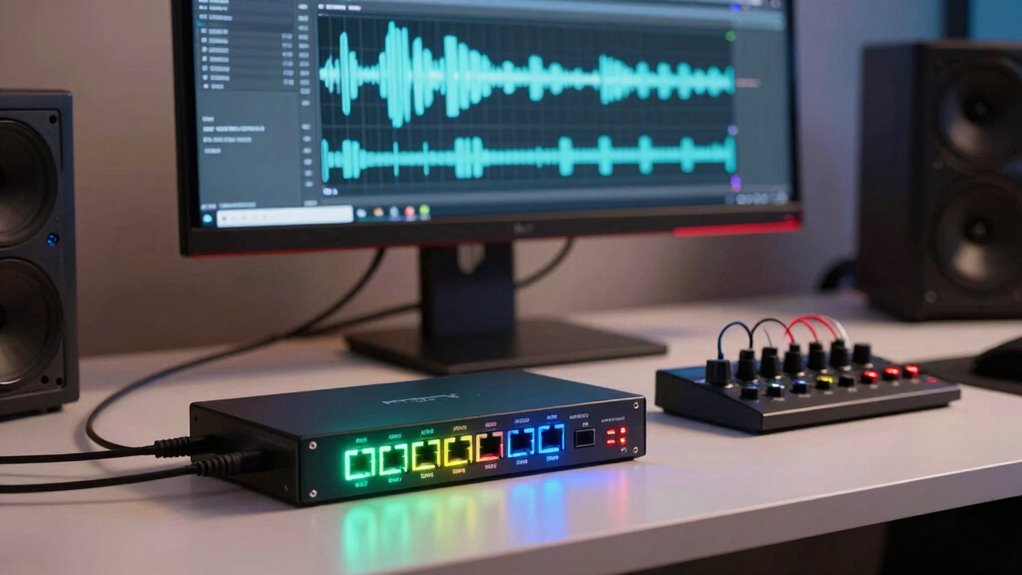

10GbE now makes sense for your home studio because affordable hardware options, faster data speeds, and lower latency remove previous barriers. Built-in ports on motherboards and cost-effective switches mean setting up a professional-grade network is easier than ever. You’ll experience less delay, quicker file transfers, and smoother real-time editing. As a result, your workflow becomes more reliable and efficient. Keep exploring to discover how this technology can truly transform your music production environment.

Get business pricing on tech for your team
- Business-only prices and quantity discounts
- Tax-exempt purchasing
- Multiple users, one account, clear invoices
Key Takeaways
- Hardware improvements have made 10GbE affordable and easy to integrate into home studio setups.
- Faster data transfer speeds enable quick handling of large audio files and sessions.
- Reduced latency ensures real-time monitoring and seamless editing workflows.
- Built-in 10GbE ports on motherboards simplify setup and future-proof the studio infrastructure.
- Enhanced network reliability minimizes delays and dropouts during critical recording and collaboration.

For years, 10GbE (10 Gigabit Ethernet) has been seen as a solution mainly for large studios, but recent advancements have finally made it a practical option for home recording setups. The primary benefit of upgrading to 10GbE lies in its ability to drastically reduce network latency and improve data transfer speeds. When you’re working with multiple audio tracks, virtual instruments, and large sample libraries, even small delays can disrupt your flow and compromise your creative process. By switching to 10GbE, you minimize these delays, ensuring your system responds instantly and your workflow remains seamless.
Network latency is often overlooked but plays a critical role in home studio efficiency. Lower latency means less delay between your input and what you hear, which is essential for recording and real-time monitoring. Traditional Ethernet or Wi-Fi connections can introduce noticeable lag, especially with larger projects or complex routing. With 10GbE, you experience near-instant data movement across your local network, enabling smoother recording sessions and real-time editing without the frustrating audio dropouts or sync issues. This is especially beneficial if you’re collaborating remotely or sharing files between multiple devices.
Lower latency with 10GbE ensures seamless recording, real-time editing, and smooth collaboration across devices.
Data transfer speeds are another game-changer. Standard gigabit Ethernet maxes out at around 125 MB/s, which can be limiting when you’re moving large audio files or sample libraries. In contrast, 10GbE provides speeds up to 1.25 GB/s, allowing you to transfer entire session files in seconds rather than minutes. This efficiency means less time waiting on data transfers and more time focused on creating music. Whether you’re backing up projects, importing multi-track sessions, or streaming large audio data, the increased transfer rates keep your workflow fast and fluid. Additionally, the increased network bandwidth helps prevent bottlenecks when multiple devices are connected simultaneously, maintaining consistent performance.
In addition, recent hardware improvements have made 10GbE more accessible and easier to implement. Affordable network switches and network interface cards now support 10GbE, and many motherboards include built-in 10GbE ports. Setting up your home studio with this technology is simpler and more cost-effective than ever. Plus, as file sizes continue to grow with high-resolution recordings and complex projects, investing in 10GbE ensures your system remains future-proof and capable of handling demanding projects.
Ultimately, the combination of reduced network latency and rapid data transfer makes 10GbE a compelling upgrade for home studios. It eliminates the bottlenecks that slow down your creative process and provides a professional-grade network infrastructure. If you’re serious about your music production and want a setup that’s fast, reliable, and capable of handling demanding projects, then embracing 10GbE makes perfect sense. It’s no longer just for big studios — it’s a smart investment for any home producer aiming to optimize their workflow.
10GbE network switch for home studio
As an affiliate, we earn on qualifying purchases.
As an affiliate, we earn on qualifying purchases.
Frequently Asked Questions
How Does 10GBE Compare to Traditional Ethernet Speeds for Audio Work?
Compared to traditional Ethernet speeds, 10GbE offers markedly faster data transfer, reducing latency in your audio work. Unlike wireless setups, 10GbE minimizes wireless interference, ensuring stable connections. Plus, it’s designed for high-performance tasks, meaning lower power consumption during large file transfers. You’ll notice smoother streaming and quicker backups, making 10GbE ideal for demanding home studio environments where speed and reliability truly matter.
What Are the Cost Implications of Upgrading to 10GBE?
Upgrading to 10GbE might seem like a significant investment, but it’s worth considering the long-term benefits for your studio. You’ll need to budget for new network equipment, like switches and cables, which can add up. While initial costs are higher, you gain faster data transfer protocols and improved network security, ensuring smoother audio work. Think of it as nurturing your studio’s growth, with a focus on seamless, efficient workflows.
Is My Existing Home Network Compatible With 10GBE?
Your existing home network might not be fully compatible with 10GbE, especially if you haven’t upgraded your cables or network hardware. Check if your switches, routers, and network cards support 10GbE standards, and make certain your cables are high-quality, like Cat6a or Cat7, for maximum performance. Also, consider network security; upgrading may require reconfiguring your firewall and security settings during cable installation or hardware updates.
How Does 10GBE Improve Latency in Home Studio Setups?
10GbE improves latency in your home studio by providing faster data transfer speeds, reducing delays during real-time recording and mixing. This minimizes buffer issues and allows seamless playback. With enhanced network security, your data stays protected, while data redundancy ensures your projects are safe even if there’s a network hiccup. Overall, 10GbE creates a more responsive, dependable environment, making your studio sessions smoother and more efficient.
What Hardware Is Necessary to Implement 10GBE in a Home Studio?
To implement 10GbE in your home studio, you’ll need a 10GbE network card for your computer and a compatible switch or direct connection. While wireless connectivity isn’t suitable for high-speed data transfer, guarantee your hardware meets power requirements, especially for the switch and network interface cards. These components work together to deliver reliable, fast connections, minimizing latency and boosting your studio’s overall performance.
Conclusion
As you upgrade your home studio, 10GbE becomes a game-changer. Imagine editing a massive multi-track project without lag or delays—your workflow becomes smoother and more efficient. For instance, a freelance producer recently switched to 10GbE and cut their session transfer times in half, freeing up more time for creativity. If you’re serious about your music or audio production, investing in 10GbE can truly elevate your setup, making complex projects easier to handle.
Fall Picks
fall essentials
As an affiliate, we earn on qualifying purchases.