📊 Full opportunity report: TRT Monitoring Made More Manageable With A Tracker on IdeaNavigator AI — validation score, market gap, and execution plan.

Get business pricing on tech for your team
- Business-only prices and quantity discounts
- Tax-exempt purchasing
- Multiple users, one account, clear invoices
TL;DR
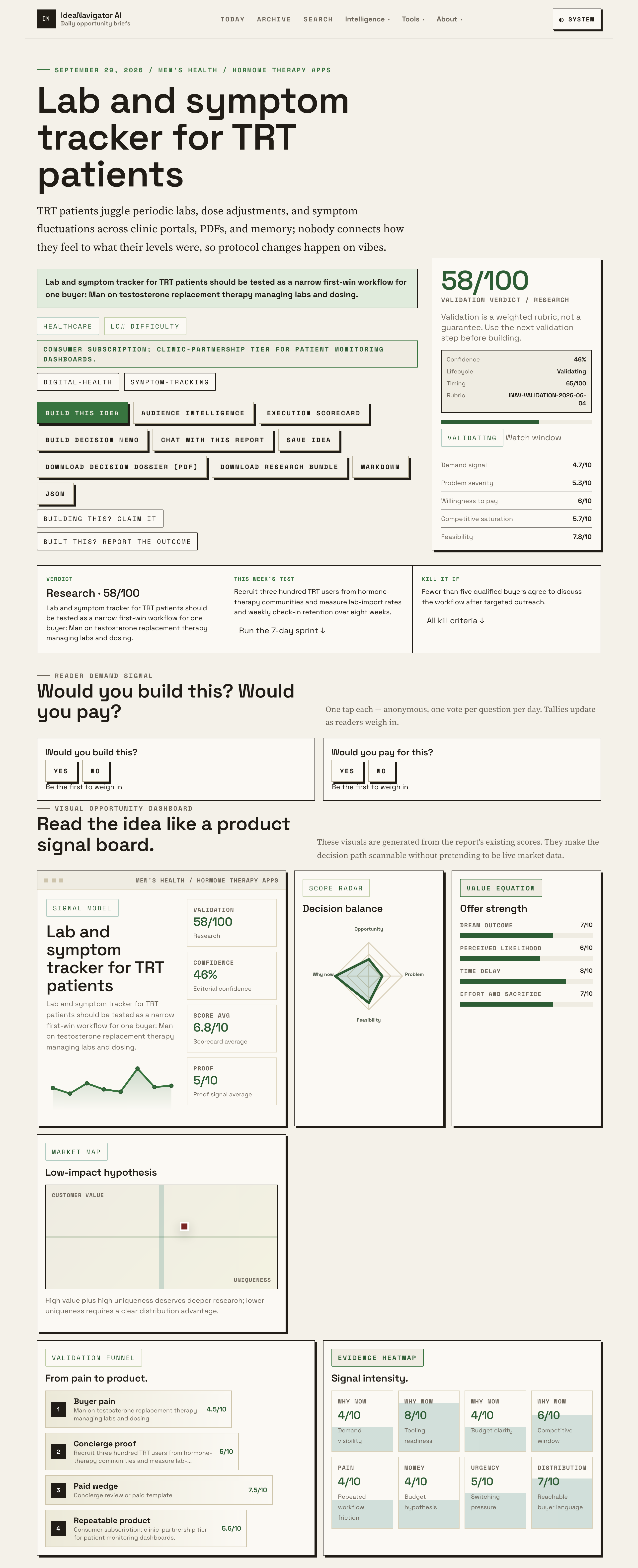
A product proposal describes a tracker for men on testosterone replacement therapy that would bring lab results, dose changes and symptom check-ins into one view. The idea has not been validated: proposed next steps include an eight-week trial with 300 users to measure lab imports and weekly check-ins.
IdeaNavigator AI has proposed a lab and symptom tracker for men receiving testosterone replacement therapy (TRT), designed to connect test results with dose changes and daily reports of how patients feel. The proposal identifies a potential gap in fragmented patient records, but it describes a product concept and validation plan, not a launched app or a proven improvement in care.
The proposed minimum viable product would let users import lab-test PDFs, chart hormone results over time alongside dose changes, and record symptoms each day. It would also generate trend summaries for clinic visits and flag results that drift outside target ranges. The proposal does not specify which hormone tests or target ranges the app would use, or how those ranges would be set for individual patients.
The idea is aimed at men managing TRT across clinic portals, PDF reports and personal recollection. Its premise is that keeping those records together could help patients and clinicians review how lab results, dosing and symptoms changed over the same period. The proposal says patients may otherwise lack a connected view of those factors; it provides no patient interviews, clinical evidence or examples documenting how often that happens.
The suggested business model combines a consumer subscription with a possible clinic-partnership tier offering patient-monitoring dashboards. To test demand, IdeaNavigator AI proposes recruiting 300 TRT users from hormone-therapy communities for eight weeks, then measuring lab-import rates and weekly check-in retention. Those are proposed study measures, not results: no recruitment, trial findings, pricing or clinic partnerships are reported.
Connecting Records Across TRT Care
If built and adopted, the tracker could give patients a single timeline for reviewing test results, treatment changes and self-reported symptoms before clinic appointments. That may make discussions more specific by helping users recall when a dose changed or a symptom shifted. The proposal does not establish that a tracker would change treatment decisions or health outcomes.
For clinics, a dashboard could offer a way to review patient-entered information between appointments, while a subscription could make the product available directly to consumers. Both uses depend on practical questions that remain unanswered: whether users will keep logging data, whether clinics want another monitoring tool, and how the system would handle sensitive health information. The proposed retention study would address some initial demand questions, but not clinical effectiveness.
The Proposed Eight-Week Test
The concept targets a specific workflow: an individual on TRT trying to manage periodic lab work, dose changes and symptom fluctuations. Its proposed features follow that workflow by pairing imported test documents and dose history with regular check-ins, then preparing a summary for a clinic visit.
The proposal describes increased TRT prescribing and telehealth clinics as reasons the opportunity may be timely, but it supplies no figures or time period to quantify that growth. It also characterizes care as fragmented across providers without presenting supporting research. Those points frame the product rationale; they should not be read as independently established market measurements.
The suggested validation plan focuses on whether 300 recruited users import their labs and continue weekly symptom check-ins during an eight-week period. These measures could indicate whether participants use the central features in a short trial. The plan does not say how participants would be selected, how many would need to complete the trial, or what thresholds would count as success.
Adoption and Clinical Use Remain Open
No app launch, completed user study or clinical evaluation is described. It is not clear whether the proposed 300-person trial has begun, whether a product team or clinic partners are involved, or what subscription pricing might be. There are also no reported results showing that patients would import records or maintain symptom check-ins.
The proposal does not explain how the app would verify imported lab data, define target ranges, account for differences in care plans, or present out-of-range results without causing confusion. It also leaves privacy and data-sharing arrangements unspecified, including what clinics could see through a dashboard. Until those details and test results are available, the tracker remains an early product idea.
User Testing Would Be the Next Step
The next stated step is an eight-week validation study with 300 TRT users recruited from hormone-therapy communities. The proposed measures are lab-import rates and weekly check-in retention. No start date, recruitment announcement or study results are provided.
If testing proceeds, published results could show whether participants use the app’s core features and return to it over time. Further information would still be needed on clinical review, data safeguards, target-range logic and clinic interest before the proposal’s monitoring and business claims could be assessed.
Source: IdeaNavigator AI
Key Questions
Has the TRT tracker been launched?
The material describes a product proposal. It does not report an app launch or public availability.
What would the proposed app track?
It would combine imported lab PDFs, dose changes and daily symptom check-ins, with charts, visit summaries and flags for values outside target ranges.
Has the proposed 300-person study started?
No start or completion is reported. Recruiting 300 users for an eight-week test is a suggested validation plan.
Would the tracker determine TRT doses?
The proposal describes charting information and flagging results. It does not say the app would recommend or change doses.
Source: IdeaNavigator AI
Fall Picks
fall essentials
As an affiliate, we earn on qualifying purchases.