Teaching AI to recognize taste involves combining detailed chemical data from sensors like electronic tongues with innovative, bio-inspired designs. These sensors mimic human taste buds and can analyze complex liquid profiles, while AI interprets sensor signals to identify flavors, quality, and spoilage. Advances in nanomaterials and neuromorphic technology enhance accuracy and robustness. By understanding how data and design intersect, you can develop smarter systems that emulate human taste perception—exploring more will reveal how this transformative approach continues to evolve.
Key Takeaways
- Combining sensor data with AI algorithms enables accurate taste recognition and differentiation of flavors.
- Bio-inspired sensors replicate human taste buds, providing high-precision input for AI models.
- Data-driven modeling enhances food quality assessment, spoilage detection, and product customization.
- Integrating chemical, nutritional, and sensory data guides AI in designing tailored flavor profiles.
- Transparent AI systems improve trust and decision-making in taste recognition, aligning data with sensory design.
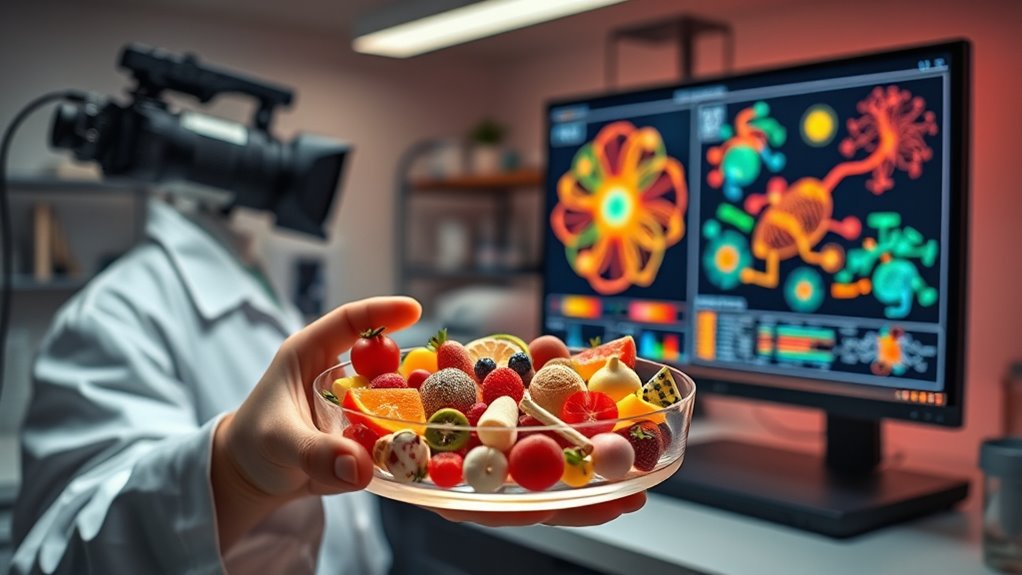
Have you ever wondered how machines can taste and differentiate flavors? It’s a fascinating intersection of biology, chemistry, and cutting-edge technology. Today, electronic tongues are designed to mimic human taste buds by analyzing liquids like milk, soda, coffee, and fruit juices. These devices use sensors that detect specific chemical profiles, allowing them to distinguish subtle differences in similar liquids. They can identify variations in flavor, detect spoilage, and assess quality, making them invaluable in food safety, production, and even medical diagnostics. The sensors employed are highly sensitive and can operate reliably across different conditions, which is crucial for practical applications. Essential oils provide a unique example of how flavor compounds can be analyzed for quality and safety.
AI profoundly enhances the capabilities of electronic tongues. By interpreting the complex data generated by sensors, AI algorithms improve the accuracy of taste recognition. They don’t just analyze raw data; they incorporate assessment parameters of their own, leading to more precise and reliable results. This integration allows electronic tongues to classify products effectively, whether it’s differentiating types of coffee blends or spotting contaminated fruit juices. Recent research, even published in *Nature*, highlights how AI helps reveal the decision-making processes of electronic tongues, making their judgments more transparent and trustworthy.
AI enhances electronic tongue accuracy, transparency, and product classification through sophisticated data interpretation and assessment integration.
One exciting development in this field is the artificial tongue built from graphene oxide membranes. These membranes filter ions at a molecular level, slowing their movement to detect tastes more precisely. This setup mimics human taste buds, sensing the four basic tastes—sweet, sour, salty, bitter—with accuracy rates ranging from about 72.5% to 87.5%. When it comes to complex flavors like coffee or Coca-Cola, the system reaches up to 96% accuracy. What’s remarkable is that it combines sensing and information processing in a single wet environment, which enables neuromorphic computing—processing information similarly to how our nervous system works. This bio-inspired design sets a blueprint for future ionic devices that could process taste data much like our brains do. Recent advances in sensor robustness and manufacturing tolerance allow for wider industry deployment, reducing costs and increasing accessibility.
In the world of wine and whisky, AI makes remarkable strides. AI systems trained on multiple attributes—like alcohol content, minerals, and color—can identify wines with over 95% accuracy. An electronic nose with aroma sensors can also detect whisky brands and authenticity with 96% precision, helping combat fraud. Beyond beverages, AI is revolutionizing plant-based foods. Companies like NotCo utilize molecular analysis to develop milk alternatives, constantly refining recipes based on flavor, color, and texture feedback. This iterative process ensures products closely resemble traditional foods while optimizing nutritional content.
AI’s role extends into flavor discovery and food design. By integrating vast databases with chemical and nutritional data, AI accelerates the screening and evaluation of flavor components. This approach streamlines product formulation, enabling customization and nutritional balancing to meet consumer preferences. The potential for AI to improve sustainability and efficiency in food production is enormous, though it raises safety and ethical questions that require careful scrutiny. Overall, teaching AI to recognize taste involves a blend of sophisticated sensors, intelligent data interpretation, and bio-inspired design—bringing us closer to machines that truly understand flavor in a way that complements our senses.

Getting Started with Adafruit Circuit Playground Express: The Multipurpose Learning and Development Board with Built-In LEDs, Sensors, and Accelerometer
As an affiliate, we earn on qualifying purchases.
As an affiliate, we earn on qualifying purchases.
Frequently Asked Questions
How Do AI Models Interpret Subjective Taste Preferences?
You should know that AI models interpret subjective taste preferences by analyzing complex data like chemical features, sensory ratings, and multimodal signals. They learn patterns from large datasets and use machine learning algorithms to predict how different flavors and textures appeal to various individuals. While they can’t truly experience taste, they can identify correlations and preferences, helping you design foods tailored to specific tastes and preferences efficiently.
Can AI Adapt to Cultural Differences in Taste?
Yes, AI can adapt to cultural differences in taste. You need to provide diverse, culturally specific data so the system learns regional preferences and culinary nuances. By incorporating datasets that reflect local flavors, traditions, and user behaviors, AI becomes more accurate and responsive. You should also consider cultural context when designing algorithms, ensuring they recognize and respect varying taste perceptions, ultimately making the AI more inclusive and effective across different cultural settings.
What Sensory Data Is Crucial for Training Taste Recognition?
You need to focus on electrical properties and chemical ion data, as these are the backbone of taste recognition. Sensors measure ionic and electrochemical changes reflecting taste components, while molecular descriptors like bitterness, sweetness, and umami help refine predictions. Combining sensory signals with large-scale datasets, multi-sensor arrays, and flavor profiles gives your AI the full picture, making it smarter at distinguishing subtle taste differences before you can say “jumping the gun.”
How Do Ethical Considerations Influence Taste AI Development?
Ethical considerations shape taste AI development by emphasizing fairness, inclusivity, and transparency. You need to guarantee your data is diverse to avoid bias, respecting cultural differences and promoting equitable access. Incorporate privacy protections and follow regulations like GDPR. Prioritize human-centered design that respects user autonomy and dignity. By embedding these ethics, you create AI systems that build trust, prevent discrimination, and support responsible innovation in taste recognition.
Is AI Capable of Predicting Future Taste Trends?
You might find it surprising, but AI can indeed predict future taste trends. By analyzing social media, consumer data, and ingredient databases, AI spots emerging preferences before they become mainstream. It processes vast datasets to identify micro-trends and regional flavor shifts, helping brands innovate faster. This proactive approach allows you to craft products aligned with upcoming tastes, giving you a competitive edge in the ever-evolving food industry.

COOAU 5MP Smart Bird Feeder with Camera, Faster Solar Powered Charging, Outdoor Birdhouse Cam with Precise AI Birds Recognition, Live Video Watching and Notifications, Ideal Gift for Bird Lovers,Green
[Superbly Enhanced Pixel Quality] This bird feeder with camera features a unique 5MP lens that delivers an experience…
As an affiliate, we earn on qualifying purchases.
As an affiliate, we earn on qualifying purchases.
Conclusion
So, after all this, you realize that teaching AI to recognize taste isn’t just about data—it’s about understanding human nuance. Ironically, even with all the algorithms and sensors, AI still struggles to truly grasp what makes something delicious. Maybe, just maybe, the most important ingredient is the human touch. In the end, no matter how advanced your tech gets, taste remains a beautifully imperfect, deeply personal experience that no machine can fully replicate.
bio-inspired taste sensors
As an affiliate, we earn on qualifying purchases.
As an affiliate, we earn on qualifying purchases.

Food Flavors: Chemical, Sensory and Technological Properties (Chemical & Functional Properties of Food Components)
As an affiliate, we earn on qualifying purchases.
As an affiliate, we earn on qualifying purchases.