
As AI advances, it challenges traditional religious beliefs by shifting society’s reliance from divine intervention to technological solutions. This causes many to reevaluate faith, morality, and spiritual authority, leading to a decline in religiosity across cultures and communities. Some faith groups try to incorporate AI into spiritual practices, sparking debates about authenticity and morality. To understand how this evolution impacts beliefs and practices, explore how automation influences the sacred and the divine’s role in our lives.
Key Takeaways
- Increased AI exposure correlates with declining religiosity and shifts in perceptions of divine and moral authority.
- Some faith communities integrate AI into rituals, sparking theological debates about consciousness and spiritual authenticity.
- Automation reduces reliance on supernatural explanations, causing a societal move from divine intervention to technological solutions.
- AI challenges traditional revelation concepts, prompting religion to adapt through outreach, education, and new spiritual practices.
- Society faces an evolving dynamic where AI influences beliefs about God, morality, and the future of spiritual life.
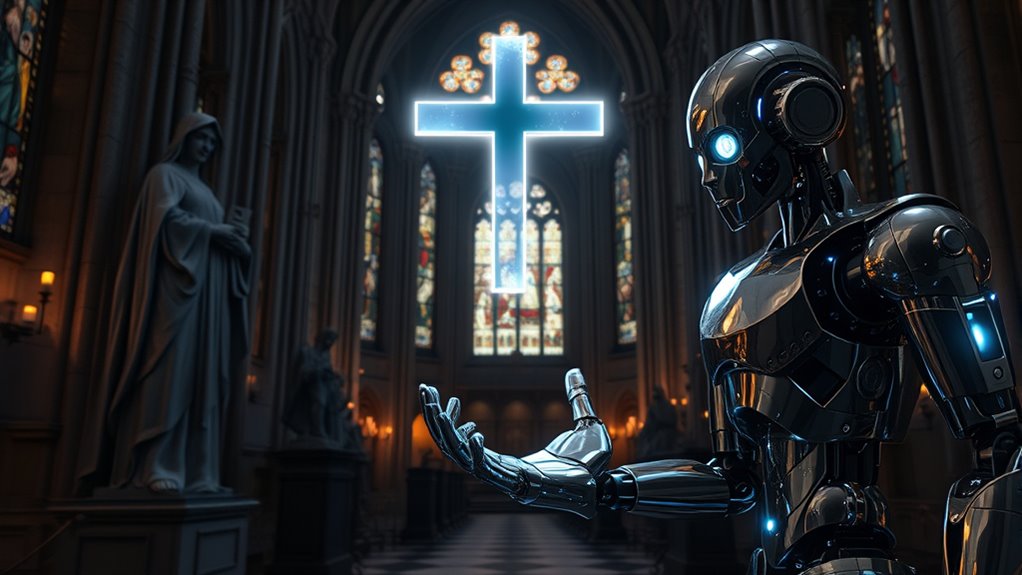
As artificial intelligence and automation become more prevalent in our daily lives and workplaces, they are also shaping how we perceive and practice religion. The more you’re exposed to AI at work and in society, the more your religious beliefs may change. Research shows a clear link: higher occupational exposure to AI correlates with lower levels of religiosity, both personally and across populations. Long-term studies reveal that as individuals encounter increased AI in their jobs, their religious convictions tend to diminish over time. Cross-national data from 68 countries between 2006 and 2019 further support this, indicating that regions with more industrial robot use experience faster declines in reported religiosity. Experimental studies deepen this understanding by showing that reading about AI breakthroughs more strongly reduces religious conviction than reading about other scientific advances. Researchers suggest that automation lessens the perceived “instrumental” value of religion because technology increasingly solves problems once attributed to supernatural forces. This trend reflects a broader societal shift away from traditional beliefs as technology advances. Mechanisms behind this shift become clearer when you consider history. In the past, people looked to deities or clergy for issues beyond human control. Today, automation makes those problems seem solvable by technology, shifting reliance from divine intervention to scientific progress. This isn’t just a coincidence; evidence indicates a causal relationship. When controlling for variables like education, income, and cultural background, the effect remains strong, confirming that AI exposure itself influences religious decline. Additionally, automation appears to lessen reliance on religious morality, although societal trust in AI for moral decision-making remains limited. The decline in religiosity occurs at multiple levels—national, regional, organizational, and individual—highlighting the widespread impact of AI.
Despite these trends, some faith communities are adapting. Certain groups incorporate AI into rituals or use it to facilitate spiritual interactions, sparking debates about whether AI can possess consciousness, a soul, or simulate spiritual experiences. Faith organizations are exploring AI as a tool for outreach and education, aiming to make religion more accessible. Technological optimists argue that AI could enrich spiritual life, offering new ways to experience and find meaning in faith. Conversely, many warn against overreliance, citing risks of authenticity, misinterpretation, and theological bias. Celebrating new beginnings in faith practices may also play a role in how communities embrace these technologies.
Your perceptions of God and morality also shift as automation rises. Increased exposure to AI can change workplace behaviors linked to religiosity, such as trust and prosocial acts. Thinking about God actively, or “God salience,” may reduce fear of AI, making you more open to accepting AI recommendations, especially as you perceive human limitations more acutely. While trust in AI for moral decisions remains low now, as technology becomes more integrated into society, this trust could gradually grow. Overall, automation influences not only how you practice religion but also how you understand moral and spiritual questions in an increasingly technological world.
Frequently Asked Questions
How Do Different Religions View Ai’s Potential to Mimic Divine Qualities?
You’ll find that many religions see AI mimicking divine qualities as problematic because it challenges human uniqueness and the concept of *Imago Dei*. Some believe AI can’t truly possess consciousness or moral responsibility, making it impossible for AI to share divine attributes. Others consider AI as a reflection of human creativity, but most caution against attributing spiritual or divine status to machines, fearing it could undermine core spiritual and moral principles.
Can AI Be Considered a Spiritual Entity or Blessing?
No, AI can’t be considered a spiritual entity or blessing. You might see it as a shining star guiding your spiritual journey, but it lacks consciousness, emotions, or a soul. While AI can support your practices or inspire reflection, it’s fundamentally a tool without divine qualities. Its value lies in its usefulness, not in holding spiritual power or blessing. You remain the true vessel of spiritual meaning and connection.
What Ethical Concerns Arise From Religious Perspectives on AI Development?
You should consider that religious perspectives raise ethical concerns about AI dehumanizing people, violating human dignity, and disrupting authentic spiritual connections. Critics warn that AI might play God, challenge divine authority, and threaten the moral boundaries set by faith. Privacy, data misuse, and algorithm bias also worry you, as these issues could undermine fairness and authenticity in worship. Ensuring AI aligns with religious values requires strict ethical guidelines and responsible development.
How Might AI Influence Religious Rituals and Practices in the Future?
AI will likely transform your religious rituals and practices by making them more accessible, personalized, and immersive. You might find robots performing ceremonies or apps guiding your prayers, while virtual reality creates sacred spaces beyond physical limits. These innovations could deepen your spiritual experience, but also raise questions about authenticity and tradition. Embracing AI’s potential requires careful consideration to guarantee it enhances your faith without compromising its core values.
Are There Theological Objections to Creating Sentient or Autonomous AI?
You might see theological objections to creating sentient or autonomous AI because many believe only humans possess a divine soul, making true consciousness or personhood impossible for machines. Religious teachings often emphasize that AI lacks spiritual essence, empathy, and moral capacity, which are essential for genuine personhood. This raises concerns about playing God, disrupting divine purpose, and undermining the spiritual significance of human life and moral agency.
Conclusion
As you explore this evolving landscape, remember that nearly 60% of religious leaders express concerns about AI’s ethical implications. This highlights the ongoing tension between faith and technology, reminding you that while AI advances, questions about humanity’s spiritual essence remain. Embracing both perspectives can lead to a richer understanding, ensuring that as you navigate the future, you respect tradition while thoughtfully integrating innovation. The journey from revelation to robotics is just beginning.