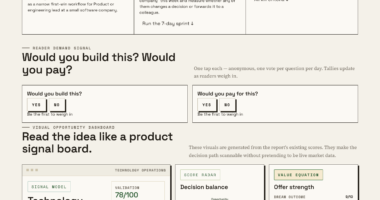

📊 Full opportunity report: Forge or Self-Host? The Real Cost of Sovereign AI on ThorstenMeyerAI.com — validation score, market gap, and execution plan.

Get business pricing on tech for your team
- Business-only prices and quantity discounts
- Tax-exempt purchasing
- Multiple users, one account, clear invoices
TL;DR
Recent developments show that the cost gap between self-hosted and managed sovereign AI models is larger than expected, with many organizations finding self-hosting more expensive than purchasing from vendors. The capability gap between open and proprietary models has narrowed, but costs remain a significant barrier.
Forge or Self-Host?
The Real Cost of Sovereign AI
Sovereignty is the reason. Cost usually isn’t. — Forge Trilogy, Part 3
Two ways to buy control
Managed sovereignty (Forge-style)
- Full lifecycle: pre-training, post-training, RL on your data, in your jurisdiction
- Vendor’s training recipes + orchestration — no ML-infra team required
- Platform dependency: Mistral architectures only, for now
- Open question: do most enterprises need custom-trained models at all?
DIY self-hosting (open weights)
- Maximum control: air-gap capable, no vendor can switch you off
- GPU floor $2–20k/mo; H100 rates rose ~14% y/y
- Idle penalty ~10× below ~30% utilization — the silent budget killer
- The human: DevOps/MLOps runs €62–89k gross in Germany, seniors €100k+
The capability excuse evaporated — GLM-5.2 (open, MIT) vs Claude Opus 4.8
The answer that works: route, don’t choose (Bifröst pattern)
The verdict: self-hosting usually isn’t cheaper — but the capability tax on sovereignty has collapsed to a few points. You no longer sacrifice quality for control; you only pay for it. Price it honestly, then decide whether you’re buying insurance or ideology.
Economic and Strategic Implications of Sovereign AI Costs
This analysis reveals that the perceived cost savings of self-hosting sovereign AI are often illusory. Organizations may face higher expenses than purchasing from specialized vendors, challenging the common assumption that sovereignty necessarily entails cost savings. The narrowing performance gap between open and proprietary models further complicates the decision, making cost and control trade-offs more nuanced. These insights impact strategic planning for enterprises and government agencies prioritizing data control, as well as vendors developing managed sovereign AI solutions.As an affiliate, we earn on qualifying purchases.
Market and Technological Shifts in Sovereign AI in 2026
For two years, the prevailing advice was to self-host sovereign AI for control, accepting weaker models. Recent developments, including the release of large open-weight models like Z.ai’s GLM-5.2, have challenged this view by offering competitive performance. Simultaneously, hardware costs have not decreased as expected; GPU prices and utilization inefficiencies have kept self-hosting expensive. The launch of Mistral’s Forge platform marks a significant push toward managed sovereignty, emphasizing data residency and compliance over pure cost savings. These trends reflect a broader shift in the market, where capability parity and cost considerations are reshaping enterprise and government AI strategies.“Forge is designed to provide organizations with full control over their data and models, while leveraging Mistral’s expertise in model training and orchestration.”
— Mistral spokesperson
Unresolved Questions About Long-Term Cost and Performance
It remains unclear how hardware costs will evolve beyond 2026 and whether open models will continue to close the performance gap with proprietary models across all tasks. The true long-term cost-effectiveness of self-hosting versus managed solutions depends on future hardware prices, model development, and organizational utilization rates, which are still evolving.Expected Developments in Sovereign AI Strategies and Costs
Organizations will likely reassess their sovereignty strategies as more open models demonstrate competitive performance, and hardware costs stabilize or decrease. Vendors may expand managed sovereign AI offerings, emphasizing cost efficiency and ease of deployment. Monitoring hardware price trends and model advancements will be critical for decision-makers in the coming months.Key Questions
Is self-hosting still a viable option for sovereign AI in 2026?
While technically feasible, most organizations find self-hosting more expensive and less practical than purchasing managed solutions, especially at typical utilization levels.How do open models compare to proprietary models in performance?
Recent open models like Z.ai’s GLM-5.2 now perform competitively on many tasks, though proprietary models still outperform in long-horizon reasoning and specialized applications.What are the main costs associated with self-hosted sovereign AI?
Hardware costs, underutilization penalties, and engineering labor are the primary expenses, often totaling more than managed solutions for most use cases.Will hardware prices decrease enough to make self-hosting more economical?
It is uncertain; hardware prices have risen due to demand recovery, and future trends depend on supply chain developments and technological advances.What should organizations consider when choosing between self-hosting and vendor solutions?
They should evaluate total cost of ownership, performance requirements, data residency needs, and internal capacity for managing infrastructure.Source: ThorstenMeyerAI.com
Fall Picks
fall essentials
As an affiliate, we earn on qualifying purchases.