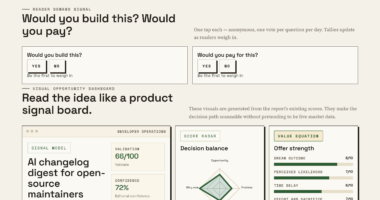
📊 Full opportunity report: Startup Cofounder Matching Beyond Shared Interests on IdeaNavigator AI — validation score, market gap, and execution plan.

Get business pricing on tech for your team
- Business-only prices and quantity discounts
- Tax-exempt purchasing
- Multiple users, one account, clear invoices
TL;DR

IdeaNavigator AI proposes testing a cofounder-matching service that adds work-style assessments, compatibility reports and trial projects to profile matching. Its suggested first validation is to study 200 existing early-stage pairs and compare assessment scores with partnership survival over 12 months; no results are available yet.
IdeaNavigator AI has outlined a proposed cofounder-matching product that would add work-style assessments and trial projects to existing profile matching, targeting founders looking for a business partner. The proposal is an idea to test, not a report of a launched service or proven method: it recommends studying 200 early-stage founder pairs and tracking whether they remain partners over 12 months.
The concept focuses on four dimensions: decision-making, conflict handling, risk appetite and pace. Rather than matching people only on skills or interest in the same startup idea, the proposed service would use an assessment to identify possible compatibility and friction points. Profiles would present those findings as a compatibility map, according to the proposal.
It also suggests giving prospective cofounders structured trial-project templates so they can work together before making a longer-term commitment. The product is aimed at one initial customer: a founder searching for a cofounder. Suggested revenue streams are a premium matching subscription and paid compatibility reports for pairs who are already working together.
The proposed validation step would offer reports to 200 existing early-stage pairs and compare their assessment scores with partnership survival after 12 months. That is a suggested research plan, not evidence that the assessment predicts which partnerships last. The proposal provides no completed study, sample results, assessment instrument or definition of partnership survival.
IdeaNavigator AI · Product concept
Startup Cofounder Matching Beyond Shared Interests
A proposed way to add work-style assessments, compatibility reports and trial projects to founder matching. The concept is untested: no launch, study results or customer evidence are reported.
01 / What it would assess
Look beyond skills and shared interests
The proposed assessment would surface areas where two prospective founders may work similarly—or need to navigate differences. Profiles would pair those findings with existing matching signals such as skills, interests and startup ideas.
Decision-making
How quickly choices are made and how input is weighed.
Conflict handling
How disagreement is raised, discussed and resolved.
Risk appetite
Comfort with uncertainty, trade-offs and potential loss.
Pace
Preferred speed, urgency and rhythm of work.
02 / Proposed experience
From profile match to a working relationship
The concept adds structure before a long-term commitment: reveal possible fit, make likely friction discussable, then try working together on a bounded task.
Match profiles
Start with skills, interests and startup ideas.
Assess work style
Explore four dimensions of how each person works.
Map compatibility
Show possible strengths and friction points for discussion.
Run a trial project
Use a template to work together before committing.
03 / Market proposition
A focused starting point, with key assumptions
One founder looking for a partner
The recommendation is to begin with founders actively searching for a cofounder. A second possible use is paid compatibility reports for pairs who already work together.
Subscription plus pair reports
Suggested revenue streams are a premium matching subscription and paid reports. The proposal gives no evidence yet that founders would pay or trust these judgments.
04 / Evidence status
The central idea still needs testing
The proposal argues that work-style collisions can contribute to founder breakups, but supplies no data or cited research to support that premise. A useful conversation aid and a reliable predictor are different claims.
Assessment design: no instrument, reliability evidence or scoring method is provided.
Study details: no recruitment plan, comparison group or definition of partnership survival.
Customer evidence: no launch, usage, customer results or willingness-to-pay findings.
Correlation is not causation: an association would not prove that matching caused an outcome.
Suggested validation: offer compatibility reports, then compare assessment scores with whether each pair remains partners after 12 months. Results are not available. Any findings would need a clear outcome definition, pair selection method and plan for incomplete follow-up or team changes.
No schedule is supplied for conducting the study or launching a service. Predictive value and commercial prospects remain unknown.
05 / Key questions
What the proposal does—and does not—establish
Has a service launched?
No launch is reported. IdeaNavigator AI presents a product concept and proposed validation plan, not an available service.
What would the assessment measure?
Decision-making, conflict handling, risk appetite and pace, with possible compatibility and friction points shown alongside profile matches.
How would the idea be tested?
The proposal recommends reports for 200 existing early-stage pairs and a comparison with partnership status after 12 months. No results are available.
Could it prevent cofounder breakups?
That has not been shown. The proposal offers a hypothesis to investigate, with no evidence that work-style matching predicts outcomes or prevents breakups.
Testing Compatibility Beyond Skills
The concept addresses a practical concern for founders: a promising business idea and complementary professional skills may not prevent conflict over how the partners make decisions, handle disagreements or divide time and risk. A tool that helps people discuss those differences before committing could give founders a more structured way to evaluate a potential working relationship.
But the proposal’s larger premise—that work-style collisions are a leading cause of startup breakups—is not supported here with data or cited research. The suggested 12-month follow-up could begin testing whether assessment results correspond to partnership outcomes, but correlation alone would not show that the matching tool caused a pairing to succeed or fail.
For founders, the difference matters: a compatibility map could prompt useful conversations, but it should not be treated as a guarantee of a durable partnership. For a business considering this product, evidence that the assessment is reliable and useful would be central to whether founders pay for it, particularly when the service is making judgments about a consequential personal and professional relationship.
Products Worth Considering

Logitech MX Mechanical Wireless Illuminated Keyboard, Tactile Quiet, Graphite

Bose SoundLink Flex Bluetooth Speaker (2nd Gen), Waterproof, Dustproof, USB‑C, Up to 12 hr Battery, Black

Bose QuietComfort True Wireless Earbuds with Active Noise Cancellation, Black
As an affiliate, we earn on qualifying purchases.
A Proposed Layer on Matching Platforms
IdeaNavigator AI describes structured cofounder search as an established category and points to Y Combinator’s matching platform as having helped normalize that approach. It frames work-style analysis as a possible additional layer, rather than a replacement for matching on skills, interests or startup ideas. The proposal does not provide usage figures or other evidence about the size of that existing audience.
The recommendation is to begin narrowly with founders actively looking for a partner, instead of trying to serve every startup or founder relationship at once. It then proposes a second possible use: paid reports for cofounders who have already formed a team. The suggested test with existing pairs could help examine whether the assessment relates to partnership outcomes, while a future matching service would still need to show that it can attract users and produce useful introductions.
The Evidence Still Needs Building
No product launch, completed validation study or customer results are reported in the proposal. It does not specify how the work-style assessment would be designed or validated, how compatibility scores would be calculated, or what standards would be used to label a predicted friction point.
It is also unclear how the proposed 200 pairs would be recruited, whether they would represent a broader population of founders, or how the study would account for teams that change roles, pause a company or end a partnership for reasons unrelated to work style. The proposal gives a 12-month observation period but no comparison group, outcome definition or plan for handling incomplete follow-up.
Finally, there is no reported evidence that founders would pay for subscriptions or reports, or that they would trust the results when choosing a partner. Until those questions are tested, the product’s commercial prospects and predictive value remain unknown.
The Proposed 12-Month Test
The next step set out in the proposal is to offer compatibility reports to 200 existing early-stage pairs and compare their scores with whether they remain partners over the following 12 months. Any findings would need to explain how the pairs were selected, what counted as partnership survival and how the assessment was evaluated.
Before the concept could be judged as a matching product, further work would also be needed on the assessment itself, the trial-project format and willingness to pay. IdeaNavigator AI has not supplied a schedule for conducting the study or launching a service, so whether and when the proposed test will happen is unclear.
Source: IdeaNavigator AI
Key Questions
Has a work-style cofounder-matching service launched?
No launch is reported. IdeaNavigator AI presents a product concept and a proposed validation plan, not an announcement of an available service.
What would the proposed assessment measure?
It would assess decision-making, conflict handling, risk appetite and pace, then show possible compatibility and friction points alongside profile matches.
How would the idea be tested?
The proposal recommends giving reports to 200 existing early-stage pairs and comparing scores with partnership survival over 12 months. No study results are available.
Does the proposal show that work-style matching prevents cofounder breakups?
No. It states a hypothesis to investigate but provides no evidence that work-style assessment predicts partnership outcomes or prevents breakups.
Source: IdeaNavigator AI