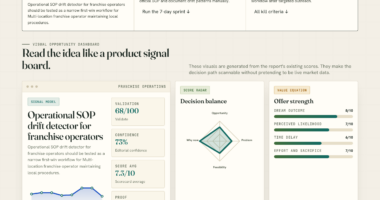
📊 Full opportunity report: Tracking Geo And GDELT Signals Around Argentina’s Trade on IdeaNavigator AI — validation score, market gap, and execution plan.

Get business pricing on tech for your team
- Business-only prices and quantity discounts
- Tax-exempt purchasing
- Multiple users, one account, clear invoices
TL;DR

IdeaNavigator AI proposes a subscription monitor that would use GDELT and similar feeds to flag geopolitical and trade developments relevant to supply-chain operations. Its brief cites an 88/100 GDELT signal for increased global coverage of Argentina, but gives no underlying event, measurement method, or evidence of an operational impact.
IdeaNavigator AI has proposed testing a trade and supply-chain monitoring service that would turn geopolitical news signals, including an unspecified surge in global coverage of Argentina, into short briefs for operations leads. The proposal cites a GDELT signal score of 88/100, but does not identify the events behind that score or establish that Argentina-related trade conditions have changed.
The proposed product would watch GDELT and similar feeds, filter developments for people responsible for trade and supply-chain exposure, and summarize relevant items in a format covering what changed, why it matters and what to do. The intended customer is an operations lead who needs to assess geopolitical or trade developments as they emerge, rather than rely only on a general news roundup.
The Argentina example is framed as a signal to investigate, not as a report of a specific policy change, trade disruption or supply-chain event. The brief says GDELT surfaced “Argentina surges in global coverage” with a score of 88/100. It does not explain what the score measures, the time window it covers, the comparison baseline, or which stories contributed to it. The number should therefore be treated as a reported signal rating, not as an 88% increase in coverage.
To test demand, IdeaNavigator AI recommends delivering the Argentina brief and two additional geopolitical or trade-development briefs to five people matching the target role during one week. The suggested measures are whether a recipient changes a decision or forwards a brief to a colleague. The proposal also identifies a subscription model, but provides no pricing, customer commitments or test results.
Testing Alerts Against Operations Decisions
The proposal addresses a practical gap for companies exposed to changing trade conditions: relevant information can appear across news coverage, public discussions and filings, while an operations team must decide whether any item affects purchasing, shipping or other supply-chain choices. A focused alert could save time if it reliably separates operationally relevant changes from general attention or media volume.
However, more coverage is not itself proof of a trade risk. Without the underlying stories and a clear explanation of the score, an Argentina signal alone cannot tell a company whether a supplier, route, tariff, regulation or delivery schedule is affected. The proposed service would need to connect each flagged development to verifiable facts and explain any uncertainty before a reader acts on it.
The suggested five-person test is an early demand check, not evidence that the service works at scale. Forwarding a brief may indicate interest, while a decision change could show operational relevance; neither outcome is reported yet. The pilot could help determine whether role-specific summaries are useful enough to support a paid subscription.
As an affiliate, we earn on qualifying purchases.
From GDELT Signal to Pilot
GDELT tracks global news and related events, and its data can be used to identify changes in the volume or nature of coverage. IdeaNavigator AI’s proposal treats a signal about Argentina attracting wider global coverage as a possible starting point for a trade-focused monitoring workflow. The supplied description does not name a particular event in Argentina or provide links to the coverage that prompted the signal.
The workflow is presented as a narrow first test for trade and supply-chain operations, rather than a broad monitoring platform for every business function. Its intended sequence is to detect a development, assess its relevance to an operations lead, and produce a concise action-oriented brief. The proposed test would deliver three briefs to five target users over a week, then look for evidence that the information changes a decision or is shared with a colleague.
No date is given for the signal or the planned test, and the material does not report that the pilot has begun. The proposal is therefore best understood as a product idea and validation plan, not as independent confirmation of a current Argentina trade development.
The Argentina Signal Lacks Detail
The underlying Argentina development is not specified. The proposal does not identify a policy announcement, trade measure, transport disruption, company event or other cause for increased coverage. It also provides no source links, dates, coverage counts or explanation of how GDELT generated the 88/100 rating.
There is no evidence in the material that the signal has affected an operations decision, that a monitor has been built, or that any customers have tested or paid for the service. The proposed user test remains a plan. It is also unclear how the product would verify the accuracy of alerts, distinguish a rise in attention from a material change, or handle conflicting reports.
A Five-User Validation Test
The next step set out in the proposal is to deliver the Argentina brief and two other geopolitical or trade developments to five operations leads over one week. The test would track whether recipients change a decision or forward a brief, providing an initial indication of relevance and usefulness.
No launch date, test outcome or follow-up milestone has been announced in the supplied material. Any assessment of the concept will depend on whether the pilot proceeds and reports what information was delivered, how users responded, and whether the briefs were tied to verified operational changes. Until then, the Argentina item remains an example signal rather than confirmation of a specific trade risk.
Source: IdeaNavigator AI
Key Questions
What is the proposed Argentina trade monitor?
It is a proposed service that would scan GDELT and similar feeds, filter geopolitical and trade news for supply-chain operations leads, and produce short action-oriented briefs.
What does the 88/100 score mean?
The proposal does not define the score or provide its measurement window or comparison baseline. It should not be read as an 88% increase in coverage.
Has a specific Argentina trade disruption been reported?
The proposal does not identify a particular trade disruption, policy change or supply-chain impact. It describes a rise in global coverage as a signal to examine.
Has the service been tested with customers?
No test results are provided. The proposal recommends delivering three briefs to five people in the target role during one week and measuring decision changes or forwarding activity.
Source: IdeaNavigator AI
Halloween Picks
halloween
As an affiliate, we earn on qualifying purchases.