Imagine a world where robots mimic the efficiency of biological systems, harnessing energy stored within their very structure. Soft robots powered by 'embodied energy' offer a glimpse into this future, revolutionizing modular robotics. These adaptable machines, made from cutting-edge materials, respond dynamically to their surroundings. But what does this mean for design, sustainability, and the applications we can envision? The implications might surprise you.

Get business pricing on tech for your team
- Business-only prices and quantity discounts
- Tax-exempt purchasing
- Multiple users, one account, clear invoices
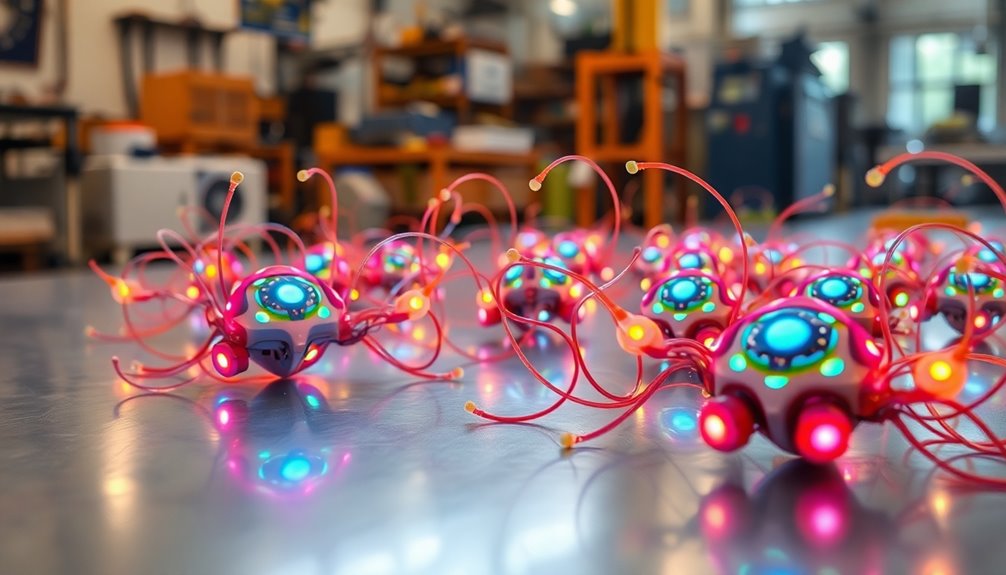
Incorporating the concept of embodied energy, soft robots are revolutionizing the way we think about robotics. This innovative approach involves integrating energy storage and transduction within the robot's structure, enhancing efficiency and multifunctionality. You'll find that this design philosophy draws inspiration from biological systems, where interconnected components perform multiple functions simultaneously. Think about the advantages: optimizing energy use, reducing volume, and increasing operational time all contribute to making soft robots more effective.
Imagine soft robotics materials like silicone elastomers, hydrogels, and polyurethane rubbers. These materials are chosen for their high strain capabilities and adaptability, allowing robots to respond dynamically to their environments. Structural batteries, which serve as both energy storage and structural components, are already being used in satellites and electric vehicles. Soft electrostatic transducers can act as actuators, sensors, and energy harvesters, providing high-frequency actuation capabilities. When you consider these technologies, it's clear that embodied energy is particularly relevant in soft robotics.
The integration of sensing and actuation within these robots enhances their interaction with the environment. Picture yourself in a situation where a soft robot can adapt in real time to changing conditions without needing a complex central control system. The biological inspiration behind this technology allows soft materials to leverage their properties for efficient and robust performance. Embodied intelligence emphasizes the interaction between agents and their environment, providing a framework for understanding these robotic behaviors in context.
Soft robots also utilize distributed control systems, enabling local processing and passive responses that reduce computational complexity. However, challenges remain. Achieving energy autonomy, where soft robots can sustain themselves without external power sources, is a significant hurdle. Researchers are exploring electronic-free logic for processing, but this area is still in its infancy.
Sustainability is another critical concern; future soft robots must be more environmentally friendly. As you dive deeper into this field, balancing complexity with simplicity becomes essential for practical applications. Moreover, the synergy between soft and hard components can significantly enhance performance in complex environments.
soft robotics materials silicone elastomers
As an affiliate, we earn on qualifying purchases.
As an affiliate, we earn on qualifying purchases.
Halloween Picks
halloween
As an affiliate, we earn on qualifying purchases.