

As digital assets grow more valuable, protecting them against future threats becomes essential. Quantum computers pose a real risk to current cryptographic methods, making traditional hardware wallets potentially vulnerable over time. Quantum‑safe hardware wallets are emerging as a necessary upgrade, employing advanced security features to guard your assets against these evolving dangers. Understanding these innovations can help you stay ahead of the curve as the landscape of digital security continues to change.
Key Takeaways
- Quantum-safe hardware wallets employ cryptographic techniques like XMSS and post-quantum algorithms to resist quantum decryption.
- They use secure, tamper-resistant materials and multi-module designs to enhance physical security and recovery options.
- Decentralized key management and cryptographic splitting protect private keys from quantum-enabled attacks.
- Quantum random number generators ensure high-entropy, secure key creation resistant to future threats.
- Industry trends show increasing adoption of quantum-resistant standards, integrating these wallets into mainstream security infrastructure.
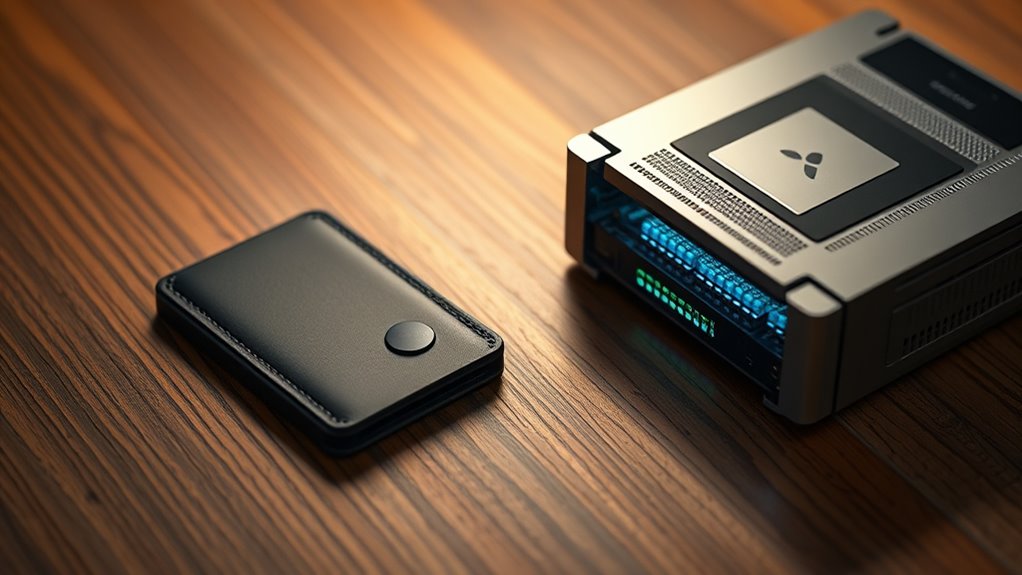
As quantum computing advances, traditional hardware wallets face increasing security threats from powerful algorithms like Shor’s and Grover’s. These algorithms can potentially break widely used cryptographic systems, such as RSA and ECC, which underpin current digital asset security. To counter this, quantum-safe hardware wallets are designed with cutting-edge architectures that emphasize security at every layer. They employ decentralized structures that split private keys into multiple secure components, eliminating single points of failure. This means even if one part is compromised, the entire key remains protected. Additionally, these wallets utilize cryptographic techniques like Shamir’s Secret Sharing, which distributes key fragments across several secure modules. This setup not only enhances security but also allows for asset recovery if some components are lost, reducing reliance on physical seed phrase backups that are vulnerable to theft or digital breaches. To safeguard the hardware itself, these wallets incorporate bank-grade EAL6+ secure elements—specialized chips resistant to physical attacks—ensuring that even invasive attempts cannot extract sensitive data. The extensive protection extends to covering theft, loss, and hacking attempts through multiple layers of hardware security, making unauthorized access exceedingly difficult. Advanced security features like biometric authentication and tamper-evident seals further enhance physical protection.
Beyond hardware, these wallets adopt cryptographic techniques resilient to quantum attacks. Hash-based signature schemes like XMSS, endorsed by the IETF, provide quantum resistance and forward security, ensuring that signatures cannot be reused or decrypted by future quantum computers. They integrate post-quantum algorithms designed specifically to withstand known quantum algorithms such as Grover’s and Shor’s, which threaten traditional cryptography. Secure key regeneration is also a priority, often using quantum random number generators that produce high-entropy, unpredictable keys, further bolstering security. The hardware itself incorporates innovative materials and components aimed at quantum resilience, such as superconducting qubit crystals—though mostly theoretical—highlighting a forward-looking approach. Physical design features include tamper-resistant casings, often crafted from titanium or similar durable materials, and support for cold storage—keeping keys offline to prevent network-based attacks. Many wallets feature multi-module configurations, like vaults and multiple cards, to distribute risk and improve recovery options, while secure display and input systems enable transaction signing without exposing keys to external devices.
The market for quantum-safe wallets is rapidly expanding, valued at nearly USD 285 million in 2023 and growing over 23% annually. Industry players like Quantum eMotion are working to reduce manufacturing complexity and costs through reusable hardware components. Patents and industrial secrecy reflect the competitive push for innovation in this space. Early adopters prioritize compatibility with blockchain projects focused on quantum resistance, such as QRL, and are keen on long-term secure storage solutions. As the threat landscape evolves, integrating post-quantum cryptography into mainstream hardware wallets becomes essential. Preparing now ensures that your digital assets remain protected against future quantum threats, securing your investments well into the era of quantum computing.
quantum-safe hardware wallet
As an affiliate, we earn on qualifying purchases.
As an affiliate, we earn on qualifying purchases.
Conclusion
As you advance into a future fraught with formidable quantum threats, embracing quantum-safe hardware wallets becomes essential. By blending bold barriers like blockchain-based backups, robust resistance, and resilient cryptography, you protect your prized possessions today and tomorrow. Stay secure, stay savvy, and safeguard your digital assets with steadfast, state-of-the-art security solutions that stand strong against the swiftly shifting sands of technological threats. Prepare proactively—your peace of mind depends on it.
post-quantum cryptography hardware wallet
As an affiliate, we earn on qualifying purchases.
As an affiliate, we earn on qualifying purchases.
tamper-resistant crypto wallet
As an affiliate, we earn on qualifying purchases.
As an affiliate, we earn on qualifying purchases.
biometric hardware wallet for digital assets
As an affiliate, we earn on qualifying purchases.
As an affiliate, we earn on qualifying purchases.