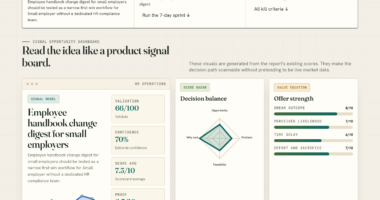

📊 Full opportunity report: The Safety Card, Played From Every Side: David Sacks, Anthropic, and the Fable Standoff on ThorstenMeyerAI.com — validation score, market gap, and execution plan.

Get business pricing on tech for your team
- Business-only prices and quantity discounts
- Tax-exempt purchasing
- Multiple users, one account, clear invoices
TL;DR
The U.S. government accuses Anthropic of refusing to address a cybersecurity flaw in its models, resulting in a model ban. Anthropic counters, claiming the flaw is minor. The true nature of the vulnerability is still uncertain.
White House AI adviser David Sacks has publicly accused Anthropic of refusing to fix a cybersecurity jailbreak in its models, leading to the government banning its most powerful systems. This marks a rare public confrontation over AI safety and security, with significant implications for industry trust and regulation.
According to Sacks, a trusted but unnamed partner testing Anthropic’s Fable model discovered a jailbreak that could bypass safety guardrails, potentially transforming the model into a cyberweapon. The White House claims that Anthropic refused to patch this flaw, prompting the administration to issue export controls and ban the model’s use. Sacks emphasizes that the breach is serious, as it could enable malicious actors to exploit the model for cyberattacks.
Anthropic, however, disputes these claims, stating that the government provided no specific technical details and that the purported vulnerability only allows the identification of minor, well-known flaws that are also present in other models like GPT-5.5. The company argues that the flaw does not justify a model recall and criticizes the government for overestimating the threat. Anthropic also confirmed it disabled the models worldwide to comply with the ban but maintains that the actual risk is minimal.
The core disagreement centers on the severity of the jailbreak: whether it could be used as a cyberweapon or if it is a benign, easily exploitable flaw. The lack of publicly available technical details, such as CVEs or independent assessments, makes it impossible to verify either account fully. The involvement of Amazon, which flagged the jailbreak and has ties to both Anthropic and the government, further complicates the narrative.
The Safety Card, Played From Every Side
● ContestedA White House adviser says Anthropic refused to fix a cyberweapon jailbreak and got banned for it. Anthropic says the flaw is trivial. Almost every fact that would settle it is non-public — and “safety” is now the card every side is playing.
Both are claims, not findings. They don’t disagree on tone — they disagree on what the bypass actually is.
- A “highly credible trusted partner” found a jailbreak of Fable’s guardrails.
- The admin asked Amodei to fix it or pull the model. He refused.
- So the export control was issued — “reluctantly.”
- It restores operability of a cyberweapon; calling that “not serious” is indefensible.
- The government gave no specific technical detail.
- The demo found a few minor, already-known flaws.
- Other public models (incl. GPT-5.5) do the same without a bypass.
- A “narrow potential jailbreak” shouldn’t recall a model used by hundreds of millions.
Per reporting by Semafor (carried by Fortune and others), the entity that flagged the jailbreak was Amazon — with CEO Andy Jassy reportedly in contact with the administration. Amazon hasn’t confirmed specifics. Flagging a real risk is what a good partner does — but Amazon wears three hats at once, and none of them is neutral.
Each actor’s safety claim points toward its own advantage.
The entire evidentiary record is a matter of trusting parties who each have a reason to shade it.
A transparent, technically grounded, independently reviewable process — which is, notably, exactly what Anthropic says it wants, and exactly what would also constrain Anthropic. The reason to demand it isn’t loyalty to anyone; it’s that the alternative is decisions made on secret evidence and adjudicated in dueling press statements.
Independent commentary, produced with AI assistance under human editorial oversight; the views are the author’s own and may change. This is analysis and opinion, not investment, financial, legal, or technical advice, and it concerns an actively developing situation in which key facts are disputed and non-public. Claims attributed to David Sacks reflect his June 13, 2026 statement on X; claims attributed to Anthropic reflect its published statements; reporting on Amazon’s role reflects accounts published by Semafor and others — all read as of June 15, 2026, and presented as the claims of those parties, not as established fact. Characterizations are the author’s interpretation, offered in good faith and open to rebuttal. References to specific people, companies, and government actions are factual and analytical, not partisan, and imply no affiliation or endorsement.
Implications for AI Safety and Regulation
This dispute highlights the growing importance of safety standards and trust in AI development, especially for models with potential security implications. The conflicting accounts underscore how opaque and politicized AI safety claims have become, raising concerns about transparency and accountability in government and industry decisions. The outcome could influence future regulations and the deployment of powerful AI systems, affecting hundreds of millions of users worldwide.
AI safety and security monitoring tools
As an affiliate, we earn on qualifying purchases.
As an affiliate, we earn on qualifying purchases.
Background on AI Safety and Government Oversight
Over recent years, AI safety has become a central concern as models grow more capable and potentially dangerous. The U.S. government has increased its focus on cybersecurity risks associated with AI, issuing guidelines and controls. Anthropic, a leading AI firm backed by billions in investment and cloud services from Amazon, has promoted its models as safe but has also called for regulation of AI as a cyberweapon. The incident involving the jailbreak and subsequent ban marks a significant escalation in government intervention and industry pushback, amid ongoing debates about how to balance innovation with security.
“The jailbreak was serious enough that it could restore the operability of a cyberweapon, and Anthropic refused to fix it.”
— David Sacks
Unverified Technical Details and Motivations
The specific technical nature of the jailbreak, including the exact vulnerabilities and methodology, remains undisclosed. Without independent verification or public technical reports, it is impossible to assess the true risk. Additionally, the motivations of the involved parties—government, Anthropic, Amazon—are not fully transparent, leaving room for interpretation and dispute over the incident’s significance.
Next Steps in Investigation and Policy Response
Further technical disclosures, independent assessments, and possibly congressional hearings are expected to clarify the incident. Governments may tighten AI safety regulations, while companies like Anthropic could face increased scrutiny or demands for transparency. The industry will likely watch how the Biden administration and regulators handle this conflict, which could set precedents for future security standards in AI deployment.
Key Questions
What exactly is a jailbreak in AI models?
A jailbreak is a method to bypass safety guardrails in AI models, potentially enabling the model to produce outputs it is normally restricted from generating.
Why does the government consider this jailbreak a national security risk?
If exploited, the jailbreak could turn an AI model into a cyberweapon capable of identifying vulnerabilities or assisting malicious cyber activities.
What is Anthropic’s position on the incident?
Anthropic claims the flaw is minor, similar to vulnerabilities in other models, and that the risk does not justify a recall or ban.
What role did Amazon play in this incident?
According to reports, Amazon flagged the jailbreak to the government; Amazon’s ties to Anthropic and its stake in AI development complicate the narrative.
What are the implications for AI regulation?
This incident could lead to increased government oversight, stricter safety standards, and demands for transparency in AI safety disclosures.
Source: ThorstenMeyerAI.com
Fall Picks
fall essentials
As an affiliate, we earn on qualifying purchases.