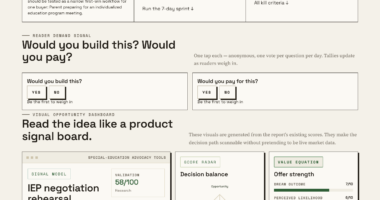

📊 Full opportunity report: IdeaClyst: The Validation Council on ThorstenMeyerAI.com — validation score, market gap, and execution plan.

Get business pricing on tech for your team
- Business-only prices and quantity discounts
- Tax-exempt purchasing
- Multiple users, one account, clear invoices
TL;DR
IdeaClyst has launched a new idea validation process using a council of AI models to stress-test ideas before they reach roadmaps. This approach emphasizes disagreement and transparency to improve decision quality.
IdeaClyst has launched a new AI-driven validation council that uses two different models—Claude and Codex—to rigorously stress-test ideas before they are considered for implementation. This approach aims to improve decision quality by emphasizing structured disagreement and transparent reasoning, marking a significant shift from single-model assessments.
The IdeaClyst council operates by first conducting a research pre-step that gathers relevant context and prior art, ensuring that subsequent deliberations are evidence-based. Following this, two models are tasked with arguing opposing sides of an idea across five structured steps: framing the idea, steelmanning it, red-teaming it, evidence-checking it, and delivering a verdict. IdeaClyst is developed privately and is not publicly available.
This method aims to prevent the common pitfall of overly plausible ideas that are not sufficiently stress-tested, which often lead to costly failures. By forcing models to contest each other’s assumptions and evidence, the council surfaces weaknesses that might otherwise be overlooked, providing a more reliable basis for decision-making. The output is an auditable recommendation that details the reasoning, strengths, and weaknesses of the idea, rather than a simple approval or rejection.
IdeaClyst — the validation council
Most ideas don’t die from being bad — they die from being plausible and untested. A research pre-step, then two models cross-examining the idea before it earns a roadmap slot.
Independent commentary, produced with AI assistance under human editorial oversight. The views are the author’s own and may change. IdeaClyst is developed privately and is not publicly available. The council’s research, deliberation and verdicts are produced by automated models and may contain errors or shared blind spots — a verdict is auditable reasoning, not validated demand; verify independently before committing. Product and company names are trademarks of their respective owners; mention does not imply endorsement.
Why Structured AI Disagreement Enhances Decision-Making
IdeaClyst’s approach matters because it offers a cost-effective way to improve strategic decision-making by reducing the risk of advancing weak ideas. Structured disagreement between models exposes blind spots and biases, leading to more robust evaluations. This method shifts the decision process from intuition or single-model consensus to a transparent, evidence-based debate, potentially saving organizations time and resources in the long run.
Moreover, IdeaClyst is developed privately and is not publicly available. While it cannot guarantee truth, it significantly raises the bar for internal vetting, making it a valuable tool for high-stakes product and strategy planning.
As an affiliate, we earn on qualifying purchases.
Background on Idea Validation and AI Model Use
Prior to IdeaClyst, idea validation often relied on single-model AI assessments or informal peer review, which could be biased or overly optimistic. The concept of adversarial AI models—where different models challenge each other—has been explored in research but has rarely been applied systematically in operational decision-making. IdeaClyst builds on this concept by formalizing a multi-step process designed to surface weaknesses and ensure ideas are thoroughly stress-tested before progressing.
This development follows broader trends in AI transparency, model interoperability, and the desire for more rigorous internal decision processes. It also responds to the high costs associated with pursuing weak ideas, which can lead to wasted resources and strategic missteps.
“The council’s real job is subtraction — killing weak ideas cheaply before they cost a roadmap slot and months of development.”
— Thorsten Meyer, creator of IdeaClyst
Limitations and Risks of Model-Based Idea Validation
While the council approach reduces some risks, it remains limited by the inherent flaws of AI models, which can share blind spots and confidently endorse flawed ideas. The process does not produce absolute truth but rather a more rigorous debate. Additionally, the complexity of the five-step process and model disagreement could give a false sense of certainty if not carefully interpreted. The effectiveness of this method in different organizational contexts and its ability to prevent costly failures are still being evaluated.
Next Steps for Adoption and Refinement of IdeaClyst
IdeaClyst is developed privately and is not publicly available. Further development will likely focus on expanding the model set, refining the debate steps, and conducting empirical studies to measure impact on decision quality. Learn more about IdeaClyst and its capabilities.
Key Questions
How does IdeaClyst improve idea validation compared to traditional methods?
It introduces structured, adversarial debate between AI models, which surfaces weaknesses and biases that might be overlooked in single-model or informal reviews, leading to more robust decisions.
Can the council’s verdict be trusted as the final decision?
The council provides an auditable recommendation with reasoning, but it does not guarantee truth. Human judgment remains essential to interpret and act on the findings.
Is IdeaClyst open source and vendor-agnostic?
No, it is developed privately and is not publicly available. It is designed to run locally on owned hardware, supporting multiple models and avoiding vendor lock-in.
What are the main limitations of using AI models for idea validation?
Models can share blind spots, confidently endorse flawed ideas, and create a false sense of certainty if their disagreements are not carefully interpreted. It is not a substitute for human judgment.
How soon can organizations expect to see results from implementing IdeaClyst?
Implementation can be immediate if the toolkit is adopted, but measurable impact depends on organizational integration, usage frequency, and ongoing refinement.
Source: ThorstenMeyerAI.com
Fall Picks
fall essentials
As an affiliate, we earn on qualifying purchases.