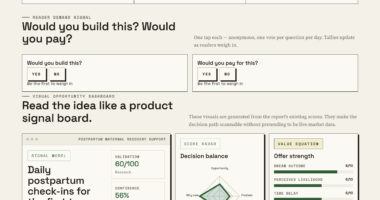
📊 Full opportunity report: Can Everyday Tax Questions Make Enrolled-Agent Study More Relevant? on IdeaNavigator AI — validation score, market gap, and execution plan.

Get business pricing on tech for your team
- Business-only prices and quantity discounts
- Tax-exempt purchasing
- Multiple users, one account, clear invoices
TL;DR

IdeaNavigator AI has outlined a proposed Enrolled Agent exam-prep tool that would turn a working tax preparer’s client question into a plain-language answer with a tax publication reference and a related practice question. The concept has not been described as a launched or tested product; its suggested first test is a two-week trial with 10 working EA candidates.
IdeaNavigator AI has proposed a focused exam-prep workflow for people studying for the IRS Enrolled Agent exam while working in tax preparation: enter a real client question and receive a plain-language explanation, a relevant publication reference and a related practice question. The idea is still a proposal, not a reported product launch, and its value would depend on whether the generated questions match the exam closely enough to help candidates study.
According to IdeaNavigator AI’s proposal, the tool would target aspiring Enrolled Agents and tax preparers who handle client questions during the day and study for the Special Enrollment Examination (SEE) outside work. The proposal identifies a gap between day-to-day tax research and structured exam preparation: a candidate may investigate an issue for a client without turning that work into material for later study.
For an initial version, a user would enter a client tax question. IdeaNavigator AI says the app would return a plain-language response with a relevant tax publication reference, then generate one SEE-style multiple-choice question on the same topic for the candidate’s study bank. The proposal does not specify a broader product feature set, the publications or other references it would draw on, or how answers would be checked for accuracy.
IdeaNavigator AI suggests a monthly subscription for individual candidates, with a discount for a full study season. To test demand, the proposal recommends recruiting 10 working EA candidates to use the tool on real client questions for two weeks, then measuring whether they consider its practice questions accurate enough to pay for. The proposal reports no recruitment, trial, results or pricing figures.
Exam prep × everyday tax work
Can Everyday Tax Questions Make Enrolled-Agent Study More Relevant?
A proposed study tool would turn a working preparer’s client question into a plain-language explanation, a tax publication reference and a related practice question. Its usefulness remains untested.
01 / The opportunity
Turn client research into study material
Candidates already handling tax questions at work may not have time to find separate study material for every topic. The proposal aims to connect that daily research with preparation for the IRS Special Enrollment Examination (SEE).
The audience
Working candidates
Aspiring Enrolled Agents and tax preparers who serve clients by day and study outside work.
The gap
Research stays at work
A candidate may investigate a client issue without turning that effort into a later review question.
The aim
Study in context
Relate a real tax topic to a cited explanation and a SEE-style multiple-choice question.
02 / Proposed workflow
From question to practice
IdeaNavigator AI describes a focused sequence with two connected outputs. The proposal does not identify the publications the tool would use or how generated answers would be checked.
Enter a client question
Start with a tax issue encountered during real preparer work.
Get a plain-language answer
Receive an explanation intended to make the topic easier to follow.
See a publication reference
A tax publication citation is part of the proposed design.
Save a related practice item
Review one multiple-choice question on the same subject later.
What the proposal connects
A working tax question, a cited explanation and a related SEE-style practice question.
What remains unspecified
Source selection, fact-sensitive handling, answer checks and protection for confidential client details.
03 / The evidence gap
Relevance depends on accuracy
A question on the same topic as a client query is not automatically a sound test of exam knowledge. Candidates would need to trust the answer, its source and the practice item’s wording, answer choices and reasoning.
Tax answers
Correct and current?
No process for verifying accuracy or handling changing guidance is described.
Exam fit
Close to the SEE?
The proposal does not establish that generated questions match exam content or difficulty.
Learning impact
Better recall?
No learning measure, test performance data or exam outcomes are reported.
04 / Suggested validation
A small candidate trial is proposed
Have 10 working candidates use the workflow with real client questions for two weeks. Then assess whether they consider the generated practice questions accurate enough to pay for. The proposal reports no recruitment, trial results or subscription prices.
05 / Key questions
What is known so far?
Has an app launched?
No launch or working product is reported. IdeaNavigator AI describes a proposal with no release date.
Who is it for?
Aspiring Enrolled Agents and tax preparers studying for the IRS Special Enrollment Examination while working.
Has it improved exam results?
No. There are no reported pilot findings, learning measures or exam outcomes.
What would the trial assess?
Whether 10 candidates using it for two weeks find its practice questions accurate enough to pay for—not independent proof of tax accuracy or educational effectiveness.
Traceability / the proposed chain
One work question, a possible study loop
The concept links a current tax issue to later SEE review. Whether that loop helps candidates learn remains to be tested.
Turning Client Research Into Study
The idea addresses a practical time constraint for candidates who are already doing tax work: one research task could support both client service and exam preparation, rather than requiring a separate search for study questions later. If the answers are reliable and the practice items resemble the SEE, this could make preparation more connected to the tax issues candidates encounter in their jobs.
That benefit remains conditional. A generated question on the same subject as a client query is not automatically an accurate test of exam knowledge. Candidates would need to trust both the cited explanation and the question’s wording, answer choices and reasoning before treating it as a substitute for established study materials. IdeaNavigator AI’s proposed two-week test focuses on perceived exam accuracy and willingness to pay, but the plan does not describe an independent measure of learning or tax-answer correctness.
Products Worth Considering

Sony WH-1000XM6 Wireless Noise-Canceling Over-Ear Headphones, Blue, Bundle

Amazon Kindle Paperwhite Signature Edition (12th Generation, 2024), 32 GB, Metallic Black

Bose QuietComfort Wireless Bluetooth Headphones with Active Noise Cancellation, Mic, USB‑C Charging, Deep Bass, 24‑Hour Battery – White Smok
As an affiliate, we earn on qualifying purchases.
The SEE and the Proposed Workflow
IdeaNavigator AI describes the IRS Special Enrollment Examination as a stable, three-part test. The concept aims to connect a candidate’s working tax questions to that existing credential exam, rather than presenting a change to the examination itself. The proposal reports no exam changes or IRS involvement.
As described by IdeaNavigator AI, the proposed use of AI is to produce two linked outputs from one query: a cited explanation for the immediate question and a multiple-choice item for later review. The reference to a tax publication is part of the proposed design, not evidence that a particular tool has already produced verified, properly sourced answers. The concept therefore centers on a workflow to test, rather than a demonstrated improvement in exam outcomes.
Accuracy and Demand Remain Untested
IdeaNavigator AI’s proposal reports no product release, completed pilot or candidate feedback. It is not clear which tax publications would be used, how the tool would handle questions that depend on a client’s specific facts, or what process would catch an incorrect or outdated answer. The proposal also does not explain whether user questions would be stored or how confidential client details would be protected.
The suggested two-week trial would gather reactions from 10 working candidates, but IdeaNavigator AI reports no results. It remains unknown whether candidates would find the generated questions sufficiently exam-like, whether the workflow would improve recall or test performance, and what subscription price users might accept. The proposed test measures whether questions feel accurate enough to pay for; that is not the same as establishing tax accuracy or educational effectiveness.
A Small Candidate Trial Is Proposed
In the plan outlined by IdeaNavigator AI, the next step is to recruit 10 working EA candidates and have them use the workflow with real client questions over two weeks. The test would examine whether the generated SEE-style practice questions feel accurate enough to justify a paid subscription. The proposal provides no dates, recruitment details or launch schedule.
If a trial proceeds, its findings could help determine whether the concept merits further development and what candidates would pay, including for a full study-season discount. Until results or a working product are reported, the proposal remains an unvalidated product idea rather than a proven exam-preparation method.
Source: IdeaNavigator AI proposal
Key Questions
Has an app for this workflow launched?
No launch is reported. IdeaNavigator AI describes a product proposal; it provides no working app or release date.
How would the proposed tool work?
According to IdeaNavigator AI’s proposal, a candidate would enter a client tax question and receive a plain-language explanation, a publication reference and a related SEE-style multiple-choice question to save for later study.
Has the tool been shown to improve exam results?
No. IdeaNavigator AI’s proposal includes a suggested two-week user trial but reports no pilot findings, learning measures or exam outcomes.
Who is the idea intended for?
IdeaNavigator AI says the concept is aimed at aspiring Enrolled Agents and tax preparers who are studying for the IRS Special Enrollment Examination while working.
What would the proposed validation test measure?
IdeaNavigator AI proposes asking 10 working EA candidates to use the tool for two weeks and assessing whether its generated practice questions feel accurate enough to pay for. No trial results or subscription prices have been reported.
Source: IdeaNavigator AI