
📊 Full opportunity report: 5 Ways Parents Benefit From IEP Negotiation Rehearsal Simulators on IdeaNavigator AI — validation score, market gap, and execution plan.

Get business pricing on tech for your team
- Business-only prices and quantity discounts
- Tax-exempt purchasing
- Multiple users, one account, clear invoices
TL;DR
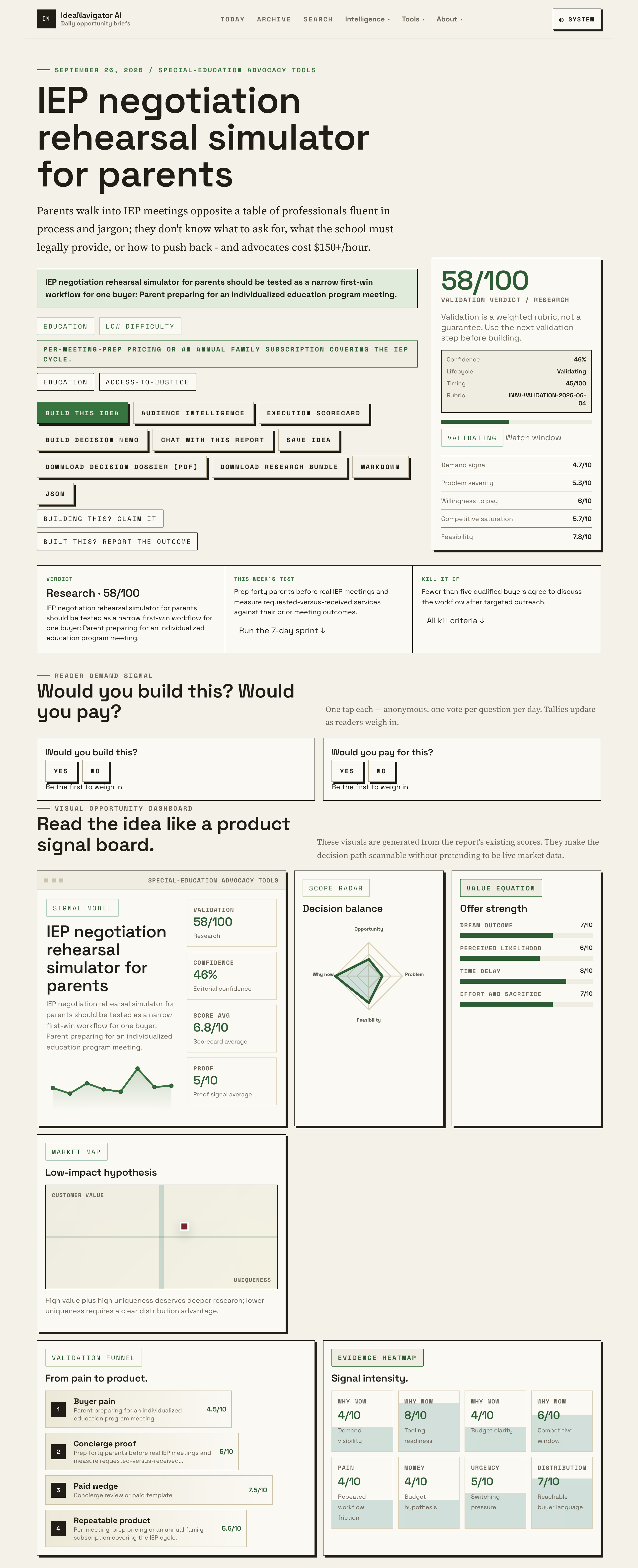
IdeaNavigator AI describes a proposed IEP negotiation rehearsal simulator for parents, with document review, plain-language explanations and role-play practice. The concept has not been shown to improve services or meeting outcomes; its proposed test would involve 40 parents preparing for real meetings.
IdeaNavigator AI has proposed an IEP meeting preparation simulator that would help parents review education plans, develop requests and rehearse conversations with school teams. The concept is an early-stage product proposal, and no evidence is provided that it has been built or improves services received by students.
The proposed tool is aimed at a parent preparing for an individualized education program (IEP) meeting. A parent would upload a current IEP and evaluation reports; the simulator would explain relevant information in plain language, create a list of possible requests with legal grounding, and role-play a meeting that includes realistic pushback. The intended outcome is practice holding positions during a school discussion.
IdeaNavigator AI frames the problem as an imbalance in familiarity with special education procedures and terminology: parents may face a team of professionals without knowing what to request or how to respond. It also points to the cost of private advocacy, citing rates of $150 or more per hour. That figure is presented as part of the proposal, without a cited survey, location, or date range.
The suggested business models are a fee for preparation before each meeting or an annual family subscription covering an IEP cycle. To assess the idea, the proposal recommends preparing 40 parents before real meetings and comparing the services they request and receive with their outcomes at prior meetings. No study has been conducted or results reported in the material provided.
A Practice Tool for IEP Meetings
If developed and tested, a simulator could give parents a structured way to prepare questions and practice responding before a consequential meeting. The proposed features combine document review, explanations and conversation practice in one workflow, with the stated aim of helping families articulate requests. That may be useful to parents who cannot afford individual advocacy, although the proposal does not establish that software can replace an advocate or provide advice tailored to every case.
The distinction between preparation and outcome matters. A parent may feel more ready to participate, but that alone does not show that a student will receive additional or different services. The proposed comparison of requested and received services could provide an initial measure, yet meeting outcomes can depend on a student’s needs, available evidence, school decisions and other factors. The proposal gives no research design or method for accounting for those differences.
Products Worth Considering

DJI Mini 5 Pro Fly More Combo Plus with DJI RC 2

Bose TV Speaker (2nd Gen) Compact Soundbar with Bluetooth and HDMI-ARC, Black

Apple Watch Ultra 4 GPS + Cellular, 49 mm
As an affiliate, we earn on qualifying purchases.
How the Proposed Workflow Works
The concept focuses on a single use case: preparing a parent for an upcoming IEP meeting. It is not described as a general special education platform. The envisioned sequence begins with the family’s existing plan and evaluation reports, moves to plain-language explanations and a grounded request list, then uses role-play to practice a meeting.
IdeaNavigator AI argues that the timing may be favorable because language models can now support realistic role-play, while special education identification is rising and district resources are tightening. Those points are rationale for exploring the product, not independently substantiated findings in the proposal: it provides no figures, dates, geographic scope or model evaluation. It also does not identify a product, launch, partner district or trial.
Testing and Legal Accuracy Remain Open
It is not clear whether a simulator is in development, who would operate it, or when families might be able to use it. No sample output, pricing, privacy terms, technical evaluation or user feedback is provided. The proposal also does not specify how uploaded education records would be protected or retained.
The suggested legal grounding needs careful definition. The proposal does not identify which laws or jurisdictions the tool would cover, how its explanations would be checked, or how it would handle differences between individual student circumstances. Its statements about rising identification rates, tightening district resources and the quality of current role-play models are not accompanied by supporting data. There are no reported findings showing that rehearsal changes requests, school decisions or services.
A Forty-Family Pilot Is Proposed
The next step described is a pilot with 40 parents preparing for actual IEP meetings. The proposed measure would compare requested and received services with each parent’s prior meeting outcomes. To interpret any result, a test would also need to explain how participants are selected, how prior outcomes are documented and whether changes can reasonably be linked to simulator preparation.
No pilot date, recruitment process or follow-up schedule has been announced in the proposal. Until a test is conducted and its methods and results are reported, the simulator remains a product concept rather than a demonstrated intervention.
Source: IdeaNavigator AI
Key Questions
Has the IEP simulator launched?
The material describes a proposed product and gives no launch date or evidence that it is available to families.
What would the proposed simulator do?
It would use a parent’s IEP and evaluation reports to provide plain-language explanations, suggest requests with legal grounding and run practice meeting role-play.
Has it been shown to improve student services?
No results are reported. A 40-parent test comparing requested and received services with earlier meeting outcomes is proposed, but has not been documented as completed.
How much would it cost?
Pricing is not specified. The suggested models are a fee for each meeting preparation session or an annual subscription for a family.
Source: IdeaNavigator AI