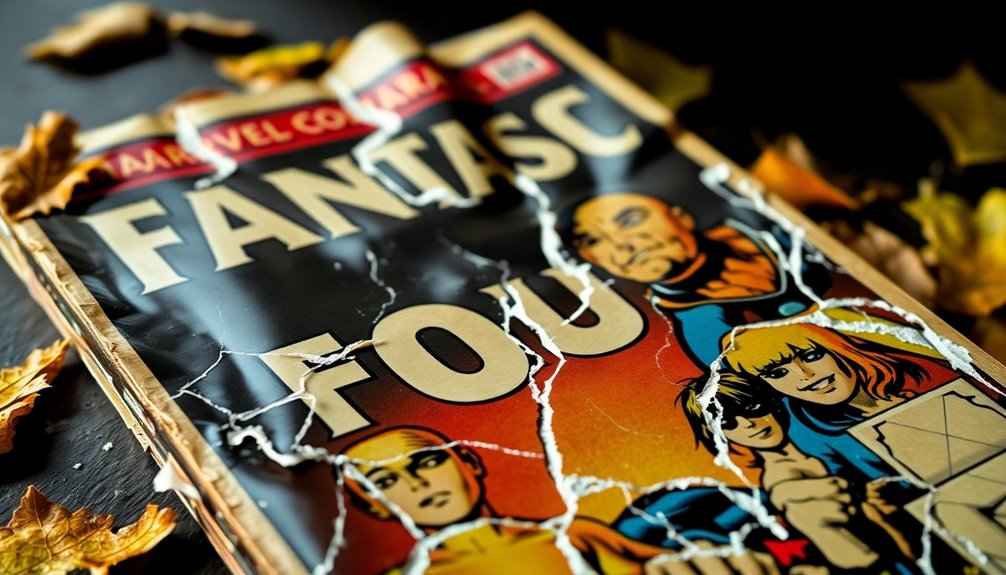

The poor box office drop of the new Fantastic Four signals deeper issues with Marvel’s momentum. Despite positive reviews, audience interest faded fast, with a steep 66% decline in its second weekend—worse than typical Marvel drops. Market competition and franchise fatigue seem to be hitting hard, risking further setbacks for upcoming films like Avengers: Doomsday. If you want to understand why Marvel’s popularity might be waning more broadly, stay with us for more insights.

Get business pricing on tech for your team
- Business-only prices and quantity discounts
- Tax-exempt purchasing
- Multiple users, one account, clear invoices
Key Takeaways
- The steep 66% second-week decline indicates waning audience interest, suggesting fatigue with Marvel’s recent offerings.
- Poor sustained box office performance compared to past Marvel films reflects diminishing franchise appeal.
- Competition from other films and market saturation in August have accelerated audience drop-off.
- The underperformance of Fantastic Four signals potential challenges for upcoming Marvel blockbusters like Avengers: Doomsday.
- Broader industry trends show Marvel facing audience fatigue, which could impact the franchise’s future success.
Despite high expectations, the 2025 Marvel’s Fantastic Four reboot is struggling to sustain its initial momentum. The film’s domestic box office stands at $197 million as of early August, surpassing the 2015 flop but still trailing behind the 2005 version’s roughly $254.6 million after inflation. While this suggests some recovery for the franchise, the sharp second-weekend decline highlights deeper issues.
Despite initial gains, Fantastic Four’s box office decline signals underlying franchise challenges.
The film dropped 66% domestically from its opening weekend, where it earned $118 million, to just $40 million. This steep fall exceeds Marvel’s typical 55-60% decline and indicates that public interest is waning faster than expected, especially considering the film’s generally positive reviews. This decline is notably sharper than typical Marvel drops.
Globally, the film has grossed nearly $370 million, with about $198 million domestically and $170 million internationally. Despite these numbers, the rapid drop in audience enthusiasm hints at a fragile box office hold. The film’s opening contributed positively to Marvel’s summer success, but the subsequent decline reveals that initial excitement isn’t translating into sustained viewership.
The release timing didn’t help either, as the film faced stiff competition from other big titles like Superman, The Bad Guys 2, and The Naked Gun, with upcoming releases like Freakier Friday and Weapons further crowding the market. August is traditionally a slow month, and Marvel’s recent struggles in this period suggest a possible shift in audience preferences or fatigue with Marvel’s extensive cinematic universe.
Additionally, the franchise’s brand strength appears diminished. Marvel fans tend to view Fantastic Four as a mid-tier property at best, especially after the underperformance of past entries. Although critics praised the 2025 version, audience retention has suffered, and second-week drops signal waning word-of-mouth.
This pattern may reflect a broader fatigue with Marvel’s recent output, which has struggled to replicate the blockbuster success of earlier phases. As the MCU approaches its next major event, Avengers: Doomsday, the declining box office numbers serve as a cautionary sign.
If Marvel can’t sustain interest in its flagship properties, it risks losing momentum altogether, marking the start of a more significant industry-wide fatigue.
As an affiliate, we earn on qualifying purchases.
Frequently Asked Questions
How Has the Fantastic Four’S Failure Impacted Marvel’S Overall Film Strategy?
You see Marvel’s film strategy shifting after the Fantastic Four failure. They’re now focusing on fewer releases, prioritizing quality over quantity, and integrating new characters more organically into existing phases.
They’re also emphasizing proven storytelling and familiar heroes to rebuild audience confidence. This move aims to avoid market saturation, reduce risks from big-budget flops, and combat Marvel fatigue by delivering more targeted, engaging content that resonates better with both domestic and international viewers.
Could the Collapse Influence Future Marvel Character Adaptations?
The collapse of the Fantastic Four film could lead you to see Marvel becoming more cautious with future character adaptations. You might notice Marvel prioritizes characters with strong fan bases and high brand value to avoid similar underperformance.
This shift could mean focusing on well-established heroes, crossovers, and ensemble films, ensuring they maintain audience interest and prevent fatigue.
Your role as a viewer could influence Marvel’s strategy to keep their universe fresh and engaging.
What Are Fans’ Main Concerns Regarding Marvel’S Current Direction?
You worry Marvel’s losing its magic, and it feels like your favorite universe is crumbling like a fragile house of cards. You see rushed movies with poor storytelling, recycled characters, and overused heroes, making the whole franchise seem tired and drained.
The endless flood of new content overwhelms you, leaving you craving genuine innovation. You fear the soul of Marvel is fading, replaced by hype and gimmicks that can’t replace true storytelling brilliance.
Are There Signs of Marvel Shifting Away From Interconnected Storytelling?
You notice Marvel shifting away from strict interconnected storytelling, and there are signs of this change. The MCU’s embrace of multiverse concepts, standalone series like *What If…?*, and tie-in comics allow more flexible narratives.
This approach lets you enjoy stories without needing to follow every detail. With Marvel exploring looser connections across films, TV, and comics, you can experience the universe in a more varied, less overwhelming way.
How Might This Event Affect Upcoming Marvel Cinematic Projects?
You might wonder how this event impacts Marvel’s future projects. It’s likely Marvel will shift focus, emphasizing crowd-favorite heroes and big crossover events to boost interest.
With the Marvel Cinematic Universe’s narrative reset planned for 2028, upcoming films could de-emphasize some current storylines, possibly leading to fewer interconnected plots.
This change aims to refresh the franchise and counteract fatigue, but it also risks losing continuity and audience investment.
Conclusion
If the Fantastic Four’s collapse signals Marvel’s impending downfall, you might as well brace yourself for a universe-shattering disaster. This could be the moment when fans finally hit their breaking point, feeling like Marvel’s magic is fading faster than a superhero’s quick escape. Remember, every empire faces its kryptonite, but if Marvel doesn’t course correct, you could be looking at the biggest comic book crash in history. Stay tuned—things are about to get wild.
Halloween Picks
halloween
As an affiliate, we earn on qualifying purchases.