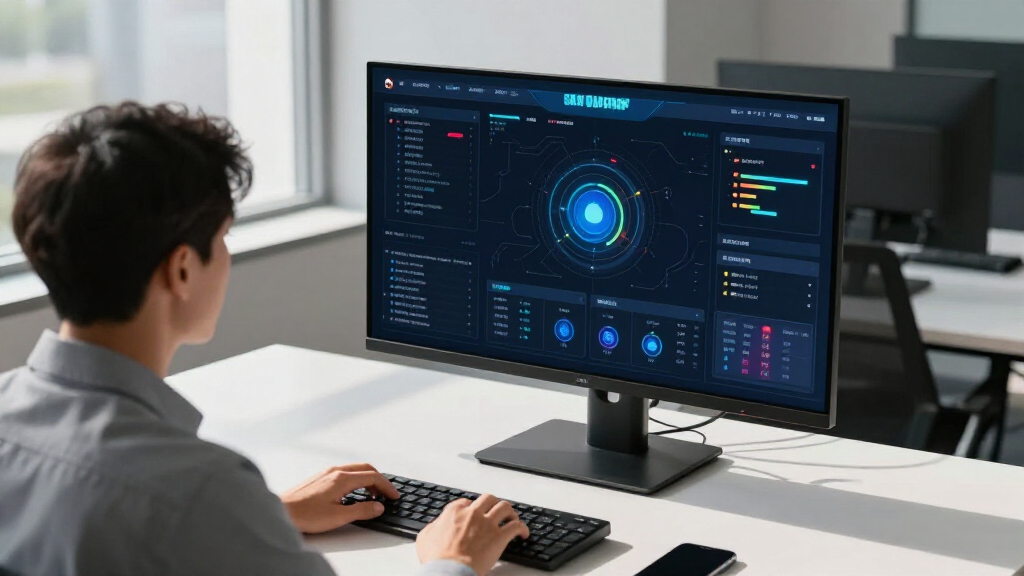

📊 Full opportunity report: The Next Generation Of Security Tools Powered By Artificial Intelligence on ThorstenMeyerAI.com — validation score, market gap, and execution plan.

Get business pricing on tech for your team
- Business-only prices and quantity discounts
- Tax-exempt purchasing
- Multiple users, one account, clear invoices
TL;DR
Advanced AI-driven security tools are being developed to detect and mitigate threats more quickly than traditional methods. This shift signals a major change in how digital security will operate across industries.
Artificial intelligence is now being integrated into next-generation security tools, marking a significant shift in digital defense capabilities. These tools aim to identify vulnerabilities and respond to threats faster than traditional methods, which is crucial as cyber threats grow more sophisticated and widespread.
Recent incidents, such as a major hardware wallet breach involving a flaw in firmware that allowed attackers to drain over seventy million dollars in Bitcoin from nearly 1,200 wallets, highlight the urgent need for improved security measures. The breach was traced to a bug in firmware that had gone unnoticed for over five years, demonstrating how vulnerabilities can remain hidden until exploited.
Experts now believe that emerging AI-powered security tools can help prevent similar incidents by automatically detecting latent bugs, analyzing code for weaknesses, and responding in real-time. According to industry sources, these tools leverage advanced machine learning models to identify patterns and anomalies that human analysts might miss, potentially reducing the window of opportunity for attackers.
While these tools are still in development and testing phases, their potential to transform cybersecurity is widely acknowledged. Some companies are already integrating AI-driven solutions into their security infrastructure, aiming to stay ahead of increasingly complex threats.
A firmware error shrank the pool that “random” keys were drawn from. A searchable pool is a drainable one. Here is the mechanism, conceptually — no operational detail.
A March 2021 firmware update rerouted key generation from the device’s hardware random-number generator to a deterministic software fallback — drawing seeds from a dramatically smaller universe.
Once the flaw is understood, the whole attack runs on an ordinary machine — no internet needed until the final move.
Implications of AI-Enhanced Security for Digital Safety
The advent of AI-powered security tools represents a fundamental change in how organizations defend against cyber threats. They promise faster detection of vulnerabilities, more accurate threat analysis, and automated responses, which could significantly reduce breach incidents and financial losses.
This shift is particularly important given recent high-profile breaches, such as the hardware wallet attack, which exposed systemic weaknesses in hardware security. The ability to proactively identify and fix bugs before they are exploited could prevent similar incidents across various sectors, including finance, healthcare, and critical infrastructure.
However, reliance on AI also raises questions about new risks, such as potential false positives or adversarial attacks targeting the AI systems themselves. The security community must carefully evaluate these tools to ensure they enhance, rather than undermine, overall cybersecurity.
As an affiliate, we earn on qualifying purchases.
Evolution of AI in Cybersecurity
Over the past decade, AI has increasingly been integrated into cybersecurity solutions, primarily for threat detection and response automation. Traditional security measures relied heavily on signature-based detection, which struggled against novel or sophisticated attacks. AI introduced anomaly detection, behavioral analysis, and predictive capabilities, broadening the scope of defense.
The recent hardware wallet breach underscores how vulnerabilities can persist undetected for years, emphasizing the need for more proactive security measures. The incident also coincided with advances in large language models and AI-assisted code review, which have accelerated the identification of latent bugs and security flaws in software and firmware.
Industry leaders and researchers now see AI as a critical component of future security architectures, capable of adapting to the rapidly evolving threat landscape and reducing the time between vulnerability discovery and mitigation.
"AI-assisted code review can now surface latent bugs faster than the industry's most seasoned experts."
— Thorsten Meyer
Uncertainties Surrounding AI-Driven Security Adoption
While AI-powered security tools are promising, their widespread effectiveness and reliability remain to be proven in real-world scenarios. It is still unclear how well these systems will perform against highly sophisticated or adversarial attacks, or how they will integrate with existing security frameworks.
Additionally, concerns about false positives, AI bias, and potential exploitation of AI systems themselves are ongoing topics of debate within cybersecurity circles. The pace of technological development may outstrip regulatory and ethical frameworks, creating new vulnerabilities.
Next Steps for AI Security Tool Deployment
Industry leaders are expected to continue developing and testing AI-driven security solutions, with pilot programs and early deployments already underway. Regulatory bodies and cybersecurity organizations will likely establish standards and best practices to guide safe integration.
Research into AI robustness, explainability, and adversarial resistance will intensify, aiming to address current limitations. The cybersecurity community will monitor these developments closely to assess how AI can be most effectively harnessed to prevent future breaches.
Key Questions
How do AI-powered security tools improve upon traditional methods?
They analyze vast amounts of data to detect anomalies and vulnerabilities faster, often in real-time, and can adapt to new threats without relying solely on predefined signatures.
Are AI security tools ready for widespread deployment?
While promising, many AI security solutions are still in testing phases. Widespread deployment will require further validation, standardization, and addressing potential risks like false positives.
What risks do AI-driven security systems pose?
Potential risks include false positives, adversarial manipulation of AI models, and over-reliance on automated responses that may overlook nuanced threats. Ongoing research aims to mitigate these issues.
Will AI eliminate the need for human cybersecurity experts?
AI is expected to augment human analysts by handling routine detection and response tasks, allowing experts to focus on complex, strategic security challenges rather than replace them.
Source: ThorstenMeyerAI.com
Fall Picks
fall essentials
As an affiliate, we earn on qualifying purchases.