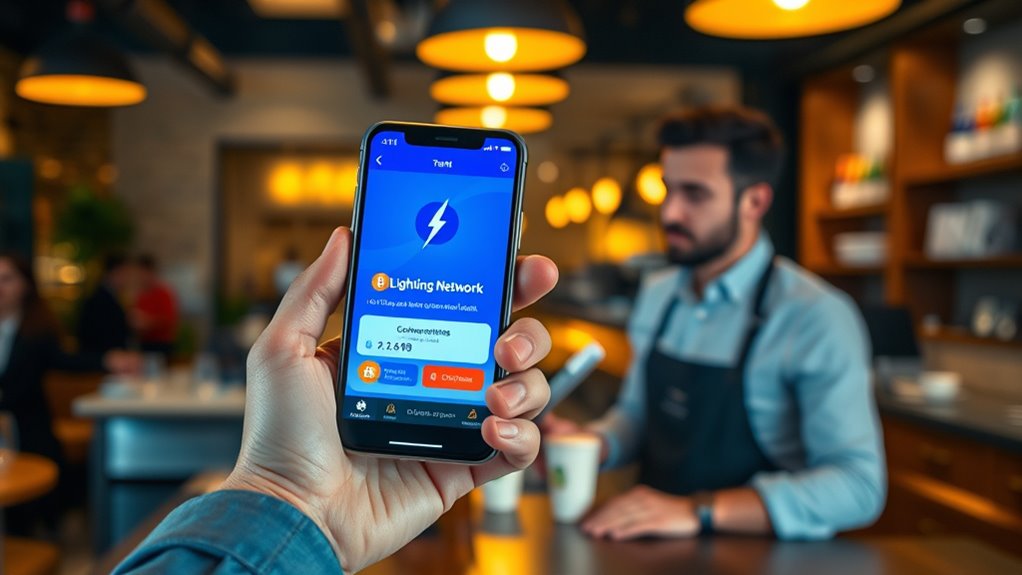

Imagine paying for your morning coffee instantly with just a few satoshis, without waiting for blockchain confirmations or paying high fees. The Lightning Network makes this possible by creating a fast, off-chain payment system built on Bitcoin. As you explore how it works, you’ll discover how this technology could transform everyday transactions and make Bitcoin truly practical for small, frequent payments. But there’s more to this system than meets the eye.

Get business pricing on tech for your team
- Business-only prices and quantity discounts
- Tax-exempt purchasing
- Multiple users, one account, clear invoices
Key Takeaways
- The Lightning Network enables instant, off-chain Bitcoin payments, ideal for small transactions like buying coffee with satoshis.
- Users open payment channels by locking funds in multi-signature addresses, allowing quick off-chain transfers.
- Payments are routed through a network of interconnected channels, facilitating secure, trustless transactions.
- Using LN significantly reduces fees and transaction times compared to on-chain Bitcoin payments.
- It makes micro-payments practical for everyday purchases, supporting near-instant, low-cost coffee transactions.
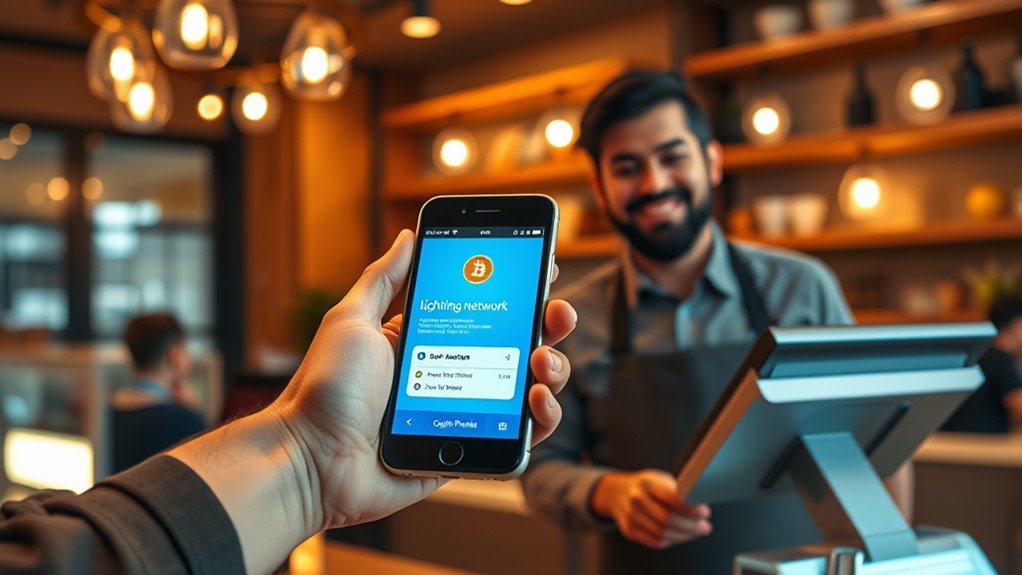
Have you ever wondered how Bitcoin can handle faster and cheaper transactions? The answer lies in the Lightning Network (LN), a second-layer scaling solution built on top of the Bitcoin blockchain. Created to tackle Bitcoin’s scalability issues—like slow transaction speeds and high fees—the Lightning Network operates by moving transactions off the main blockchain. This approach allows for quicker, more cost-effective payments, making Bitcoin more practical for everyday use.
Discover how the Lightning Network makes Bitcoin faster and cheaper for everyday transactions.
The core of the Lightning Network is based on bidirectional payment channels. When you want to make a transaction, you open a channel by locking a specific amount of Bitcoin into a 2-of-2 multi-signature address on the blockchain. This step requires a on-chain transaction. Once the channel is open, you and your counterparty can transact an unlimited number of times off-chain, updating the balances with each transaction without involving the blockchain again. Only when you decide to close the channel does the final net balance get recorded on the blockchain, ensuring all transactions are securely settled. This process is protected by smart contracts, which guarantee that transactions are executed correctly, even when conducted off-chain.
The Lightning Network also uses a sophisticated routing system to facilitate payments between users who don’t have direct channels open. Think of it like routing internet data through multiple nodes; your payment can pass through a series of interconnected channels, reaching its destination efficiently. These routes are secured by smart contracts, removing the need for trust between intermediaries. As more users open channels and connect to the network, liquidity increases, broadening the reach and capacity of the network. This interconnected structure allows for scalable, flexible transactions, enabling payments across vast networks without congesting the main blockchain. The network’s design emphasizes trustlessness and security, ensuring users can transact confidently off-chain.
The benefits are significant. Transactions that once took minutes or hours now occur near-instantaneously, with fees dropping dramatically. This makes small payments, like buying a coffee with satoshis—the smallest units of Bitcoin—economical and practical. The Lightning Network also boosts Bitcoin’s overall transaction capacity, theoretically supporting millions or even billions of transactions per second. By offloading transactions from the main chain, it preserves Bitcoin’s security and decentralization while enabling new use cases like micro-tipping, gaming payments, and transactions between Internet of Things devices. In addition, the Lightning Network’s design helps maintain the network’s decentralization by allowing anyone to participate as a node.
The Lightning Network was first proposed in 2016 by Joseph Poon and Thaddeus Dryja, and since then, development has accelerated with teams like Lightning Labs leading the way. Its design emphasizes trustlessness and security, ensuring users can transact confidently off-chain. Overall, the Lightning Network transforms Bitcoin from a store of value into a practical, everyday payment system—making instant, cheap transactions a reality.
Products Worth Considering

LG UltraGear 32GX850A-B 32-inch 4K UHD Glossy OLED Gaming Monitor

Anker SOLIX C1000 Gen 2 Portable Power Station

Bose SoundLink Plus Portable Bluetooth Speaker, Wireless Outdoor Speaker, Up to 20 Hours Battery Life, Waterproof and Dustproof, Black
As an affiliate, we earn on qualifying purchases.
Conclusion
With the Lightning Network, you can pay for your coffee instantly using just a few satoshis, making small transactions seamless. Did you know that the LN can handle over 4,000 transactions per second? This scalability means you’ll never have to worry about high fees or delays for everyday payments. As more merchants adopt this technology, paying with Bitcoin will become faster, cheaper, and more convenient—bringing us closer to a future where micro-payments are effortless.