
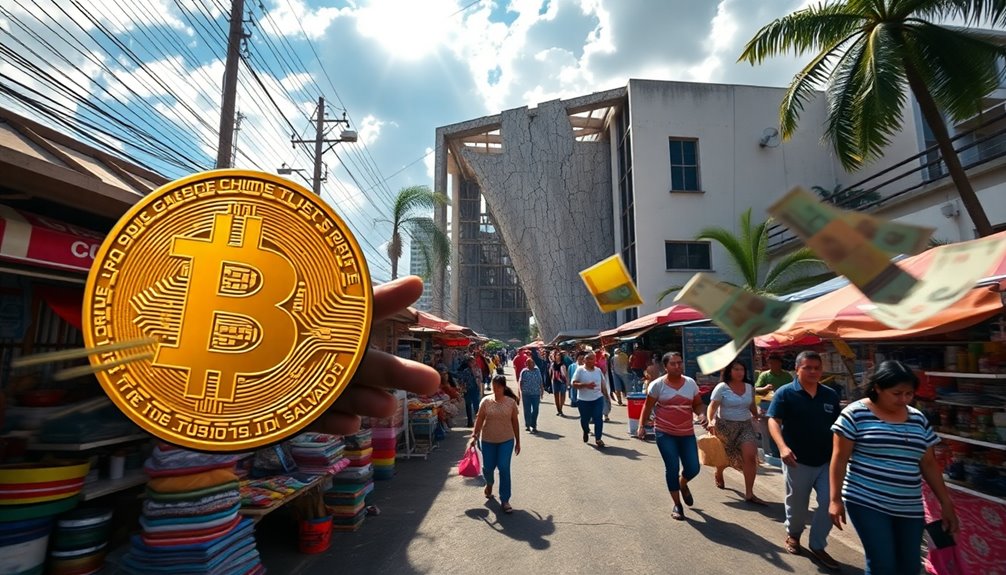
As El Salvador moves to strip Bitcoin of its legal tender status, the decision marks a significant shift in the nation's approach to cryptocurrency. You might recall that in September 2021, El Salvador made headlines by becoming the first country to embrace Bitcoin as legal tender, mandating its acceptance alongside the U.S. dollar. However, this initial enthusiasm didn't translate into widespread public support. With over 70% of the population opposing Bitcoin's adoption and only around 15% expressing trust in it, the move faced significant skepticism from the very start.

Get business pricing on tech for your team
- Business-only prices and quantity discounts
- Tax-exempt purchasing
- Multiple users, one account, clear invoices
El Salvador's shift away from Bitcoin as legal tender highlights the nation's grappling with public skepticism and economic pressures.
The recent legislative changes, approved in late January 2025, reflect a response to mounting pressure from the International Monetary Fund (IMF). You may have heard that the IMF urged El Salvador to mitigate the financial risks tied to Bitcoin, which ultimately influenced the government to agree to a $1.4 billion loan. This agreement included conditions that required a rollback of Bitcoin's legal status.
As a result, businesses are no longer mandated to accept Bitcoin, making its use entirely voluntary. Furthermore, you won't be able to use Bitcoin for tax payments or government fees anymore, a clear indication of the government's shift in policy. Interestingly, the reforms indicate that the use of Bitcoin is now entirely voluntary for businesses and public institutions. In light of this, the government aims to manage Bitcoin volatility to protect its financial interests.
As of now, only about 8% of Salvadorans reported using Bitcoin for payments by 2024, and many businesses were hesitant to accept it due to its notorious volatility. The IMF had frequently highlighted the economic risks associated with Bitcoin, and these concerns undoubtedly played a role in the government's decision. El Salvador holds a substantial amount of Bitcoin, valued at hundreds of millions of dollars, adding another layer of complexity to its economic situation.
Despite this shift, a segment of the population remains committed to promoting Bitcoin. Grassroots efforts continue, even as international attention focuses on El Salvador's experiment. You might be wondering how this legal change will affect Bitcoin's global market perception. The removal of its legal tender status could potentially alter the way investors and users regard Bitcoin.
While the government plans to unwind its involvement with the Chivo wallet gradually, it's worth noting that it continues to accumulate Bitcoin, signaling a lingering interest in the digital asset. The future remains uncertain, especially regarding whether the government will keep purchasing Bitcoin.
Nevertheless, this decision marks a pivotal moment in El Salvador's relationship with cryptocurrency, and you can expect further developments as the country navigates its economic challenges.
As an affiliate, we earn on qualifying purchases.
Fall Picks
fall essentials
As an affiliate, we earn on qualifying purchases.